
AI Literacy for Teachers: What Educators Need to Understand, Verify, Teach and Govern
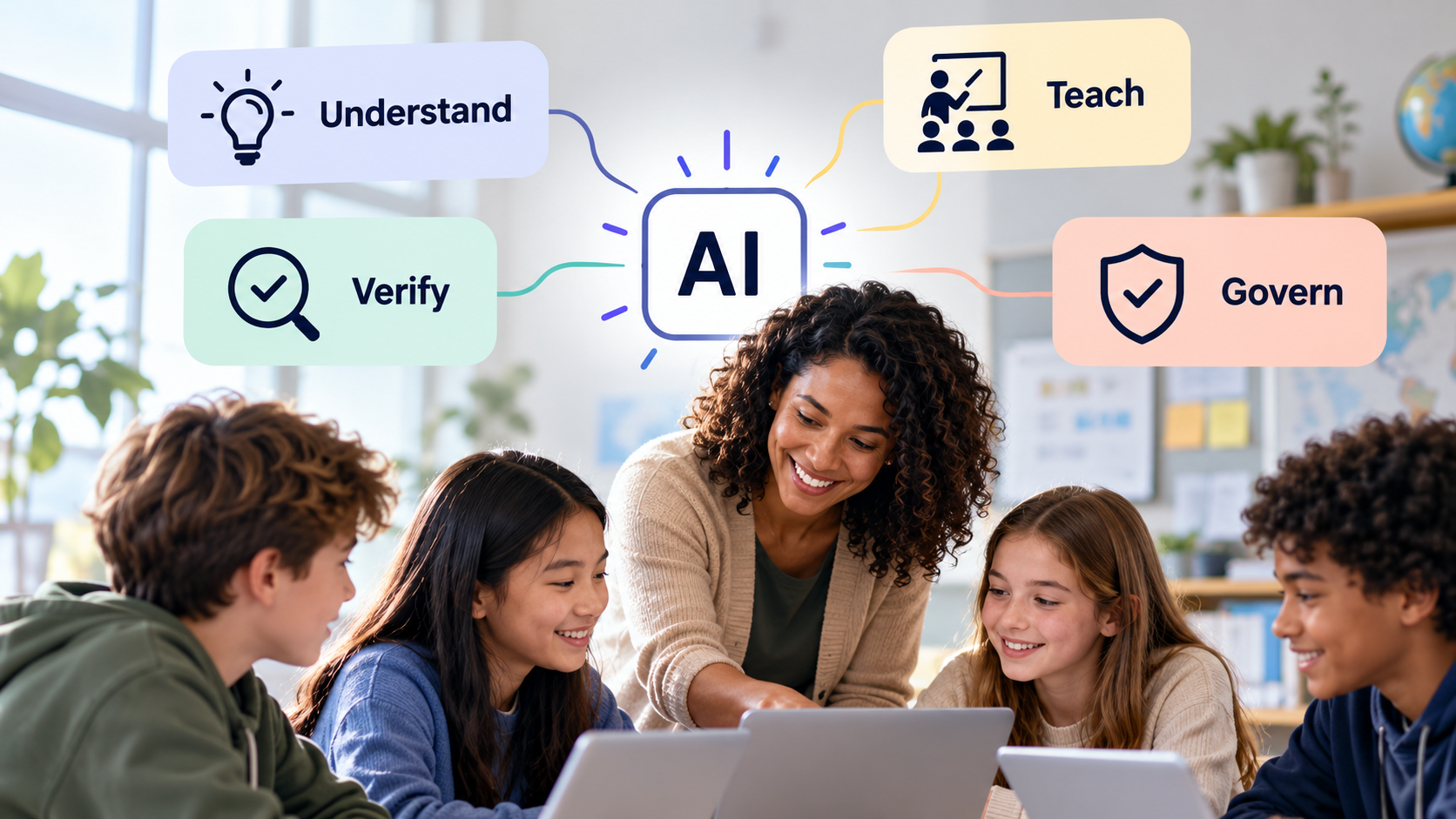
AI literacy for teachers is often reduced to prompt writing. That is too narrow. A teacher may generate a polished worksheet and still be unable to explain how the system produced its claims, which information entered the service, what evidence requires verification, whether the task still measures the intended learning, or who remains accountable when the output is wrong.
Teacher AI literacy is the capacity to make sound educational decisions when artificial intelligence is present. It combines conceptual understanding, critical verification, protection of learners, pedagogical judgement, assessment design and participation in institutional governance. The objective is not to turn every teacher into a software engineer. It is to ensure that educators can use, refuse, adapt and explain AI-supported practice on educational grounds.
UNESCO’s AI Competency Framework for Teachers provides a strong international reference. It sets out 15 competencies across a human-centred mindset, ethics, AI foundations and applications, AI pedagogy, and AI for professional learning, with development described through Acquire, Deepen and Create levels. A school can use that framework to define progression. The practical curriculum below translates its broad domains into the recurring decisions teachers make in lessons, assessment and professional work.
Tool training is not AI literacy
Tool training teaches procedures: how to open a service, enter a prompt, generate a quiz or revise a text. Those procedures may be useful, but they are tied to a product interface and may become obsolete quickly. Literacy concerns transferable judgement. It asks what kind of system is being used, which claims are uncertain, what data are involved, how the tool affects cognitive work, who may be disadvantaged and what evidence remains under human control.
This distinction changes professional development. A demonstration that produces an impressive lesson plan can create enthusiasm, yet it offers little evidence that participants can detect a fabricated citation, protect student information or redesign an assessment. Strong training exposes limitations as deliberately as capabilities. It treats refusal or restriction as legitimate professional outcomes rather than signs of resistance.
The enduring questions are straightforward: What is the system doing? What could be inaccurate, unsafe or unfair? Does the use serve the learning goal? What judgement must remain with a qualified person? What should students learn about the system rather than merely receive from it?
Seven strands of teacher AI literacy
The seven strands below form an integrated curriculum. They should not be taught as isolated compliance topics because decisions about data, bias, pedagogy and assessment interact.
| Strand | Essential understanding | Observable professional practice |
|---|---|---|
| Concepts and limits | Generative systems produce outputs from learned patterns; fluency does not guarantee truth, reasoning or current knowledge. | The teacher explains capabilities and limits without anthropomorphism and selects tools according to purpose. |
| Verification | Claims, citations, calculations, interpretations and images require checks proportional to consequence. | The teacher traces important claims to independent evidence and documents uncertainty. |
| Data, privacy, security and intellectual property | Inputs may include personal, confidential or copyrighted material; product terms and retention vary. | The teacher minimises data, uses approved systems and knows when not to upload material. |
| Bias, inclusion and accessibility | Outputs may reproduce stereotypes, omit perspectives or create barriers. | The teacher compares outputs, checks representation and provides accessible alternatives. |
| Pedagogy and learner agency | AI can support or replace the cognitive work a task was designed to develop. | The teacher defines the AI role, preserves student thinking and checks independent understanding. |
| Assessment and academic integrity | Permitted assistance, evidence of authorship and validity must be specified at task level. | The teacher communicates boundaries, uses disclosure and collects process or transfer evidence. |
| Professional judgement and governance | Decisions require responsibility, escalation, review and institutional coherence. | The teacher works within policy, reports problems and contributes evidence to policy improvement. |
The table is a map, not a sequence of mastery. A teacher may be confident in pedagogical design yet uncertain about data governance, or skilled at verification but unfamiliar with accessibility risks. Professional development should therefore begin with evidence of practice rather than assumptions based on enthusiasm, age or technical confidence.
Concepts and limits: enough understanding to ask better questions
Teachers do not need to reproduce the mathematics of a large language model. They do need an accurate mental model. A generative system predicts and constructs an output based on patterns in training data, instructions and context. It can imitate explanation, argument and confidence without possessing a teacher’s relationship with the learner, a reliable memory of sources or a duty of care.
This conceptual understanding changes behaviour. If a system is treated as an answer engine, fluent output can be accepted too quickly. If it is understood as a generator of plausible language, verification becomes part of the design. Teachers also become more precise about purpose: an AI system may be useful for proposing alternatives or creating practice variations, but less suitable for determining a student’s need or making a high-consequence judgement.
A useful workshop asks participants to compare outputs from the same task under different prompts, contexts or sessions. The aim is not to discover a “perfect prompt.” It is to observe variability, unsupported certainty, missing assumptions and the effect of the information supplied.
Verification: turn output into evidence
Verification is more than checking spelling or asking the model whether it is correct. The depth of checking should rise with the consequence of error. A playful example sentence may require a quick subject check. A medical, safeguarding, assessment or legal claim demands authoritative sources and often qualified human review.
The TRACE routine gives teachers a compact verification process:
| Step | Question |
|---|---|
| T — Type | What kind of claim is this: factual, interpretive, predictive, creative or procedural? |
| R — Risk | What happens if it is wrong, incomplete or biased? |
| A — Authority | Which independent source or professional is appropriate for checking it? |
| C — Context | Does it fit the learner, curriculum, date, jurisdiction and purpose? |
| E — Explain | Can the teacher explain the final decision without relying on the model’s authority? |
Participants should practise TRACE on deliberately mixed outputs containing accurate statements, subtle errors, fabricated references and reasonable but contextually inappropriate advice. Evidence of literacy is not that they find every hidden problem in one exercise. It is that they apply a repeatable method, recognise uncertainty and know when to stop or escalate.
Data and rights: minimise before you upload
Teachers work with information that can reveal identity, attainment, behaviour, disability, health, family circumstances and safeguarding concerns. Convenience does not remove the duty to protect that information. Before entering content into an AI system, the teacher should ask whether the task can be completed without personal data, whether the platform is approved, what the service retains, who can access the information and whether an offline or institutionally controlled alternative exists.
Anonymisation is not simply deleting a name. A detailed combination of age, class, diagnosis, incident and location may still identify a learner. Data minimisation begins earlier: use a generic scenario where possible, summarise only what is necessary and avoid uploading student work to a public system unless institutional approval and lawful conditions are clear.
Intellectual property also requires professional judgement. A tool may generate material that resembles protected content, and a user may not have permission to upload a textbook chapter or commercial resource. Teachers should distinguish quotation, licensed use, public-domain material and original work, while following local policy rather than assuming that educational purpose automatically permits any use.
UNESCO’s Guidance for Generative AI in Education and Research places data privacy, age-appropriate use and human-centred governance among its central concerns. Literacy therefore includes knowing that a technically possible action may still be educationally, ethically or legally inappropriate.
Bias, inclusion and accessibility: test the experience, not only the text
Bias is not limited to openly offensive language. It can appear through omission, default assumptions, unequal error rates, stereotypes in examples, narrow cultural references or systems that work poorly for particular languages and forms of expression. Accessibility may improve when AI reformulates a text or supports translation, but it may worsen when an interface, output format or automated judgement does not accommodate a learner’s needs.
A meaningful bias audit compares outputs across carefully varied scenarios. Participants can examine whose perspective is treated as normal, whether advice changes when demographic details change, which groups disappear from examples and whether the system signals uncertainty consistently. The review should include the classroom context: a technically identical output may have different effects when used for brainstorming, behaviour interpretation or grading.
Inclusive practice also requires an alternative route. If the activity depends on a paid account, stable connectivity, rapid typing or independent access at home, the design may create hidden advantages. A teacher should be able to explain how a learner can meet the same objective without using the tool.
Pedagogy and learner agency: protect the thinking that matters
The central pedagogical question is not whether AI was used. It is which cognitive work the learner still performed.
An AI-generated explanation may help a student compare representations, yet it can also remove the need to retrieve, organise and express knowledge. Feedback may prompt revision, yet it can become a stream of corrections that the student accepts without evaluation. A chatbot may support planning, yet it may also make every strategic decision on the learner’s behalf.
Before introducing a tool, define the learning target and the role of AI. Then identify the work that must remain with the student. If the aim is argumentation, the student might use AI to generate objections but must select evidence and defend the final reasoning. If the aim is vocabulary retrieval, the system can create additional practice examples, but delayed recall should occur without assistance. If the aim is planning, the learner should eventually be able to construct or adapt the plan rather than follow a generated sequence indefinitely.
The Learning Coach guide to building student independence provides a wider framework for transferring responsibility. AI literacy applies that principle to digital support: assistance should make learning more strategic, not simply make the product more polished.
A practical LEARN check can structure lesson design: Learning goal, Expected student thinking, AI role, Review of output, and No-tool evidence. If the teacher cannot identify the no-tool evidence, the activity may be measuring tool use more than learning. The transfer problem examined in From Brain Games to Real Learning is relevant here: success with a scaffold or tool does not establish that the underlying strategy will appear in a new context. The comparison in Academic Coaching vs. Tutoring for Teens also clarifies why developing methods and judgement is different from supplying task completion.
Assessment and academic integrity: design valid evidence
Rules such as “AI allowed” or “AI forbidden” are often too vague. Assessment instructions should specify which functions are permitted, which stages remain independent, how assistance must be disclosed, what sources are required and how understanding may be confirmed.
Disclosure is educational when it requires the student to describe purpose and judgement: what the tool contributed, what was rejected or changed, and how claims were checked. A decorative statement that “AI was used” offers little evidence.
Schools should also avoid relying on uncertain detection as the centre of integrity practice. Stronger assessment design gathers multiple forms of evidence: staged drafts, discussion, source notes, in-class decisions, short oral explanation, live application and transfer to a new context. These methods make learning visible while reducing the risk of unsupported accusation.
The question is validity. If an assignment is intended to measure independent writing, extensive generated text may invalidate the evidence even when accurately disclosed. If the task is to critique AI output, using the system is part of the construct. The same technology can therefore be appropriate in one assessment and inappropriate in another.
Professional judgement and governance: know who decides
Teachers need clear institutional boundaries. They should know which tools are approved, what data may be entered, which uses require additional review, how incidents are reported and which decisions cannot be delegated. The school, in turn, needs evidence from teachers because policy written without classroom feedback quickly becomes impractical.
The European Commission’s ethical guidelines on AI and data in teaching and learning encourage educators and leaders to engage critically and ethically with systems rather than treat governance as a purely technical matter. The OECD Digital Education Outlook 2026 similarly places AI within broader questions of digital transformation, evidence and system design.
Professional judgement becomes visible when a teacher can explain why a use was selected, how risks were reduced, what evidence was checked and what would cause the activity to stop. Compliance is necessary, but literacy requires reasoned participation.
A 12-hour professional-learning sequence
A school can organise the curriculum as six two-hour modules. The first develops accurate concepts by comparing capabilities, limits and variable outputs. The second teaches TRACE verification with mixed-quality examples. The third addresses data minimisation, privacy, intellectual property, bias, accessibility and safeguarding through realistic cases.
The fourth module redesigns lessons using the LEARN check, with particular attention to the cognitive work that must remain with students. The fifth focuses on assessment validity, task-level permissions, disclosure and independent evidence. The final module turns participants into practitioner-inquirers: each teacher plans a bounded use, defines success and risk indicators, tests it in practice and reviews whether the evidence supports continuation.
The sequence should alternate explanation with rehearsal. Participants need to inspect outputs, revise task instructions, practise difficult conversations and justify decisions. Product demonstrations can be included, but they should serve the professional problem rather than dominate it.
| Module | Core output |
|---|---|
| Concepts and limits | An accurate explanation of what the chosen system can and cannot establish. |
| Verification | A completed TRACE review of a consequential output. |
| Safe and inclusive use | A data-minimised, accessible use-case plan. |
| Pedagogical design | A lesson in which student thinking and no-tool evidence are explicit. |
| Assessment | Task-level AI guidance and a meaningful disclosure requirement. |
| Inquiry and governance | A small pilot with success, risk and stopping criteria. |
How to assess teacher AI literacy
Confidence surveys are useful but insufficient. Teachers may feel capable after a demonstration while still missing critical errors. Assessment should use professional performances.
Ask participants to analyse a classroom case, classify the risk, identify the data involved, test an output, redesign the learning task and explain the final decision to a student or parent. A strong response integrates several strands. It does not merely recite policy.
A teacher self-audit can focus on evidence from recent practice. Can I explain the AI role in the task? Can I show how I verified a consequential claim? Have I protected student information? Can students describe what remains their responsibility? Did I provide an accessible alternative? What evidence shows that learning, rather than completion, occurred? What would make me stop or redesign this use?
Growth should be documented through improved decisions, not the number of tools tried.
Common weaknesses in AI professional development
Prompt-only training creates rapid activity but shallow judgement. Participants learn to optimise output without considering whether the output deserves a place in the lesson. The remedy is to begin with an educational problem and include verification, data and assessment in every tool exercise.
Training also becomes misleading when it demonstrates only successful examples. Teachers need to see fabricated sources, biased assumptions, overconfident advice and contextually inappropriate material. Failure cases teach the habit of review.
A third weakness is treating enthusiasm as readiness. Interest may support experimentation, but readiness requires policy knowledge, subject expertise, risk awareness and a viable classroom design. Conversely, cautious teachers may possess valuable critical judgement. Professional learning should not divide staff into innovators and blockers.
Finally, never use identifiable student data in a live demonstration merely to make the example realistic. A generic or synthetic case can teach the process without exposing a learner.
The durable standard
AI literacy for teachers is demonstrated when an educator can select or reject a use for a clear educational reason, verify information in proportion to risk, protect learners and their data, preserve meaningful cognitive work, design valid assessment evidence and explain who remains responsible.
That standard is more demanding than generating a worksheet, but it is also more durable. Interfaces will change. Professional judgement must transfer.
Educators who want to connect AI literacy with observation, diagnostic questioning, scaffolding and learner autonomy can explore the Become a Learning Coach training pathway. The book Become a Learning Coach develops the human role when information and automated assistance are widely available. Additional English-language resources are available through the Learning Coach article hub.
