
Best YouTube Channels to Learn Portuguese in 2026: 10 Picks
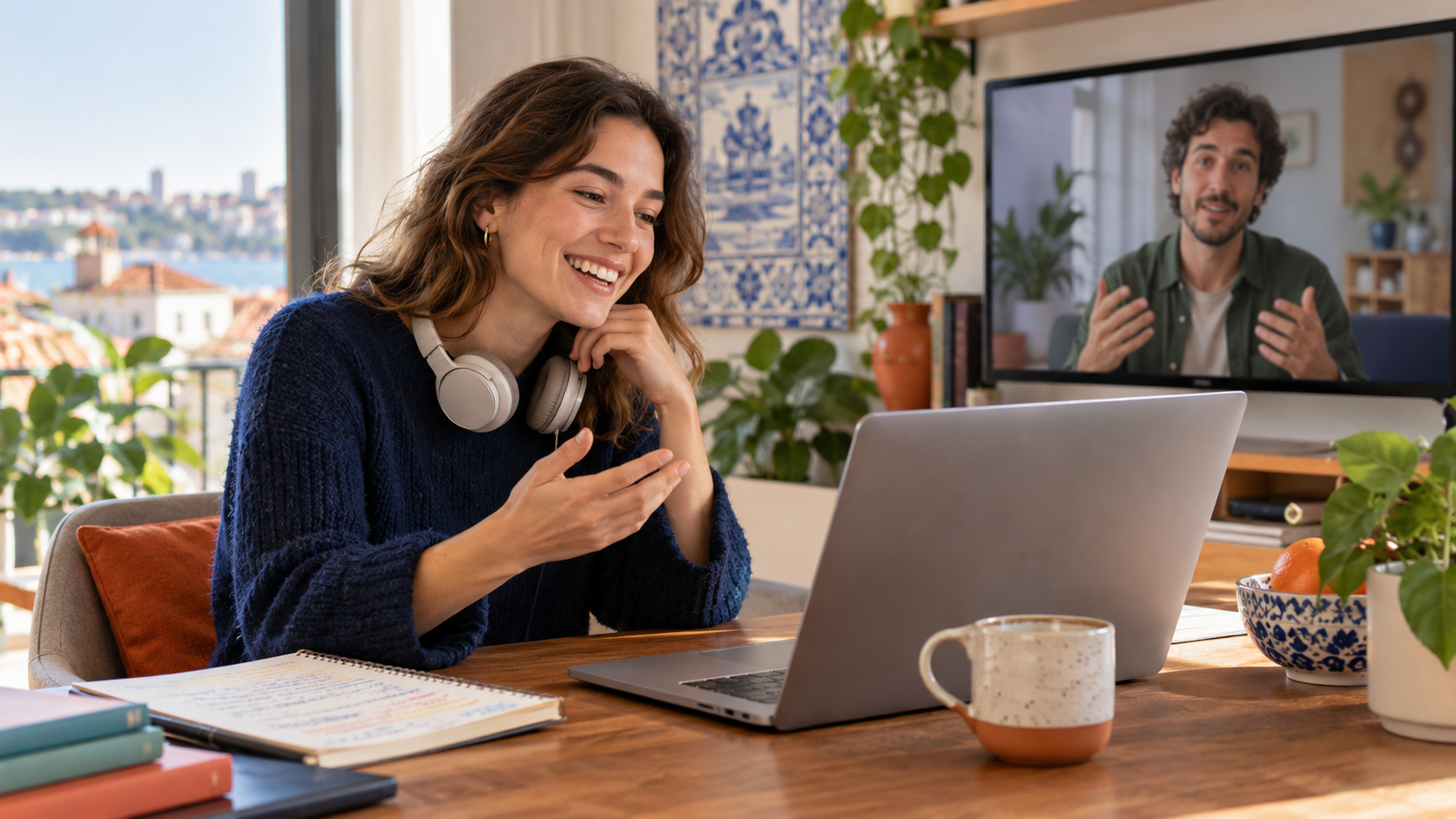
You learn to say bom dia in your first Portuguese lesson. It feels manageable. Then a friend from São Paulo says tudo bem? at full speed, or a waiter in Lisbon asks a question that sounds nothing like the words on the page. Suddenly, knowing the vocabulary is not enough.
Portuguese offers a particularly useful lesson about language learning: understanding a teacher is not the same as understanding spontaneous speech, and understanding speech is not the same as being able to answer. That is why the best YouTube channels to learn Portuguese are not necessarily the most popular or the ones with the longest lessons. They are the channels that help you practice the next skill you actually need.
This guide compares 10 YouTube channels for learning Portuguese in 2026, including five especially useful for Brazilian Portuguese and five focused on European Portuguese. You will find recommendations by level, strengths and limitations, concrete video exercises, and a 30-day plan for turning free content into active learning. The recommendations are intended primarily for English-speaking learners in the United States and other English-speaking markets.
The level labels are editorial estimates, not official CEFR assessments of the channels. YouTube lessons are generally free to view, although some creators also offer paid courses, transcripts or memberships. Availability, captions and playlists can change.
First choose: Brazilian or European Portuguese?
Before subscribing to ten teachers, choose the variety you most want to understand and speak first. Portuguese is one language with multiple varieties, and speakers across regions share a great deal. But pronunciation, rhythm, everyday vocabulary, and some choices of grammar and address differ in ways that matter when you are new.
Brazilian Portuguese (PT-BR) is the natural starting point if you are moving to Brazil, communicating mainly with Brazilians, or following Brazilian media. Many learners find its vowels more audible, but this is not a promise that it will be easier for everyone. Speech varies greatly within Brazil.
European Portuguese (PT-PT) is the most immediately relevant target for daily life in Portugal. Unstressed vowels are often reduced, creating a listening challenge for people whose study materials have taught them to pronounce each written vowel clearly. The use of tu, você and other forms of address is socially nuanced; memorizing a single equivalent of “you” is not enough.
A simple comparison makes the choice tangible. Both varieties use obrigado or obrigada for “thank you,” according to the speaker, and both understand bom dia. Yet the sound of those phrases, the speed at which syllables connect, and the phrases that accompany them may be quite different.
Our rule: spend your first month with one main variety. Explore the other later for comprehension rather than mixing pronunciation models accidentally. If you need Angola, Mozambique or another Portuguese-speaking setting, prioritize local voices too: neither Brazil nor Portugal represents every Portuguese variety.
The best Portuguese-learning YouTube channels at a glance
| Channel | Variety | Best use | Starting level |
|---|---|---|---|
| Speaking Brazilian | Brazilian | Clear grammar and pronunciation | A1–B1 |
| Plain Portuguese | Brazilian | Practical speech and listening | A1–B2 |
| PortuguesePod101 | Mostly Brazilian | Short beginner lessons | Pre-A1–A2 |
| Easy Portuguese | Primarily Brazilian; some Portugal content | Street interviews with subtitles | A2–B2 |
| Português com Marcia Macedo | Brazilian | Natural expressions and grammar | A2–C1 |
| Portuguese With Leo | European | Listening through culture and history | A2–C1 |
| Practice Portuguese | European | Everyday conversation and listening | A1–B2 |
| Portuguese With Carla | European | Pronunciation and conversational context | A1–B2 |
| Mia Esmeriz Academy | European | Structured explanations | A1–B2 |
| Talk the Streets | European | Real-life phrases in Portugal | A1–B2 |
Five excellent channels for Brazilian Portuguese
1. Speaking Brazilian — best for building a reliable foundation
Watch Speaking Brazilian on YouTube.
Virginia Langhammer teaches Brazilian Portuguese with deliberate explanations of grammar, vocabulary, pronunciation and cultural context. The archive accommodates learners who want a guided route rather than random entertainment. It also offers listening material in Portuguese for students ready to move beyond English explanations.
Why it works: a lesson about a verb or expression connects meaning with spoken examples. That makes it especially useful when you can recognize a word on a page but cannot produce it naturally in a sentence.
Try this: choose a beginner lesson about introductions, personal pronouns or a common verb. After watching, close the tab and record five sentences about yourself without reading. Reopen the video to check the forms you missed. This turns an explanation into retrieval practice.
Limitation: a teacher's articulate voice does not replace diverse regional accents or unpredictable conversations. Pair this channel with interviews as soon as basic sentences become familiar.
2. Plain Portuguese — best for everyday vocabulary and confident speech
Watch Plain Portuguese on YouTube.
Teacher Bea designs lessons for Brazilian Portuguese learners across levels. Her materials combine approachable explanations, English support, useful expressions, pronunciation and interactive listening activities. Topics involving shopping, travel, services and everyday life are particularly useful if you want language you can apply outside a classroom.
Why it works: people rarely struggle only with vocabulary. They struggle to select the right words quickly while another person is waiting. Context-based lessons help bridge that gap.
Try this: watch a lesson about a familiar setting, such as ordering food. Write three alternative versions of your order, then practice aloud with the screen turned away. Add a question you might hear in reply and rehearse a suitable answer.
Limitation: pausing often to translate every sentence can create dependency on English. Once you know the essential vocabulary, attempt a replay without the English subtitles.
3. PortuguesePod101 — best for bite-sized beginner routines
Watch PortuguesePod101 on YouTube.
PortuguesePod101 is the Portuguese offering from Innovative Language. Its YouTube content includes introductory vocabulary, language basics, themed phrases, pronunciation and short instructional videos. Longer lesson paths and additional features may sit on the provider's own learning platform.
Why it works: beginners benefit from small tasks with a clear finishing line. Learning to introduce yourself or recognize numbers is more actionable than watching an hour of unfamiliar conversation.
Try this: select one short lesson before breakfast. Before replaying it the next day, say or write everything you remember. Spend the final minute building one sentence that matters in your own life.
Limitation: bite-sized clips can become a stream of disconnected facts. Create your own topic sequence: greetings, questions, numbers, verbs, directions and short conversations. Verify each video’s language variety instead of assuming every resource fits your goal.
4. Easy Portuguese — best for hearing people outside the classroom
Watch Easy Portuguese on YouTube.
Part of the Easy Languages project, Easy Portuguese uses street interviews, conversations, Portuguese-and-English subtitles, and occasional slower episodes designed for new learners. Much of its output comes from Brazil, with additional content featuring other Portuguese-speaking contexts.
Why it works: spontaneous speech includes repetition, self-correction, filler words, humor, hesitation and regional pronunciation. Those features are not mistakes to avoid: they are part of the language you need to recognize.
Try this: watch thirty seconds of an interview with subtitles off. Write down three facts you understood. Turn on Portuguese captions and identify words you missed. Use English only for the unresolved meaning, then replay the same section once more without captions.
Limitation: authentic speech can overwhelm a complete beginner. Start with the slower videos or study the theme using a teaching channel first. Not understanding every word is normal; understanding almost nothing is a sign to reduce difficulty.
5. Português com Marcia Macedo — best for richer Brazilian usage
Watch Português com Marcia Macedo on YouTube.
Marcia Macedo's long-running channel explores spoken Brazilian Portuguese, grammar, everyday expressions and the cultural dimension of language. It is especially useful when the basics feel familiar but your sentences remain overly literal or formal.
Why it works: at intermediate levels, progress depends increasingly on recognizing phrases as units rather than assembling every sentence one word at a time. Common expressions help with comprehension and natural production.
Try this: collect three expressions from a lesson. Write a situation in which each would sound appropriate, then create a six-line dialogue that includes them. A week later, try recalling the expressions before looking at your notes.
Limitation: some lessons use substantial Portuguese explanation. Learners at the earliest stage may need an English-supported introductory channel first.
Five excellent channels for European Portuguese
6. Portuguese With Leo — best for listening with cultural depth
Watch Portuguese With Leo on YouTube.
Leonardo Coelho, from Lisbon, teaches European Portuguese through language discussions, cultural subjects, Portuguese history, interviews and longer listening content. His approach offers something learners often lack: interesting material worth following for its subject, not just for its grammar.
Why it works: when you are curious about a topic, listening becomes an information-seeking activity. You are trying to understand a story or opinion rather than merely waiting for the lesson to end.
Try this: choose a topic you already know a little about. Before watching, predict five Portuguese words that may appear. Watch a short segment for the main idea, then summarize it in two sentences—first in English if necessary, eventually in Portuguese.
Limitation: videos delivered substantially in Portuguese can feel fast to absolute beginners. Start with beginner-friendly videos or shorter extracts rather than selecting the newest long-form episode automatically.
7. Practice Portuguese — best for everyday listening in Portugal
Watch Practice Portuguese on YouTube.
Practice Portuguese focuses specifically on the language as spoken in Portugal. Its videos and complementary resources address everyday expressions, communication choices, and the difficulties learners encounter when actual speech does not match textbook examples.
Why it works: the channel helps connect pronunciation to social situations: greeting someone, understanding a reply, navigating a small interaction and choosing an appropriate expression.
Try this: use a video with a short dialogue. Pause after a question and answer aloud as though the speaker were addressing you. Then compare your answer with the model. Ask whether your response was understandable and appropriate, not simply identical.
Limitation: some supporting exercises or transcripts may be available through the paid learning service rather than YouTube. You can still build an independent practice routine from the free video.
8. Portuguese With Carla — best for listening closely to European pronunciation
Watch Portuguese With Carla on YouTube.
Portuguese With Carla teaches the Portugal variety using practical dialogues, pronunciation guidance and everyday communicative situations. It makes a useful companion to grammar lessons because hearing connected speech is often the difficult part for English-speaking newcomers.
Why it works: Portuguese pronunciation is not just a collection of isolated sounds. Stress, timing, vowel reduction and connected words affect how whole phrases are perceived.
Try this: pick a five- to ten-second phrase. Mark where you hear stresses and reductions. Repeat the recording three times, then record yourself once. Compare rhythm before worrying about a perfect accent.
Limitation: imitation helps pronunciation but is not sufficient for spontaneous interaction. After shadowing a phrase, change one word or grammatical element to make the sentence your own.
9. Mia Esmeriz Academy — best for a classroom-style European foundation
Watch Mia Esmeriz Academy on YouTube.
Mia Esmeriz Academy specializes in European Portuguese. Its educational content addresses grammar, practical vocabulary and the questions that arise when learners want to speak and understand Portuguese in Portugal. This makes it a strong option for anyone who likes explanations before independent practice.
Why it works: an explicit grammar model can resolve recurring confusion, especially when beginners cannot yet identify why two similar phrases have different forms.
Try this: take a lesson on a single grammar distinction. Write two columns with examples that contrast the forms. Then produce your own sentences, cover the model and explain aloud what changed and why.
Limitation: grammar knowledge can grow faster than speaking confidence. Balance every grammar lesson with a short listening task and an original spoken response.
10. Talk the Streets — best for real-life communication in Portugal
Watch Talk the Streets on YouTube.
Created by Liz Sharma, Talk the Streets teaches practical European Portuguese with special attention to pronunciation, everyday interaction and life in Portugal. Its topics are particularly relevant to travelers, newcomers and residents who need to function outside an English-speaking bubble.
Why it works: a goal such as handling an appointment or answering a question at a café gives your study a concrete purpose. You can measure progress by what you can do rather than by how many videos you complete.
Try this: choose one situation you expect to encounter. Make a two-person script with three possible replies from the other speaker. Practice all three so you are not dependent on one memorized exchange.
Limitation: a polished tutorial cannot account for every speaker or regional register. Build in exposure to other native Portuguese voices once the scenario becomes manageable.
Which channel should you start with?
For an absolute beginner learning Brazilian Portuguese, begin with Speaking Brazilian or Plain Portuguese. Add short PortuguesePod101 lessons if you prefer a predictable daily sequence. Introduce Easy Portuguese when you can recognize basic sentences.
For an absolute beginner learning European Portuguese, start with Mia Esmeriz Academy or Portuguese With Carla. Add Practice Portuguese for short, meaningful listening tasks. Use Portuguese With Leo when you want longer comprehension practice.
For a learner who knows grammar but freezes in conversation, spend less time collecting explanations and more time responding aloud to Easy Portuguese, Practice Portuguese or Talk the Streets. The central exercise is answering without reading a prepared sentence.
For an intermediate learner who understands videos but struggles to speak, watch a clip once, give a 30-second summary, and record one original opinion. The channel matters less than the transfer from input to output.
For parents or teachers supporting younger learners, choose short, clear clips with visual context, then let the learner explain something they understood or create an example. Avoid making the adult the permanent translator.
A better way to learn Portuguese from a YouTube video
YouTube offers remarkable access to language, but watching can create an illusion of competence. You may recognize a sentence while it plays and forget it when you need it the next day. That gap is not a reason to give up; it is a reason to change the task.
A practical lesson has five stages.
1. Decide the outcome before pressing play. “Learn Portuguese” is too broad for a 15-minute session. “Understand how to ask for the price of two items” is observable. If you are studying Portugal Portuguese, make that explicit in your notebook.
2. Watch once for meaning. Notice the situation, the speaker's intention and the ideas you already understand. Do not pause after every unfamiliar word. Your first objective is a mental map of the message.
3. Watch again to notice language. Choose three to five phrases that are useful to you. Include a phrase for asking, one for answering and one for repairing a conversation, such as requesting repetition.
4. Retrieve and produce. Hide the captions. Say the new phrases from memory. Change their nouns, times or people. Record a question and answer it spontaneously. Research on retrieval practice supports actively recalling learned material rather than depending exclusively on restudy; however, it does not establish that any particular channel guarantees fluency.
5. Return later. Reuse the expressions tomorrow, three days later and the following week. Research reviews identify distributed practice and practice testing among effective general learning approaches. Adapt the spacing to your actual memory and schedule.
For a short lesson, fifteen purposeful minutes can be more useful than forty distracted minutes. Time is a study-planning choice, not a scientifically guaranteed fluency formula.
A 30-day Portuguese study plan using YouTube
Week 1: Build an ear and a small speaking toolkit
Choose one variety and one main teaching channel. Spend approximately twenty to thirty minutes a day: ten minutes learning, ten minutes repeating and responding, and a few minutes recalling yesterday's expressions.
Work on greetings, introductions, numbers, common questions and the verbs most relevant to your goals. Each day, record a 20–30-second description of yourself or your routine.
End-of-week checkpoint: Can you introduce yourself, ask where someone is from and give three simple personal facts without reading a script? Note what still requires a prompt.
Week 2: Connect sound, text and meaning
Keep the teaching channel, but add one listening-focused source: Easy Portuguese for Brazil or Practice Portuguese for Portugal. Use clips of manageable length.
First watch without subtitles; then with Portuguese captions if available; finally use English support only to settle important gaps. Avoid turning every session into a transcription marathon.
End-of-week checkpoint: Listen to a new short clip and identify its setting, main topic and two details. Record which details you understood before reading captions.
Week 3: Train conversational responses
Shift the balance toward speaking. Study common questions, requests, prices, times, directions and expressions for clarification. Use short role-plays in which the other person does not always give the same answer.
For Brazil, include everyday dialogues from Plain Portuguese or spontaneous exchanges from Easy Portuguese. For Portugal, draw situations from Talk the Streets or Portuguese With Carla.
End-of-week checkpoint: Hold a two-minute practice conversation with a friend, tutor or language partner if available. If not, use recorded prompts and answer at natural speed. Assess pauses, comprehension and recovery, not just grammar.
Week 4: Build independence
Choose three topics that matter to you personally: work, study, family, travel, food, sports, music or local culture. Find relevant videos in your target variety and reduce dependence on English-language explanations.
At the end of each session, produce something: a voice note, brief summary, question, or personal opinion. Revisit a Week 1 recording to observe what feels easier and what remains unclear.
Day 30 checkpoint: Record a three-minute introduction plus a short explanation of something you watched. Compare it with Day 1. Thirty days is enough to establish and evaluate a practice habit—not enough to promise a particular proficiency level.
Seven mistakes that make language-learning videos less effective
Following too many channels. Constantly changing teachers can feel productive while preventing continuity. Start with one instructional source and one real-speech source.
Choosing the wrong variety for your destination. A resource can be excellent and still be poorly aligned with the Portuguese you need to hear first. Label your subscriptions BR, PT and other relevant varieties.
Treating captions as automatic comprehension. Reading fast English subtitles may leave little attention for Portuguese sounds. Use captions deliberately, then test comprehension without them.
Copying without creating. Repeating a line accurately is useful pronunciation work. Replacing a noun or answering an unexpected question is closer to independent communication.
Skipping retrieval. If yesterday's phrases disappear when the video is closed, review them actively before adding more.
Mistaking difficulty for progress. A full-speed interview that is entirely opaque may be discouraging. Choose shorter segments, use more context, and increase challenge gradually.
Measuring only viewing time. Keep a record of tasks completed: questions answered, phrases retrieved, minutes of intelligible listening, or conversations attempted. Hours watched are an input metric, not the learning outcome.
The educational lesson: become the coach of your own learning
The most useful question after watching a Portuguese tutorial is not “Did I finish the video?” It is “What can I now understand or do without the teacher?”
That question captures a central idea in learning coaching: meaningful progress becomes visible when learners set goals, monitor their methods, use available resources and gradually take responsibility for their own progress. A teacher or parent can support this process without becoming a permanent source of answers.
You can use a simple self-coaching review after each session:
My goal: the real-life Portuguese task I was practicing.
My evidence: something I understood or said without captions or notes.
My difficulty: the sound, expression or interaction that blocked me.
My next action: one small, specific exercise for tomorrow.
If you help students learn—whether as a teacher, tutor or parent—this approach works as a general educational habit beyond language learning. For professionals interested in supporting learners' study methods, motivation and autonomy, explore the Learning Coach professional training pathway. It is a training in learning support, not a Portuguese-language course.
For additional reading on how learners build skills and self-direction, browse the English Learning Coach book collection. Choose a title that addresses your actual learning challenge rather than assuming one book will suit everyone.
Frequently asked questions
Can you learn Portuguese for free on YouTube?
You can learn a substantial amount of Portuguese vocabulary, pronunciation and listening comprehension through free YouTube videos. Speaking, feedback, reading, writing and interaction also need deliberate practice. Videos may be a strong part of a study plan, but they do not automatically replace conversation.
Is Brazilian Portuguese or European Portuguese easier?
There is no universal answer. Your first language, previous experience, the people you speak with and the variety of resources you use all influence difficulty. Choose the variety aligned with your goals and stay consistent initially.
Which is the best YouTube channel for Portuguese beginners?
For Brazilian Portuguese, Speaking Brazilian and Plain Portuguese are excellent starting points. For European Portuguese, begin with Mia Esmeriz Academy, Portuguese With Carla or beginner-friendly Practice Portuguese videos. “Best” depends on the learner's needs.
Should you use Portuguese or English subtitles?
Use them for different purposes. Portuguese captions can connect spelling with the speech you hear. English subtitles can clarify meaning when context and Portuguese captions are not enough. Test your listening without either so captions do not become a permanent crutch.
How long does it take to speak Portuguese?
It depends on what you mean by “speak,” your language background, how often you practice, the quality of your interactions and the level you want. A useful first milestone is handling a short familiar exchange; advanced proficiency requires much broader skills. The Council of Europe's CEFR descriptors provide more meaningful proficiency descriptions than fixed promises.
Conclusion: the best channel is the one that changes what you can do
The best YouTube channels to learn Portuguese in 2026 do different jobs. Speaking Brazilian, Plain Portuguese and PortuguesePod101 can help you begin Brazilian Portuguese. Easy Portuguese and Português com Marcia Macedo move you closer to real expression. Mia Esmeriz Academy, Portuguese With Carla, Practice Portuguese, Talk the Streets and Portuguese With Leo provide complementary routes into the Portuguese spoken in Portugal.
Do not turn that variety into an endless subscription list. Choose your target, select two compatible channels, give each video a purpose, and produce one thing from memory every day. The goal is not to become better at watching Portuguese lessons. It is to become more capable of communicating in Portuguese without them.
Sources and further reading
Council of Europe — CEFR descriptors: language-learning proficiency frameworks and observable abilities.
Roediger & Karpicke (2006), Test-Enhanced Learning: research on retrieval and later retention.
Dunlosky et al. (2013), Improving Students’ Learning With Effective Learning Techniques: review of study techniques, including distributed practice and practice testing.
Class Central — Brazilian Portuguese courses and resources (2026): independent context on beginner resources.
Portugalist — Ways to learn Portuguese: independent context on resources focused on Portugal.
