
The Cognitive Effort Budget: Which Thinking Should Students Do Before, During and After AI Support?
The short answer
A cognitive effort budget is a deliberate decision about which thinking students must still do themselves, which thinking can be shared with AI, and which low-value operations may be delegated. The central question is not whether students used a tool. It is whether the activity still required them to notice the problem, retrieve relevant knowledge, make consequential choices, test claims, explain reasoning and transfer what they learned to a new situation.
Schools often discuss artificial intelligence through permissions: allowed, restricted or prohibited. Those categories matter, but they are too coarse to guide lesson design. Two students may both be “allowed to use AI” while doing radically different intellectual work. One may ask for a complete answer, polish it and submit it. Another may first attempt the task independently, use AI to generate a counterexample, check that counterexample against reliable evidence, revise a flawed assumption and then explain the final reasoning without the tool. The visible product could look similar. The learning process is not.
The cognitive effort budget offers a more useful lens. Before a teacher permits AI, the teacher identifies the mental operations that create the intended learning. Those operations are protected. AI may then reduce unnecessary friction, provide feedback, widen access or accelerate routine work, but it should not silently perform the very thinking the task was designed to develop.
Productive effort is not the same as needless difficulty
Learning requires effort, but this does not mean that every obstacle is educational. A student who struggles to decode an inaccessible interface, copy text from a poorly formatted document or hold six unrelated instructions in working memory may expend considerable energy without learning the target concept. Removing that friction can improve access. By contrast, retrieving a principle from memory, comparing competing explanations, choosing a method, monitoring an error and revising a conclusion are often part of the learning itself. Removing those operations may make the activity smoother while making the learning shallower.
This distinction matters because generative AI is exceptionally good at collapsing visible difficulty. It can produce examples, summaries, outlines, explanations, calculations and polished prose within seconds. The immediate performance gain is real, but performance during tool use is not equivalent to durable learning. The OECD’s 2026 synthesis warns that general-purpose generative AI can improve the quality of a learner’s output while failing to produce comparable gains when the learner later works without the tool. Its analysis also highlights the risk of removing the productive struggle through which knowledge becomes organized, retrievable and transferable.
A sensible effort budget therefore protects desirable cognitive work while reducing extraneous friction. It does not romanticize confusion, delay support or treat exhaustion as evidence of rigor. It asks a more precise question: If AI performs this step, what capability will the student no longer need to exercise, and is that capability part of today’s objective?
Seven kinds of thinking to budget
The phrase “do the thinking yourself” is too vague for classroom design. Thinking must be decomposed into observable operations. The following model gives teachers, coaches and students a common vocabulary.
| Cognitive operation | What the learner actually does | Default budget decision | Evidence that the learner retained ownership |
|---|---|---|---|
| Orient | Interprets the task, identifies the goal and notices constraints | Protect before AI | Restates the problem accurately and names what success requires |
| Retrieve | Recalls facts, concepts, procedures or prior examples | Protect when retrieval is an objective; share when recall is incidental | Produces an initial recall attempt and corrects it after feedback |
| Reason | Connects evidence, selects a method, infers, compares and justifies | Usually protect or tightly share | Explains why a choice follows from evidence and rejects a plausible alternative |
| Produce | Drafts, calculates, represents or creates the visible output | Share selectively | Can identify which parts are original, assisted or transformed |
| Verify | Checks accuracy, sources, assumptions, logic and fit for purpose | Always protect | Finds weaknesses, triangulates claims and records corrections |
| Transfer | Applies learning in a new context without copying the original pattern | Protect after AI | Solves a changed problem or explains the idea from a new perspective |
| Regulate | Plans, monitors progress, seeks help and evaluates strategy | Protect across the whole task | Names the plan, detects an impasse and chooses an appropriate next step |
This table is not a universal prohibition list. Retrieval may be incidental in one lesson and central in another. Producing grammatically correct sentences may be the learning objective in a language class, while in a science inquiry the same sentence-level polishing may be a reasonable support. The budget is determined by the objective, not by the feature of the tool.
For a broader account of how planning, strategy use, help-seeking and transfer reveal independence, see Learning Coach’s practical guide to building student independence. The cognitive effort budget turns those broad capabilities into decisions about a specific AI-supported task.
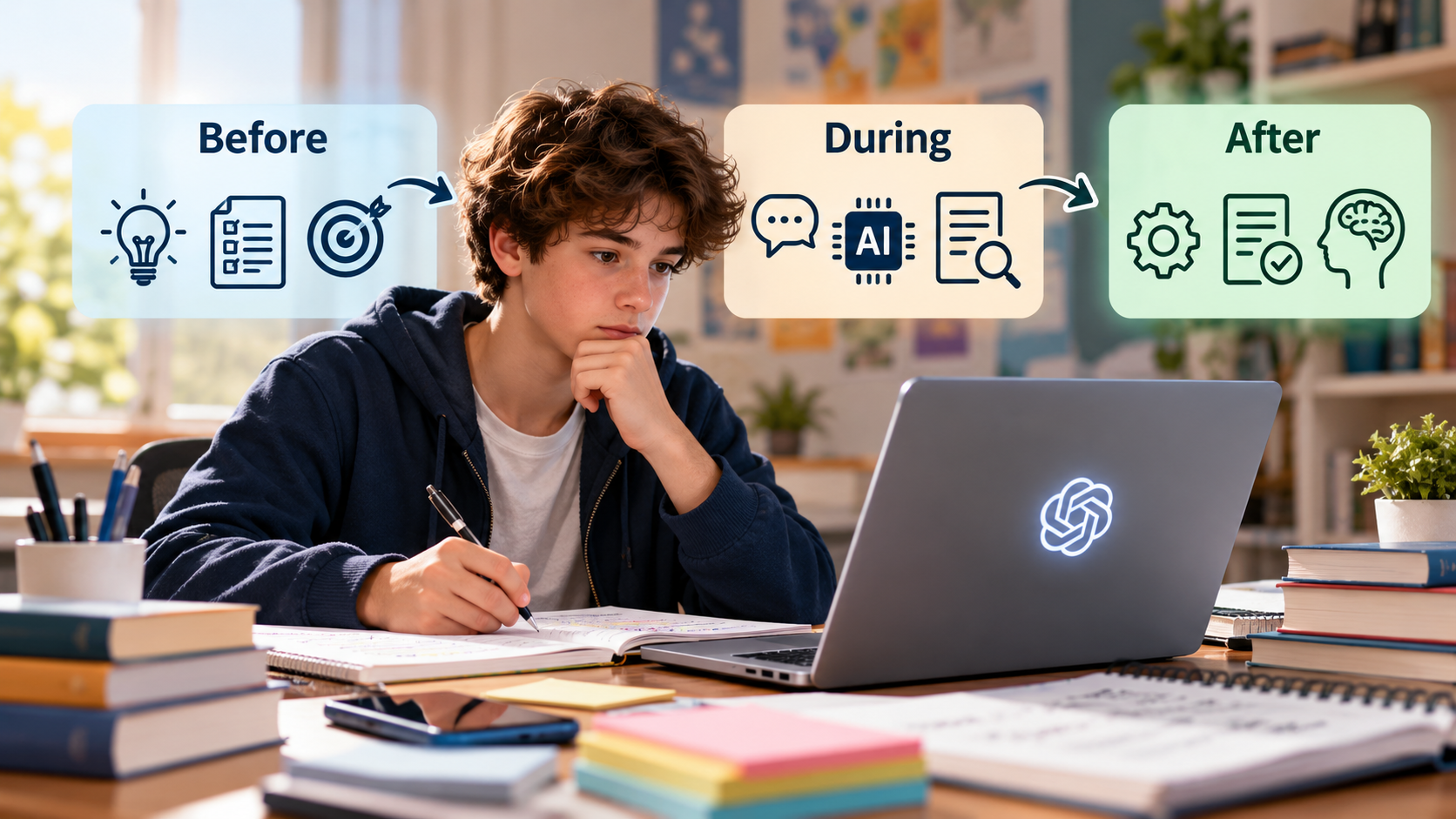
Before, during and after AI: a three-phase architecture
AI use becomes easier to govern when the lesson is designed as a sequence rather than a single permission. Each phase has a different purpose. Before AI, the learner establishes a cognitive baseline. During AI, the tool extends or challenges thinking under clear constraints. After AI, the learner consolidates, verifies and transfers.
| Phase | Student-owned work | Legitimate AI contribution | Teacher evidence |
|---|---|---|---|
| Before AI | Interpret the task, activate prior knowledge, make an initial attempt, state uncertainties and choose a provisional strategy | None, or accessibility support that does not solve the target problem | Baseline note, retrieval sample, prediction, plan or first representation |
| During AI | Formulate a purposeful request, compare outputs, interrogate assumptions, decide what to use and record changes | Examples, alternative explanations, feedback, simulation, translation, formatting or targeted hints | Prompt-and-decision log, annotated comparison, verification notes |
| After AI | Reconstruct the reasoning, explain the final decision, correct errors and apply the idea to a changed case without assistance | Optional feedback only after the independent check | Oral explanation, closed-tool transfer task, error analysis or reflective commentary |
The “before” phase prevents the tool from defining the problem on the learner’s behalf. Even a three-minute attempt can reveal what the student notices, remembers and misunderstands. The “during” phase makes AI interaction analytical rather than consumptive. Students should have to compare, choose and justify. The “after” phase is where teachers test whether the apparent success belongs to the learner or only to the temporary human–tool system.
This sequence also clarifies accommodations. A student may use text-to-speech before AI, a translation aid during AI or speech-to-text after AI without surrendering the target reasoning. Accessibility tools can remove barriers while the protected mental operation remains intact. Equity does not require identical interfaces; it requires credible evidence that students exercised the intended capability.
The effort allocation matrix
A teacher can build an effort budget in less than five minutes by crossing the learning goal with the role proposed for AI. Four decisions are possible: protect, scaffold, share or delegate.
| Decision | Meaning | Appropriate when | Main risk |
|---|---|---|---|
| Protect | The learner performs the operation before any AI support | The operation is the learning objective or a prerequisite that must become fluent | Students may need graduated support if the task is beyond reach |
| Scaffold | AI offers hints, questions, partial models or feedback without completing the operation | The learner can progress with contingent assistance | Hints may become disguised answers if they arrive too early |
| Share | Learner and AI contribute, but the learner compares, selects and justifies | Variation, critique or iterative improvement supports the objective | The boundary between assistance and substitution may become invisible |
| Delegate | AI performs the operation and the learner checks the result | The operation is routine, already mastered or irrelevant to the objective | Repeated delegation may erode a skill that still matters elsewhere |
Consider a history lesson on evaluating causes of a political event. Generating a clean bibliography format can be delegated if citation formatting is not the target. Producing possible counterarguments may be shared, provided the student evaluates them. Interpreting primary-source evidence should be protected. Checking whether an AI-generated quotation exists must also remain student-owned because verification is integral to trustworthy inquiry.
Now consider a beginner language lesson. Sentence production may be the protected operation, so asking AI to rewrite the entire paragraph defeats the purpose. The same rewriting function might be acceptable in an advanced history course where the objective is causal analysis and the learner has already demonstrated control of the ideas. The tool has not changed; the effort budget has.
Four worked classroom examples
The most reliable budgets are concrete enough to guide action but flexible enough to fit subject knowledge. These examples show how the same three-phase structure changes across domains.
| Context and objective | Before AI | During AI | After AI |
|---|---|---|---|
| Mathematics: choose and justify a method | Student represents the problem, predicts a method and completes a first step | AI supplies two possible approaches, including one with a subtle error; student diagnoses both | Student solves a structurally similar problem without AI and explains why the chosen method fits |
| History: evaluate competing explanations | Student identifies claims in supplied sources and proposes a provisional judgment | AI generates a counterargument; student checks it against the source set and revises only when warranted | Student writes a source-grounded conclusion and defends it orally |
| Science: interpret experimental evidence | Student predicts a relationship and names variables and possible confounds | AI helps visualize data or suggests alternative interpretations; student tests each against the design | Student explains limitations and predicts what a modified experiment would show |
| Writing: improve an argument | Student states a thesis, audience and line of reasoning, then drafts one substantive paragraph | AI acts as a critical reader, asks questions and offers alternative organization | Student rewrites in their own voice, annotates major decisions and presents a fresh paragraph under closed-tool conditions |
These examples preserve consequential choices. They also avoid using AI merely as an answer machine. In mathematics, the tool introduces a diagnostic contrast. In history, it broadens the argument while the student retains evidential judgment. In science, it helps surface interpretations but cannot decide which the design supports. In writing, it functions as a reader rather than a ghostwriter.
Transfer remains essential. A polished AI-supported product can demonstrate orchestration, but not necessarily independent command. Learning Coach’s analysis of why reasoning gains often fail to transfer from brain games to schoolwork explains the underlying problem: success in one format does not automatically generalize. A changed example, a delayed explanation or an independent reconstruction provides stronger evidence.
Protect the decision points, not every keystroke
Teachers sometimes respond to AI by requiring every step to be completed manually. That approach can preserve work without preserving the right work. The more useful strategy is to identify the decision points that carry the discipline’s meaning.
In literature, a decision point might be selecting textual evidence and explaining how language creates an effect. In science, it may be distinguishing correlation from causation. In mathematics, it may be choosing a representation or testing whether a solution is reasonable. In design, it may be translating user needs into criteria and evaluating trade-offs. In each case, AI can support peripheral operations while the learner remains responsible for the decisive judgment.
This is why the final product alone is insufficient. A teacher needs traces of the decisions that shaped it: the rejected option, the corrected assumption, the source that changed the conclusion, the reason a method was selected or the point at which the learner asked for help. These traces need not become a bureaucratic transcript of every interaction. A short decision log with three entries can be more informative than pages of prompt history.
The companion AI Homework Disclosure Protocol can eventually make such traces consistent across tasks, but disclosure serves a different purpose from budgeting. Disclosure records what happened. The effort budget designs what should happen before the task begins.
Metacognition is the operating system of the budget
A budget only works when learners can recognize what kind of help they need. This makes metacognition—not prompt fluency—the central capability. The Education Endowment Foundation organizes metacognitive activity around planning, monitoring and evaluating. Those verbs map directly onto responsible AI use.
Planning means identifying the goal, activating relevant knowledge, estimating difficulty and deciding where assistance may be useful. Monitoring means noticing whether the explanation is understood, whether a source is credible, whether the method still fits and whether the tool is beginning to replace rather than extend thought. Evaluating means judging both the product and the strategy: Did the AI improve understanding? Which decision remained mine? What could I now do without it?
These questions should be modeled explicitly. A teacher might think aloud: “I am not asking for a solution because selecting the method is today’s objective. I will ask for two representations after I have drawn my own. Then I will compare the assumptions behind each representation.” This demonstrates strategic restraint. Students learn that effective AI use is not measured by how much output they can obtain, but by whether the support matches the learning need.
The same principle underpins effective academic coaching. Families comparing support models may find Learning Coach’s guide to academic coaching versus tutoring for teenagers useful: tutoring commonly emphasizes subject explanation, while coaching can make planning, monitoring, strategy choice and independence more visible. An effort budget gives that coaching conversation a concrete object.
Verification must never be delegated
Generative AI can produce fluent statements that are inaccurate, unsupported, outdated or detached from the assigned evidence. Verification is therefore not a final cosmetic step; it is a protected cognitive operation. Students should distinguish between checking surface plausibility and establishing warrant.
A robust verification routine asks whether the claim is traceable to a reliable source, whether the cited source actually supports it, whether relevant context has been omitted, whether calculations can be reproduced and whether a confident formulation hides uncertainty. When AI summarizes an assigned text, the learner should return to the text. When it provides a quotation, the learner should locate the exact passage. When it suggests data, the learner should identify the original dataset or authoritative publication. When it proposes code or a mathematical procedure, the learner should test it with known cases.
UNESCO’s AI competency framework for students places human-centred judgment, ethics, technical understanding and responsible creation within the same progression. That balance is important. Verification is not only a defence against hallucination; it is how students retain agency and accountability when a powerful system contributes to their work.
Schools exploring wider institutional models may also consult Learning Coach’s overview of eight international AI-school experiments. Such initiatives differ substantially, but they reinforce a key design question: which decisions remain educationally and ethically human even when technology can produce an answer faster?
Do not confuse productive struggle with abandonment
The language of effort can be misused. Students do not learn more simply because help is withheld. A learner who lacks prerequisite knowledge, receives ambiguous instructions or faces an inaccessible format may experience overload rather than productive struggle. The correct response is not to insist on independence at any cost. It is to adjust the support while preserving the target operation.
A good scaffold reduces complexity temporarily, provides a model, narrows the choice set or supplies feedback that helps the student take the next step. It should be contingent: more support when needed, less as control develops. AI can contribute to such scaffolding by generating an additional example, translating a difficult explanation, posing a diagnostic question or offering immediate practice. The teacher still decides when the support arrives, what it may reveal and how it will be withdrawn.
This is especially important for learners with disabilities, multilingual learners and students with uneven prior opportunities. Equality of learning does not mean equality of friction. A student may need vocabulary support to participate in scientific reasoning, or an alternative input method to demonstrate historical analysis. The effort budget should protect the scientific or historical reasoning, not the barrier that prevents access to it.
The test is functional: after support, can the learner perform more of the intended operation with less assistance? If yes, the scaffold is building capacity. If support becomes permanently necessary for the same operation, the school should investigate whether the sequence, prerequisite teaching or tool boundary needs redesign.
A five-question planning routine for teachers
An effort budget does not require a new policy document for every lesson. It can be built into planning through five questions.
First, what capability should become more independent by the end of the task? Second, which mental operations create that capability? Third, where could AI remove irrelevant friction or provide useful feedback? Fourth, what evidence will show that the learner—not merely the learner-plus-tool system—can perform the target operation? Fifth, when and how will support be reduced or removed?
The answers should be written in verbs. “Understand photosynthesis” is difficult to budget. “Explain how a change in light intensity affects the rate of photosynthesis, interpret a graph and justify a prediction” identifies observable work. Once the verbs are clear, the AI boundary becomes clearer as well.
Schools can record the result in a short design statement: “Students must independently interpret the graph and make an initial prediction. They may use AI to generate two alternative explanations after the prediction. They must verify those explanations against the supplied evidence and complete a new graph-based transfer question without AI.” This is more operational than “AI permitted for support” and more educationally precise than a blanket ban.
How to know whether the budget worked
The success criterion is not compliance with a tool rule. It is improved capability. Teachers should compare evidence from before, during and after AI support. The baseline shows what the learner could initially do. The interaction reveals how assistance was used. The transfer check shows whether knowledge or strategy became more available without the same support.
Useful evidence includes the quality of independent retrieval, the accuracy of explanations, the ability to detect a planted error, the relevance of help-seeking, the strength of source verification and performance on a changed task. Student reflection can add context, but self-report alone is insufficient. A learner may sincerely feel that AI improved understanding because the output became clearer. Only an independent explanation or transfer task can test that impression.
At school level, leaders should avoid crude metrics such as prompt counts or the percentage of assignments declaring AI use. More meaningful questions include whether departments identify protected cognitive operations, whether students receive explicit instruction in verification, whether closed-tool transfer checks are common, whether accommodations preserve the target capability and whether dependence decreases across a sequence.
This is also where professional learning matters. Teachers need time to examine tasks, compare budgets and calibrate evidence of independence. The goal is not a single universal threshold. It is a shared discipline of asking what the learner is supposed to become able to do.
A school-wide principle for human agency
The UNESCO framework emphasizes that students should become responsible users and co-creators of AI, not passive recipients of automated outputs. A cognitive effort budget translates that human-centred principle into daily teaching. It protects the moments in which learners form intentions, exercise judgment, accept responsibility and build knowledge they can later use.
A school-wide statement might read: We use AI to expand access, feedback, variation and possibility, while preserving the cognitive operations required for knowledge, judgment, independence and transfer. Departments can then interpret that principle through their disciplines. The exact protected operations will differ, but the logic remains stable.
This avoids two unhelpful extremes. One treats all AI assistance as intellectual surrender. The other assumes that because AI is now part of adult life, students should delegate as much as possible. Education has a different time horizon from immediate productivity. Students are not only completing today’s task; they are building the internal resources with which they will approach tomorrow’s unfamiliar problem.
Teachers and coaches who want to develop this kind of task analysis systematically can explore the Learning Coach training pathway and the accompanying Become a Learning Coach book. The value of professional judgment lies precisely here: deciding when assistance enables learning, when it conceals missing knowledge and when it should fade.
Final takeaway
The most important AI question in education is not “Was the tool used?” It is “What thinking did the learner still have to do?”
A cognitive effort budget makes that question answerable. It identifies the operations that create learning, protects them before assistance, constrains AI during the task and checks transfer afterward. It removes unnecessary friction without removing the struggle that builds knowledge. It supports access without confusing access with substitution. It treats verification, regulation and human judgment as permanent responsibilities.
AI can accelerate production. Education must still cultivate the person who can orient, retrieve, reason, verify, transfer and decide when the tool is gone.
References
OECD Digital Education Outlook 2026: Exploring Effective Uses of Generative AI in Education
OECD: How to effectively use Generative AI in education
OECD: Reimagining Teaching in an Accelerating World
Education Endowment Foundation: Metacognition and Self-Regulated Learning
