
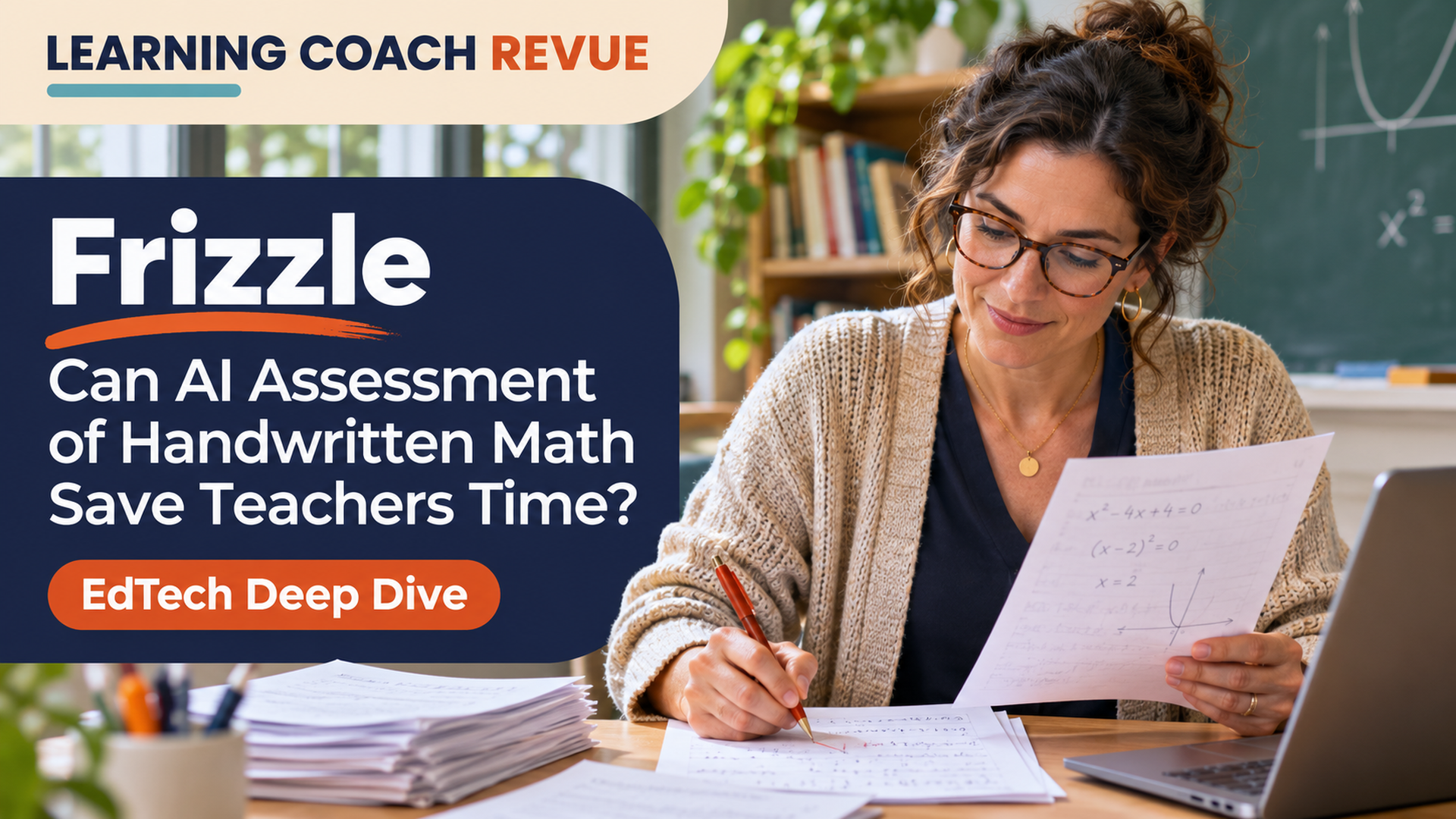
The future of educational technology may not require children to spend another minute in front of a screen. Frizzle, a US startup founded in 2025, is exploring a different route: let students continue solving mathematics on paper, then use artificial intelligence to turn their handwritten reasoning into feedback and instructional evidence. The deeper opportunity is not faster marking alone. It is giving teachers the time and information to respond before a small misunderstanding becomes a lasting learning difficulty.
The information trapped inside a sheet of paper
A mathematics worksheet is a surprisingly rich record of learning. A crossed-out number, a fraction drawn in the margin, a missing negative sign or a carefully constructed diagram can reveal something that a final answer alone cannot. There may be evidence of a productive strategy, a misconception about place value, a calculation slip or a learner who understands the concept but has not yet mastered the notation.
The trouble is not that teachers fail to recognize this richness. It is that recognition takes time. Reading thirty solutions to a single problem is an intellectual task. Reading thirty solutions to ten problems, interpreting them, assigning credit, identifying recurring errors, writing individual comments and planning tomorrow's lesson is an entirely different proposition.
At the end of a working day, the teacher faces a difficult allocation of attention. Every additional minute spent decoding student work is a minute unavailable for planning an explanation, preparing a different example, speaking with a struggling learner or simply recovering the energy needed to teach well again.
The pressure is measurable. RAND's 2023 State of the American Teacher survey found that teachers reported longer working weeks than other employed adults: 53 hours versus 46. These numbers concern the whole workload, not grading alone, but they illustrate why an innovation that genuinely reduces repetitive assessment work deserves attention.
Frizzle approaches that challenge by beginning with something already familiar to millions of students: paper and pencil. It treats the worksheet not as an obsolete medium to be replaced, but as a source of information that can be made easier for a teacher to interpret.
Two engineers and a problem worth solving
Frizzle was founded in 2025 by Abhay Gupta and Shyam Sai. The company joined Y Combinator's Summer 2025 batch and is listed in New York City. According to its Y Combinator profile, Gupta is the CEO and Sai the CTO. Their professional backgrounds span product management and machine learning, respectively, and they met at the Illinois Mathematics and Science Academy.
There is a particularly relevant educational thread in Sai's background. The Midwest Math Circle's founder page documents his involvement in creating a community through which younger learners could encounter challenging mathematics. Mathematics circles are interesting precisely because they emphasize exploration and problem solving rather than treating the subject as a succession of answers to be checked.
An interview published by Every describes the initial product's launch in July 2025. The founders' public accounts frame the venture around teacher workload and the possibilities of AI-assisted marking. Frizzle's own account of its mission likewise places the teacher at the center of the product.
The founding story offers an instructive contrast with the familiar narrative of educational AI as an autonomous tutor. Frizzle's immediate customer is the professional already responsible for the classroom. Rather than trying to create a parallel relationship between child and machine, the company is building a tool around a relationship that already exists between learner and teacher.
That distinction matters. A teacher knows what has been taught, what language was used, which methods were encouraged and what a particular student has been struggling with. A machine examining a page has access only to the evidence available to it. The opportunity lies in combining the two kinds of intelligence rather than confusing them.
How the platform works: from handwriting to instructional decisions
Frizzle's product website and public tutorials describe a workflow built around capturing existing student work. Teachers can digitize assignments using a phone or scanner; the platform also documents importing and returning work through supported digital workflows. Its software proposes assessment outputs, including scores, comments and patterns across assignments. Public documentation describes options for rubric-based marking and different forms of feedback.
The original focus was handwritten mathematics. More recent company descriptions extend the ambition to written work in other subjects. This investigation concentrates on mathematics, where the product's initial proposition is especially compelling.
Consider three questions on a hypothetical algebra worksheet. The first asks students to simplify an expression; the second asks them to solve an equation; the third requires an explanation of why a proposed solution is incorrect. A system designed exclusively around final answers might score the first two items readily and struggle to represent the reasoning in the third.
A system that reads the actual page can, in principle, identify intermediate steps and connect a proposed judgment to the place where an error appears. This is the distinction Frizzle is pursuing. Its public materials describe diagnostic flags and links to evidence in the original work, along with class-level summaries intended to support subsequent instruction.
The result is a workflow that can be understood as four stages: capture the evidence, interpret it, verify the interpretation, and act on it. The third stage is indispensable. Even a sophisticated system can misread a decimal point, confuse two symbols, overlook a valid alternative solution or assign partial credit in a way that conflicts with the teacher's intention.
The value of a digital annotation is therefore not merely that it appears quickly. It should also make the source of a judgment accessible. When a teacher can compare an AI-generated observation with the original written step, the interface supports professional judgment rather than concealing it.
A class summary has a different function from individual marking. Imagine that a teacher discovers that twelve pupils have made essentially the same error while simplifying fractions. Instead of writing twelve different explanations of an identical principle, the teacher might address the pattern with a short demonstration and reserve individualized attention for the remaining difficulties.
The benefit depends on what happens next. A dashboard left unopened is not formative assessment. A correct diagnosis followed by an inappropriate teaching response is not enough either. Frizzle makes a particular part of this process more manageable; the educational result remains a product of the entire feedback loop.
Why preserving handwriting is a meaningful design decision
There is a subtle form of technological friction in asking a student to demonstrate mathematical thinking through an unfamiliar interface. A learner may know the mathematics but still struggle with typing a fraction, finding an exponent control or drawing a diagram with a trackpad. These tasks demand attention that could otherwise be devoted to the problem.
This is not an argument that paper is inherently superior to digital mathematics. Digital tools can make dynamic geometry possible, provide accessible representations and offer immediate opportunities for experimentation. Some learners also benefit greatly from keyboards or assistive technology. The important question is whether a medium supports the task and the person doing it.
For a school already using paper, Frizzle separates the medium of learning from the medium of analysis. A child can sketch, erase, reorganize and annotate without first mastering a new software interface. The teacher can benefit from digital aggregation afterward.
That separation also changes the economics of adoption. Rather than replacing curriculum materials, purchasing a device for each student and retraining an entire class, the starting point may be an existing worksheet and an authorized capture process. It does not remove all technology requirements: scanning quality, connectivity, teacher access, rostering and school privacy approval still matter.
From a neuroergonomic perspective, the design ambition is to reduce unnecessary interactions at both ends of the process. The student should be free to concentrate on mathematical reasoning; the teacher should be able to devote attention to interpretations that matter. The ideal interface would make uncertainty as easy to inspect as certainty, and original work as easy to reach as its summary.
The science of feedback: speed is useful, information is essential
Educational feedback is often treated as if its presence alone were beneficial. The research tells a more complicated story.
In their influential 2007 review, John Hattie and Helen Timperley described feedback in relation to the learner's goal, current progress and subsequent action. They distinguished feedback concerning the task, the underlying process, self-regulation and the person. This framework helps explain why telling a student that an answer is wrong is not equivalent to teaching that student how to improve.
A later meta-analysis by Wisniewski, Zierer and Hattie (2020) examined 435 studies involving more than 61,000 participants. It found a positive average effect, with substantial differences between interventions. The information contained in feedback was an important consideration. The studies covered diverse educational settings, and the pooled result should not be interpreted as an expected effect size for Frizzle.
The distinction is particularly apparent in mathematics. Take a student who incorrectly adds two fractions by adding their numerators and denominators separately. A score indicates that the answer does not meet the criterion. An explanation can identify the mathematical relationship that has been misunderstood. A prompt can go further by inviting the learner to represent the fractions visually, compare their denominators and attempt the problem again.
Each response demands a different kind of cognitive engagement. A learner who receives the complete corrected calculation may simply copy it. A learner who receives an appropriately chosen question may be encouraged to reconstruct the reasoning. Neither strategy is universally better: a novice who lacks the relevant knowledge may first need an explicit worked example.
A systematic review of feedback research in mathematics education discusses how feedback can focus on the mathematical process and the learner's capacity to detect errors. This distinction offers a useful lens through which to assess automated comments. Do they merely identify mistakes, or do they help learners recognize how to detect and remedy them?
Another systematic review of formative assessment in mathematics education, published in ZDM in 2025, reports promising results across several forms of assessment while emphasizing the influence of context and the different ways feedback is used. The findings support the educational rationale for collecting actionable evidence; they do not establish that a particular commercial product produces equivalent gains.
These studies suggest that the best version of a tool like Frizzle is not necessarily the one that generates the longest comment or marks the most pages per minute. It is the one that helps teachers deliver information learners can use, at a moment when they have both the knowledge and opportunity to act on it.
A mistake is not always a misconception
The diagnostic ambitions of AI assessment deserve especially careful scrutiny. There is a meaningful difference between a mistake and a misconception. A learner might write 6 × 7 = 48 because multiplication facts are not yet fluent, because attention momentarily wandered or because a numeral was copied incorrectly. The page provides evidence of the answer, but not definitive access to the cognitive event that produced it.
Similarly, a wrong answer obtained through a coherent but incorrect rule can suggest a stable conceptual misunderstanding. Repeated evidence across different contexts would make that interpretation more plausible. A single page may not.
Frizzle's product materials describe identifying mathematical misconceptions and relating them to relevant skills and prerequisites. The educational promise is considerable: teachers could recognize patterns that a percentage grade conceals. Yet a diagnostic label is useful only if its uncertainty and evidential basis remain visible.
A teacher might ask a learner to explain a step aloud, present another example or compare two representations. Such a brief conversation can distinguish a copying error from a deeper difficulty. This is the kind of human investigation a machine-generated flag could make more targeted.
There is another subtle risk. Suppose a pupil develops an unusual but valid solution that differs from the expected rubric. A system that rewards only familiar patterns may penalize mathematical creativity. In mathematics education, the capacity to recognize equivalence between multiple strategies is central. The software must be evaluated not only on standard answers but also on unexpected correct methods.
The conceptual distinction is between observing written performance and diagnosing understanding. The former can inform the latter; it does not replace it.
What might change in tomorrow's lesson?
Imagine a hypothetical seventh-grade classroom. On Monday, students attempt an exercise involving proportional relationships. The teacher reviews a class summary and discovers that a group of learners appears to rely on additive rather than multiplicative reasoning. Some others get correct answers without being able to explain why, while several appear comfortable with the principle.
On Tuesday, instead of repeating the same lesson for everyone, the teacher introduces a counterexample to the first group, asks the second to justify their reasoning with diagrams and gives the third a more demanding problem involving unfamiliar quantities.
On Wednesday, a short new task tests whether students can apply the relationship in a different context. If the initial difficulty persists, the teacher investigates further. If it disappears only when the numbers look familiar, the next challenge is transfer.
This is a scenario, not a reported Frizzle classroom outcome. It illustrates the kind of instructional cycle that a rapid assessment workflow might enable.
The difference between this scenario and conventional grading is not merely the number of hours saved. It is the interval between the first sign of misunderstanding and the opportunity to address it. An inaccurate idea can be rehearsed repeatedly while assignments wait to be reviewed. A shorter, well-designed loop may reduce that delay.
There is also an equity dimension. Students who ask many questions often reveal their difficulties naturally. Quiet students may not. Systematic analysis of everyone's work can help ensure that a teacher's attention is not allocated exclusively to the pupils who are most visible or confident. The promise must be balanced against the possibility of uneven recognition of different handwriting styles or forms of notation. A system that misses the work of the least visible learners would reproduce the very problem it is intended to solve.
Measuring impact without confusing convenience with learning
Frizzle's public descriptions include performance and workload claims. They are useful for understanding the company's goals, not sufficient to establish an independent estimate of classroom impact. In the sources examined for this investigation, no peer-reviewed controlled evaluation of Frizzle itself was identified that establishes its effect on mathematics achievement or verifies a generalizable time-saving estimate.
An institutional signal is available: the Oak Ridge Institute for Science and Education's AI education resource directory records a Frizzle commitment of 150,000 free platform seats for eligible K–12 mathematics and science teachers in Title I schools through 2029. That is a documented access commitment, not the number of teachers who have already adopted the platform. It also does not constitute a study of effectiveness.
A useful school evaluation would distinguish several outcomes that are easy to collapse into a single word like impact.
| Outcome | What a school could measure |
|---|---|
| Teacher workload | Total time from capture to reviewed feedback, including corrections and setup |
| Assessment reliability | Agreement with independently marked samples; missed errors and unjustified deductions |
| Diagnostic usefulness | Whether flagged patterns are confirmed by follow-up tasks or teacher discussion |
| Learning | Improvement on new, independently assessed problems, including delayed retention and transfer |
| Equity | Differences in recognition and scoring across handwriting, accommodations and language needs |
| Professional autonomy | Whether teachers can understand, correct and disregard proposed judgments |
A practical comparison might begin with two weeks of ordinary marking, followed by several weeks of authorized AI-assisted assessment on comparable work. Where possible, parallel classes or counterbalanced assignments could help separate tool effects from differences in topic difficulty. A second teacher could independently score a sample without seeing the AI's output.
A review would record not only the mean agreement but also the nature of disagreement. An error of one point may have little significance on a practice sheet; a systematic error that treats alternative strategies as wrong could be much more consequential.
Learning measures must also be independent of the grading system. If the platform's own mastery score is both the intervention and the outcome, improved scores may reflect a changed measurement process rather than a change in understanding.
The most revealing question is what teachers do with the recovered time. If it is absorbed by reviewing additional dashboards or new administrative demands, the promised relief may evaporate. If it is invested in better lessons, individual conversations or sustainable working hours, the value may extend well beyond the marking process itself.
The business of giving teachers time back
Frizzle's commercial proposition connects two kinds of customer. An individual teacher may want to solve a personal workload problem, while a school or district may be seeking consistent, useful assessment evidence across classrooms. A free entry point can let a teacher evaluate the tool before an institutional commitment is considered. District-level features can then address needs such as administration, integration and reporting.
The pricing page reviewed for this article displayed a free tier, a Pro offer at an annual-billing equivalent of $16.67 per month ($200 per year) and a custom annual institutional contract. The same page described worksheet limits on the free tier, whereas the homepage used broader language about free grading for teachers. Because the published descriptions are not fully aligned, the current quota, included features and billing conditions should be confirmed directly with Frizzle before purchase. The Title I commitment is a separate eligibility-based opportunity.
This is a promising business structure if the software's recurring cost is lower than the value of the time and instructional opportunities it creates. But schools cannot assume that every hour saved will translate into a financial saving. Teachers are salaried professionals, and the return often takes the form of better working conditions or additional capacity rather than reduced payroll.
The cost of adoption likewise includes more than subscription fees. There may be training time, scanning logistics, integration work, privacy reviews and the continuing cost of human quality assurance. In districts with incompatible infrastructure, even a low subscription price can conceal a significant organizational burden.
A deeper source of commercial value could be the ability to combine insights across different assignments without forcing a school into a proprietary curriculum. When a platform fits existing teaching practices, it may become part of daily work rather than a supplementary destination that teachers must remember to visit.
The company's financial performance, revenue, customer retention and audited unit economics were not independently established in the materials reviewed. The business case described here is an analysis of the value proposition, not a claim about profitability.
Trust, privacy and the right to challenge a grade
A handwritten assignment can contain far more than mathematics: a child's name, a class identifier, a personal note or an indication of an accommodation. Digitizing a whole stack of papers changes the data environment even if the students never create accounts.
Frizzle's public privacy policy and terms of service address the handling of school and student data. Its website represents that it follows relevant US student privacy requirements and provides contractual data protection arrangements. These are provider statements; the applicable agreement, current security evidence, retention period, subprocessors and deletion process need to be reviewed by the adopting institution. A US compliance claim cannot be assumed to satisfy every other jurisdiction's requirements.
There is a related question of fairness. A learner should have a meaningful opportunity to challenge a mistaken interpretation. A teacher should be able to inspect the underlying page, change the proposed grade and explain the reason. A school should decide when automation is appropriate and when a human must assess work directly.
For low-stakes practice, a carefully reviewed automated suggestion may be useful even when imperfect. For high-stakes examinations, placement decisions or accommodations, the consequences of mistakes demand much stronger validation and oversight. The two settings should not be treated as equivalent.
Human review also needs thoughtful design. If a teacher faces hundreds of flags with no indication of their priority or reliability, the review itself becomes a second marking job. If the system hides uncertainty, the teacher may accept unreliable outputs out of convenience. A helpful interface would surface consequential ambiguity without making routine work unnecessarily cumbersome.
The product's success should ultimately be measured by the teacher's capacity to exercise judgment, not by how completely the teacher can be removed from the process.
Beyond the Innovation: a classroom that learns from its own evidence
The possibility opened by Frizzle reaches beyond grading. When written work becomes a usable record of learning, the classroom itself can become a more responsive system.
One potential future direction, offered here as an editorial hypothesis rather than a description of an existing feature, is a carefully designed misconception timeline. Instead of treating a skill label as a permanent property of a pupil, it could show a sequence of observations, the interventions that followed and the evidence of subsequent improvement. A teacher would see a changing pattern rather than a fixed identity.
A particularly valuable design would make room for positive evidence. A student who originally struggled with proportional reasoning but later applies it successfully in a new problem deserves to have that progress represented. Otherwise, assessment records risk becoming archives of failure. A system that remembers only weaknesses cannot faithfully tell the story of learning.
Another possibility is the development of anonymous, teacher-curated examples of mathematical reasoning. With appropriate safeguards and permissions, common solution paths could become material for professional development or classroom discussions. Teachers might compare alternative strategies, learn how colleagues address a recurring misconception and select examples that reveal why a method works. The educational benefit would emerge from reflection on actual reasoning, not from accumulating more grades.
At a different scale, schools might use carefully aggregated and validated evidence to identify where a curriculum sequence is creating predictable difficulties. If multiple classes encounter a similar conceptual obstacle, the explanation may lie in the way a topic is introduced, not in a deficiency shared by every learner. Such an interpretation requires attention to teaching context, task design and data quality. It should never turn uncertain analytics into a simplistic ranking of teachers or students.
These possible developments share a principle: educational data should be a means of understanding and helping people, not a mechanism for freezing them into categories. Their feasibility would depend on privacy safeguards, clear consent and institutional authorization, reliable recognition, interoperability and the ability to evaluate the educational consequences.
Frizzle's most interesting long-term contribution may be to make information that already exists in classrooms easier to use. There is a compelling elegance in that ambition. The innovation does not necessarily require learners to change how they express their ideas; it asks technology to adapt to the ways those ideas are already expressed.
Discovering Frizzle in practice
Mathematics teachers and instructional leaders can explore Frizzle's official website, examine its tutorials and consult the pricing and access options. Schools interested in the Title I offer can check the institutional resource listing and confirm eligibility with the provider.
The most instructive first evaluation would be modest: choose a familiar, low-stakes assignment with a mixture of standard solutions, unusual correct methods and plausible errors. Use only authorized material and compare the proposed assessment with independent teacher judgments. Then observe whether the information helps plan a more effective next lesson.
Frizzle is pursuing a question that education has long been trying to answer: how can one teacher respond to the learning of many individuals without sacrificing the attention each deserves?
The answer will not come from grading alone. It will come from what educators can do when the time between a student's attempt and a meaningful response becomes shorter. If technology can make that interval more useful without weakening the teacher's authority or the learner's dignity, the humble sheet of paper may turn out to be one of the most important interfaces in the future of education.
References and further reading
Frizzle. Official website, About, Tutorials, Pricing, Privacy, Terms. Product and commercial information, consulted 25 November 2026.
Y Combinator. Frizzle company profile and launch. Founding and team.
Midwest Math Circle. Founders. Educational background.
Every. Abhay Gupta Is Building Frizzle to Transform Math Education With AI. Founder account.
ORISE. Presidential AI education resources: Frizzle. Access pledge.
Steiner, E. D., Woo, A., & Doan, S. (2023). All Work and No Pay — Teachers' Perceptions of Their Pay and Hours Worked. RAND. Report.
Hattie, J., & Timperley, H. (2007). The Power of Feedback. Review of Educational Research, 77(1), 81–112. DOI.
Wisniewski, B., Zierer, K., & Hattie, J. (2020). The Power of Feedback Revisited. Frontiers in Psychology, 10, 3087. DOI.
Feedback in mathematics education research: a systematic literature review (2024). DOI.
Formative Assessment in Mathematics Education: A Systematic Review (2025). ZDM – Mathematics Education. DOI.

