
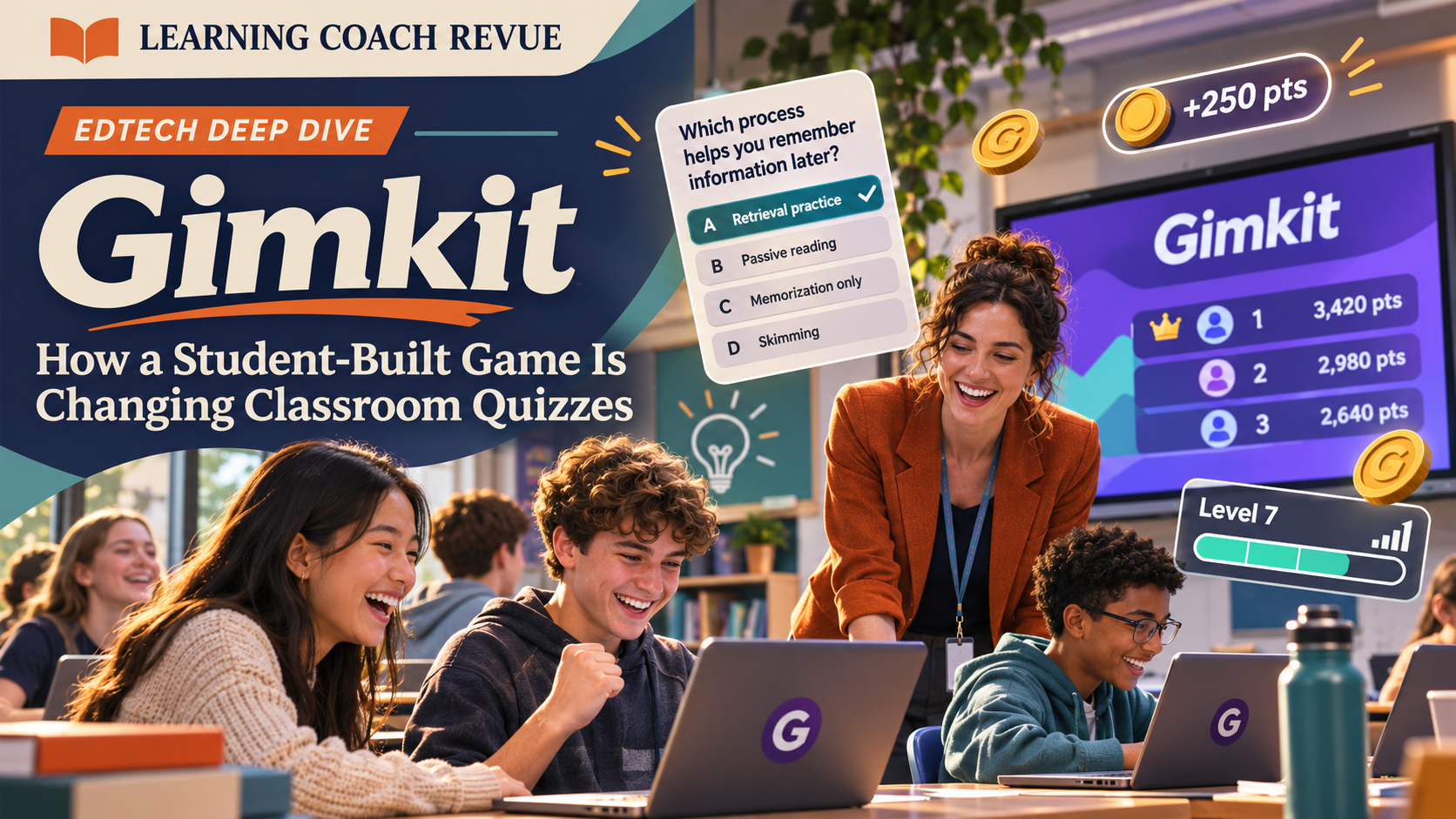
What happens when answering a classroom question becomes the means to pursue a goal rather than the end of an exercise? Born as a high-school project, Gimkit offers an unusually revealing case study in the relationship between play, memory, feedback and learner agency. Its greatest educational promise may be found not in its games themselves, but in what those games make students willing to do repeatedly.
The classroom quiz that refused to stay a quiz
A teacher asks a question. Several hands rise. One student answers. The teacher moves on. What happened in the minds of everyone else remains largely invisible. Some retrieved the answer silently; others recognized it only when someone said it; some were thinking about something entirely different. The classroom appears to have reviewed the material, although the actual cognitive work may have been distributed remarkably unevenly.
The digital quiz promised to change this. Every student could respond, every response could become evidence, and the teacher no longer had to infer an entire class's understanding from three confident voices. Yet the familiar sequence of question, response, score and next question retained much of the architecture of the traditional test.
Gimkit offers a different proposition. In many of its games, a question is not the final destination. Answering it produces a resource that the player can use to pursue another objective. Knowledge becomes an ingredient of action. The quiz is no longer simply what the student is doing; it is part of the world in which the student is acting.
That difference deserves attention. A learning platform cannot manufacture understanding simply by adding a game economy. But it can change the conditions under which learners choose to practice, the frequency with which they encounter ideas, and the emotional meaning of a mistake. These are consequential changes in a profession where getting learners to make a second, third or fifth attempt is often harder than explaining the concept in the first place.
Gimkit is particularly interesting because this proposition emerged from the other side of the classroom desk.
An educational product born inside education
In 2017, Josh Feinsilber was a student at Gibson Ek, a project-based high school in Issaquah, Washington. Rather than waiting until graduation to build a technology company, he developed a classroom game as a school project. A 2019 interview with Feinsilber and Jeff Osborn traces its public launch to Product Hunt in October 2017. Local reporting by KIRO 7 subsequently documented the young entrepreneur and the tool's use by teachers. Osborn joined the venture full-time in early 2018, as he recounts in his 2019 essay about building a company with a high-school student.
There is something important about the environment that produced the product. Project-based education treats learning as something that can emerge while a person creates an artifact for a real audience. Gimkit itself was such an artifact. Coding had a purpose, design had consequences, and feedback from users was not merely a grade. It was information about what to build next.
The company thus embodies two educational ideas at once. Its product attempts to make practice purposeful through game mechanics; its origin illustrates how an authentic project can give purpose to acquiring skills. Neither idea requires pretending that school should always feel like entertainment. Both suggest that the relationship between effort and a meaningful objective matters.
The distinction between a student founder and a product designed for students is more than a compelling origin story. A learner can notice a form of friction that an adult purchasing software might overlook: the experience of being asked to participate in an activity whose rules, pace and rewards were chosen by someone else. Designing around that experience does not replace teachers' professional knowledge. It opens another source of educational insight.
The early product revolved around questions, virtual earnings and strategic decisions. The platform has since expanded into multiple game formats, asynchronous assignments, collaborative question authoring and a creative environment for building game worlds. What ties these developments together is the possibility of making the learner an active participant in the system rather than simply a respondent to it.
Inside Gimkit: a single body of knowledge, different worlds
The unit of instructional content is a kit: a collection of questions. A teacher can prepare a set around a topic and then choose how it will be experienced. The official hosting guide describes the sequence from selecting content to launching a mode and sharing entry information. Learners can generally participate in teacher-hosted activities without individual accounts, according to the account FAQ.
This separation of subject matter and game design is central to the platform's value. A set on fractions, French vocabulary or the organs of the digestive system can remain conceptually identical while the social and strategic context changes. A teacher does not need to write a new curriculum every time the class needs a different form of review.
The economy of answering
In classic quiz-oriented modes, correct responses can generate virtual currency. Players may use game resources in strategic ways, depending on the rules of the selected mode. The educational question becomes a gateway to another decision: earn, save, spend, invest, cooperate or pursue a goal.
Consider a hypothetical vocabulary lesson. Instead of asking thirty students to complete a list of translations once, a teacher prepares a kit of twenty terms. In a suitable mode, recalling a word creates progress in the game; another recall opportunity arrives as the game continues. The immediate desire to advance can support a longer sequence of retrieval attempts than a single pass through a worksheet.
There is a crucial caveat. A student who manages resources brilliantly may finish ahead of someone with stronger vocabulary knowledge. The game's ranking cannot therefore be treated as a direct measure of mastery. The two performance systems need to remain separate: success within the rules of the game and success in understanding the subject.
This distinction also makes room for valuable conversations. A learner who loses despite answering accurately may have learned something about the game, not failed the lesson. A learner who wins despite inconsistent accuracy may need more academic practice. Both experiences can be useful if interpreted correctly.
A world to explore
Gimkit's 2D game modes add movement and spatial interaction. A student can encounter an educational question within a wider sequence of game events. In a well-chosen mode, knowledge supports a mission rather than appearing as a series of detached interruptions.
This design gives teachers a richer set of choices. A short review before an exam may call for a simple format with minimal navigation. A collaborative consolidation activity may benefit from a common objective. A more exploratory class project may use an environment where learners build or discover something.
Not all modes make the same demands on attention. A student who is learning to navigate a two-dimensional world, interpret its symbols and coordinate movements is performing additional cognitive work. That work can be worthwhile when it contributes to the educational purpose, but it can compete with the content when it is merely an obstacle between questions. The teacher's choice of mode is therefore an instructional decision, not simply an aesthetic preference.
Learning through creating the questions
KitCollab allows participants to propose questions that a teacher can review before incorporating them into a kit. Contributions can be collected during class or independently. A learner moves from selecting the answer to considering what makes a good question.
This change in role is easy to underestimate. Imagine a history class preparing a review on industrialization. Writing a question about the date of an invention is relatively simple. Writing one that distinguishes a cause from a consequence, invents credible incorrect alternatives and explains why those alternatives are misleading requires a more organized understanding. A teacher who asks students to justify their proposed answers can turn a question bank into a collective exercise in reasoning.
The approval mechanism matters because students can confidently write incorrect questions. Teacher review is part of the pedagogy, not an inconvenience to eliminate. An inaccurate question that appears repeatedly in a game could reinforce an error rather than correct it.
Question authorship can also reveal more than answer selection alone. A student's choice of what to ask exposes what they consider important. Their distractors may reveal persistent misconceptions. Their explanations can show whether they understand the relationships behind the facts. With a careful rubric, a teacher can recognize quality of thinking in the contributions, independently of anyone's game score.
Gimkit Creative: the learner as world-builder
Gimkit Creative extends the idea beyond question sets. Its tools allow users to construct game environments using objects, devices and logic. The resulting activity can become a form of design-based learning: a student has to anticipate what another person will experience and arrange rules that make the intended experience possible.
An example already exists in the academic literature. A report entitled Save Our School: an educational game made with Gimkit Creative describes a dental hygiene educational game in which progression through different settings depended on course-related questions. This is a documented design example, not evidence that every custom map improves achievement.
Imagine a science class building a model of an ecosystem as a game world. Students first need to agree on the relationships they want to represent. They then have to decide which actions are possible, what feedback follows, and how one event affects another. If a peer misunderstands the world, the authors must investigate whether the explanation, question or game rule is responsible.
The educational potential here is not limited to the content embedded in the game. Designing an interactive artifact can invite systems thinking, explanation, testing, debugging and revision. Those skills are most likely to develop if they are explicitly part of the project brief. A beautiful map can otherwise absorb hours of decorative work without requiring much disciplinary reasoning.
The creator's challenge is to make the rule meaningful. If a game claims to teach food chains, its world should ideally represent relationships between organisms rather than simply attaching unrelated quiz gates to a visually attractive map. The closer the game logic and subject logic are connected, the more interesting the learning opportunity becomes.
What learning science sees beneath the game
Gimkit does not need a novel theory of the brain to explain its educational relevance. Several established lines of cognitive and educational research provide a more useful framework than the vague claim that games make learning better.
Retrieval practice: remembering is an act
One of the most durable discoveries in memory research is that attempting to retrieve previously learned information can itself strengthen later access to it. In a classroom, an exercise that requires recall can serve both as assessment and as a learning event.
In 2021, Pooja Agarwal, Ludmila Nunes and Janell Blunt published a systematic review of retrieval practice in schools and classrooms. Their review examined 50 experiments conducted in authentic educational contexts and identified broadly positive learning benefits across a range of conditions. Henry Roediger and colleagues' work on test-enhanced learning is part of the scientific tradition behind this approach; Jeffrey Karpicke's 2021 review of retrieval-based learning discusses the wider theoretical and empirical picture.
Gimkit can create conditions for repeated retrieval, particularly when a learner must recall content to continue playing. But the nature of the question determines the mental activity. Selecting the only familiar word from four obvious alternatives is not the same as producing an explanation from memory. Guessing rapidly is not necessarily the same as retrieving thoughtfully. A strong question set uses plausible alternatives, appropriate difficulty, and opportunities to generate answers before revealing choices.
The aim is not to maximize how many times a screen is tapped. It is to maximize worthwhile attempts to recover, connect and use knowledge.
Spacing is more than repetition
A game may lead a student to answer the same question several times during a session. This can support initial practice, but repetitions compressed into a few minutes are not equivalent to returning to knowledge after a meaningful delay. A learner may remember the answer because it appeared moments ago rather than because a durable memory has formed.
The opportunity lies in arranging a sequence beyond the individual session. A teacher could use a short kit after a lesson, revisit selected questions two days later, and return to the ideas the following week in a slightly different context. The platform becomes one component of a wider learning schedule.
The difference matters because an enthusiastic class can give the impression of considerable progress while everyone still has the material freshly available. A later, unassisted question offers a better test of whether the information remains accessible.
Feedback: the moment after a wrong answer
Correctness information helps a student locate a mistake, but a mark alone does not necessarily repair the misconception behind it. Consider a student who believes that a larger denominator always produces a larger fraction. Being told that one answer is wrong may leave the underlying rule untouched.
A teacher can use recurring errors in a game as a reason to interrupt the activity, bring the class together and show a visual representation of the fractions. Students can then explain the relationship and return to a new question. In that sequence, the game detects a problem, the teacher supplies the explanation, and further practice tests the revision.
This division of labor is powerful because it respects the limits of both systems. Software can collect responses from many learners quickly. A teacher can interpret a misconception in the context of previous instruction, student language, confidence and classroom relationships. Neither has to pretend to be the other.
Motivation: between meaningful choice and virtual rewards
Michael Sailer and Lisa Homner's 2020 meta-analysis of gamification found positive average effects across cognitive, motivational and behavioral outcomes, alongside variation between interventions and study designs. The research does not imply that every reward system improves learning. It points to the importance of what particular game elements cause learners to do and experience.
The theoretical lens of self-determination is especially relevant. Choice may support autonomy, achievable challenges may support perceived competence, and cooperation may support belonging. Conversely, a public ranking that repeatedly places the same learners at the bottom can threaten their sense of competence. A reward can provide a reason to start an activity without providing a lasting reason to value the subject.
Gimkit's virtual economy is therefore interesting precisely because it can be both a useful invitation and a source of distortion. For some learners, it transforms otherwise repetitive practice into something they are willing to sustain. For others, optimizing the game can become the only objective. The quality of the educational experience depends on the connection between the two purposes.
A revealing question to ask after a session is not only whether students enjoyed it, but whether they can describe what they learned and why it is useful outside the game.
The emerging evidence: encouraging, not unlimited
Unlike many digital products whose learning claims rely exclusively on general research, Gimkit has attracted several studies involving the actual platform. Their results offer reasons for interest and reasons for methodological restraint.
| Research | What it contributes | What it does not establish |
|---|---|---|
| Nursing education study, 2023 | Reported a learning advantage for Gimkit-based reinforcement compared with conventional questioning. | Universal effects across ages, subjects or implementations. |
| Dental hygiene nutrition pilot, 2023 | Explored the platform in a factual learning context using performance and satisfaction data. | Strong causal evidence; voluntary survey participation was only 10% of the class. |
| Descriptive student experience study, 2025 | Examined experiences, game preferences and motivation; external incentives were prominent. | An experimental demonstration of achievement gains. |
| Deniz and Taşkiran, 2026 randomized trial | Compared digital retrieval-based play, a collaborative escape room and a control condition in 82 nursing students. Gimkit showed an immediate knowledge advantage. | A statistically significant between-group advantage at the short-term follow-up. |
The most instructive detail in the 2026 randomized trial is the divergence between immediate performance and later performance. Third-year nursing students received standardized instruction and then participated in one of three conditions. The Gimkit group performed better on the immediate HPV knowledge measure than the comparison groups, but the groups were not statistically distinguishable at the later short-term assessment.
That result is valuable even without a lasting advantage. It suggests that an intervention can be effective at a particular stage of learning without automatically solving the problem of retention. It also provides a concrete reason to investigate what happens when games are embedded in distributed review rather than used as isolated events.
The studies identified here include substantial representation from health-professions education. Such environments often require learning terminology, classifications and factual distinctions. It would be premature to assume that the same effects apply to elementary mathematics reasoning, essay composition or complex scientific explanation. A game that is good for recalling anatomical terms may require substantial redesign to support argumentation.
The distinction between product evidence and mechanism evidence should remain visible. Retrieval research is relevant to Gimkit because of the activities it can facilitate. It is not a substitute for comparing the platform with equally well-designed retrieval practice without gaming. The most revealing experiment would match practice time, content, question difficulty and feedback, leaving the game design as the primary difference.
The teacher's hidden dashboard
A game screen shows action; a teacher's report can show patterns. According to Gimkit's reporting documentation, teachers can examine results from their own hosted kits by student, at the overall level, or by question, with PDF export available.
The educational value of these reports lies less in their existence than in the decisions they make possible. Suppose a class has answered a collection of questions on photosynthesis. An overall result might look satisfactory while one question reveals systematic confusion between the inputs and outputs of the process. That specific pattern is a reason to change the next lesson. Another class might display no shared misconception but several individual difficulties, suggesting a different form of support.
This is the logic of formative assessment: information has educational value when it changes what happens next. The report is not the end of the feedback cycle. It is an invitation to interpret and act.
Repeated questions introduce another analytical challenge. Several correct responses by one student are not independent evidence that the student can transfer the knowledge. An educator might examine first attempts, changes after feedback and performance on a new question instead of focusing only on aggregate correctness. These are analytical goals, not claims that all such measures are available in the current dashboard.
The platform's potential for learning coaches follows from the same principle. A coach can help a learner compare confidence with actual recall and choose a topic to revisit. In a hypothetical coaching session, a student who insists that everything is understood could predict their performance, answer a small set of questions and reflect on any differences. The point is not to turn the game into a judgment of intelligence. It is to turn it into information the learner can use.
When an attractive game is not the best tool
A learning game asks the student to allocate attention between content and the surrounding experience. Extra stimuli can be motivating, but they can also increase demands on working memory. For a novice who is still trying to understand a mathematical procedure, rapid transitions and simultaneous game decisions may leave little space to reason.
A quiet, self-paced activity, a written worked example or a conversation with a teacher may be preferable during initial instruction. Once the learner has a basic mental model, game-based review can provide more productive practice. This is a question of timing and task design, not an argument against play.
Accessibility is equally important. Gimkit's technical documentation notes that 2D modes rely on WebGL. Schools with older devices or restrictive browser configurations should test the selected activity before relying on it. A learner who struggles with navigation, reading speed, visual processing or competitive pressure may need an alternative route to demonstrate knowledge. No independent accessibility conformance audit was established in this investigation.
Privacy also deserves attention when activities involve children. Gimkit provides information about its third-party service providers and access to collected information. Schools should review the applicable policy, local data-protection obligations and account arrangements. Account-free participation can reduce some administrative friction; it does not mean that no data are processed. Publicly shared Creative maps also have community rules that prohibit disclosure of personal information.
An inclusive classroom measures successful participation by the quality of the learning opportunity, not by whether every student participates in precisely the same game.
A business model built around the teacher's ability to start
Gimkit's commercial structure follows a recognizable freemium pattern. The free tier enables educators to try classroom activities with a rotating selection of game modes. The paid tier extends the available formats and supports independent assignments and richer question media. Institutional licenses offer another route to access.
The official Pro FAQ, updated in May 2026, lists the following prices and access arrangements. Prices are in US dollars and should be confirmed at purchase; the FAQ contains a minor inconsistency in its annual-price arithmetic, so the annual amount below follows its dedicated subscription listing.
| Offering | Published price | Educational value |
|---|---|---|
| Basic | Free | Featured live game modes, class organization and reporting. |
| Pro monthly | $14.99 per month | Full game-mode access and independent assignment options. |
| Pro annual | $59.88 per year | Annual access to Pro features. |
| Department license | $650 per year | Access for up to 20 teachers. |
| School license | $1,000 per year | School-wide access. |
The model lowers the cost of experimentation. A teacher can discover whether the platform is useful before an institution commits to wider adoption. A successful trial may establish a practical case for purchasing additional capabilities. The institutional tier can reduce individual purchasing and reimbursement friction.
Yet the price of a subscription is only one part of the economics of educational technology. A school should also consider preparation time, the quality of reusable question banks, technical support, student device availability and the time required to interpret results. An inexpensive tool can be expensive to implement badly. A paid tool can be worthwhile if it meaningfully reduces teacher workload or increases the number of useful practice opportunities.
Gimkit's content architecture is particularly relevant here because a teacher can reuse a question set in different contexts. The economic asset is not merely the subscription. It is the collection of carefully constructed questions that accumulates through teaching. Collaborative authoring can distribute some of that effort, provided educators retain responsibility for quality.
No audited revenue, profitability, current user count or school adoption total was established in this investigation. The structure can be described without making unsupported claims about the company's financial performance.
Beyond the innovation: a game that knows what you have forgotten
The most intriguing future for this kind of platform may not involve ever more elaborate worlds. It may involve a more meaningful relationship between the game and the history of the learner's knowledge.
Imagine a future review environment in which a question returns because the learner is likely to be forgetting its answer, not simply because it belongs to today's kit. A student completes a mission on Monday. On Thursday, a new mission quietly includes two ideas that were fragile on Monday. A week later, those ideas return in a different form. The student experiences a sequence of adventures; the educational architecture provides distributed practice.
This is a prospective concept, not a description of a verified current Gimkit feature. It would require reliable item-level histories, a defensible scheduling model, transparent teacher controls and careful decisions about student data. Repeated exposure alone would not be sufficient: the system would need to avoid confusing recency with mastery.
Another possibility emerges when students write their own questions. Imagine that every proposed question is accompanied by a brief explanation of the correct answer and the misconception represented by each distractor. A peer examines the question, a teacher approves it, and the resulting collection becomes a map of the class's reasoning. The game is now built from the intellectual work of the people who will play it.
Artificial intelligence could help organize such contributions or flag ambiguous wording, but the intellectual responsibility should remain visible. A generated answer that seems plausible can still be false. The educational opportunity is not to make the question-writing process disappear. It is to make thoughtful question design easier to learn.
A third possibility concerns the separation of knowledge and game performance. A future learner-facing reflection might show two histories: progress toward the game objective, and progress toward academic understanding. A student could see that strategic choices were excellent even though a particular concept remains weak, or that conceptual knowledge is strong despite a modest game outcome. This would make the platform a richer environment for metacognition.
The challenge is to present such information without turning every activity into an intrusive measurement system. Learning analytics should increase the learner's ability to act, not create a permanent public record of difficulty.
One can also imagine a cooperative game in which every participant must become an expert on one part of a larger problem, then teach teammates so the group can succeed. The design challenge would be preventing one fast player from carrying the rest. Individual explanations, complementary roles and a shared challenge would make knowledge genuinely interdependent. Social success would depend less on who accumulated the most virtual resources and more on whether understanding was distributed across the team.
None of these scenarios requires the disappearance of the teacher. Each creates a more interesting role for the educator as a designer of practice, interpreter of evidence and guide to reflection.
A small classroom experiment with a larger question
The best way for a teacher to explore Gimkit is not necessarily to begin with the most spectacular mode. Start with a modest instructional problem: students frequently forget a set of ideas that have already been taught.
Prepare a focused question set. Include items that reveal common confusions. Use a game mode that fits the group's devices, preferences and needs. After the game, discuss the question that generated the most revealing errors. A few days later, ask learners to answer new questions about the same ideas without the game.
This simple sequence is not a controlled scientific trial, but it can help a teacher distinguish excitement from evidence of learning. If learners remember more, participate more willingly and can explain what changed, there is a practical reason to continue exploring. If the activity consumes time without producing meaningful improvement, a different form of review may be preferable.
For a stronger school-level evaluation, classes could compare game-based review with ordinary retrieval practice under matched conditions. Immediate knowledge, delayed recall, transfer, participation, student experience and teacher preparation time would all be relevant outcomes. The design would need to account for prior knowledge, class differences and repeated exposure.
There is no need to demand that a game prove itself superior in every category. An activity that achieves similar learning with better participation or less preparation time may be valuable. Equally, a more engaging activity that displaces essential instruction and produces weaker retention deserves reconsideration.
Educators can explore Gimkit's official platform, consult the Help Center or investigate the possibilities of Gimkit Creative. Starting from a genuine learning objective will reveal more about the platform than trying to fit an attractive mode into a lesson without a clear purpose.
Gimkit began as a student making something rather than waiting for someone else to make school more interesting. Years later, the product invites us to examine a related question: what if the work of remembering, explaining and practicing could be organized so that learners participate in it more deliberately?
A game can make students want to play again. The more profound educational achievement is to make that next round an opportunity to understand something better.
References and further reading
Gimkit: official website; hosting; game modes; reports; assignments; KitCollab; Creative; Pro FAQ.
The Pioneer Collective (2019). TPC Member Spotlight: Gimkit — Josh Feinsilber & Jeff Osborn.
Sinha, R. (2019). Issaquah student launches online education business from high school. KIRO 7.
Agarwal, P. K., Nunes, L. D., & Blunt, J. R. (2021). Retrieval practice consistently benefits student learning: A systematic review of applied research in schools and classrooms. Educational Psychology Review, 33, 1409–1453. DOI.
Karpicke, J. D. (2021). Practicing retrieval facilitates learning. Annual Review of Psychology, 72. DOI.
Sailer, M., & Homner, L. (2020). The gamification of learning: A meta-analysis. Educational Psychology Review, 32, 77–112. DOI.
The effect of reinforcement using the Gimkit game on learning the subject in nursing students (2023). Nurse Education in Practice. PubMed.
Live quiz games to teach nutrition in a dental hygiene program: A pilot study (2023). PubMed.
Exploring students' experience with game-based learning: A descriptive study (2025). PubMed.
Deniz, A., & Taşkiran, N. (2026). Comparing retrieval-based and collaborative gamification strategies for knowledge acquisition and retention in nursing education: A randomized controlled trial. Nurse Education in Practice. DOI.

