
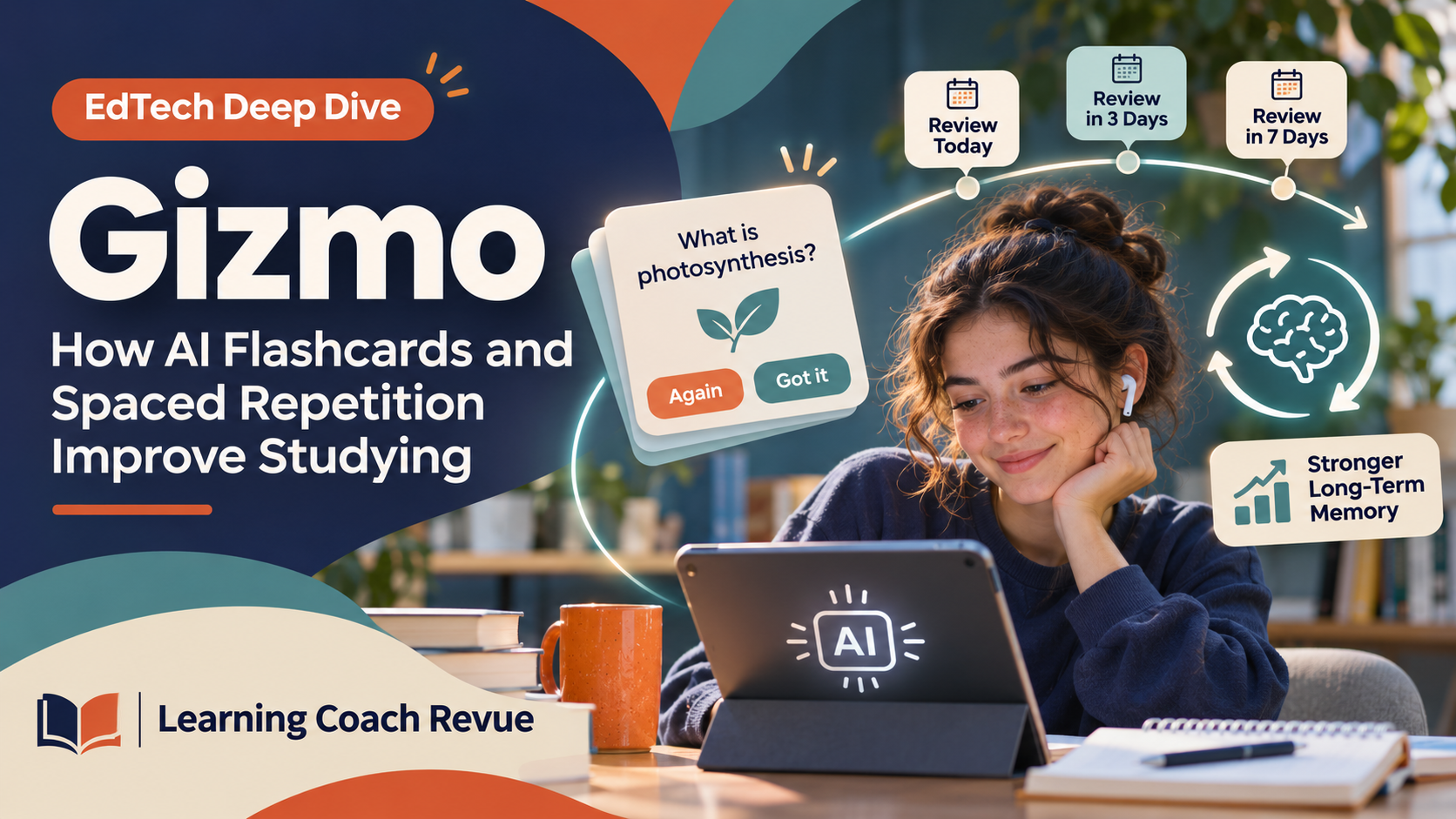
A London-based startup is using artificial intelligence to turn the material students already possess into interactive study sessions. Behind its colorful quizzes lies a serious educational proposition: make remembering a regular activity rather than an emergency before an exam. But the real test of Gizmo is whether its engaging experience produces knowledge that survives beyond the screen.
The difference between reading and remembering
A student can spend an entire evening revising a chapter and discover, the following morning, that very little of it is available without the textbook. The frustration is familiar. The pages seemed understandable, the highlighted definitions looked recognizable, and the hours spent studying felt productive. Yet when a question appeared without the familiar cues, the knowledge was difficult to retrieve.
The difficulty is not necessarily a lack of intelligence, motivation or commitment. Sometimes the learner has simply been practicing the wrong activity. Recognizing information while looking at it is different from reconstructing it when it is absent. The first can create a compelling feeling of familiarity; the second exposes what has actually been learned.
This distinction is at the heart of Gizmo, an educational technology company founded in London that builds AI-assisted flashcards, quizzes and tutoring experiences. Rather than asking students to find entirely new courses, it starts with their existing educational material and reorganizes the experience of studying it. The ambition is intriguing precisely because the ingredients are not entirely new. Flashcards predate smartphones, and distributed practice predates artificial intelligence. The innovation is in making these methods easier to begin, repeat and sustain.
Gizmo offers a useful case study in the future of AI in education: the machine can take responsibility for a portion of the administrative work of learning while the student retains responsibility for the cognitive work. That distinction is easy to state and surprisingly difficult to design into a product.
A British startup in the attention economy
Gizmo was founded in 2021 by three University of Cambridge graduates: Petros Christodoulou, Robin Jack and Paul Evangelou. The company's April 2026 funding announcement identifies them as CEO, CTO and CPO respectively. Its London headquarters and its roots in the British startup ecosystem make it a particularly interesting example of the consumer-oriented EdTech emerging alongside the country's exam-preparation platforms.
On April 15, 2026, Gizmo announced a $22 million Series A led by Shine Capital, with participation from Ada Ventures, Seek Investments, GSV and NFX, among others. NFX had led an earlier $3.5 million seed round. The company also reported that its platform had reached more than 13 million learners across over 120 countries. These are company-reported reach figures, not independently audited measures of active subscribers or learning gains. Tech.eu's coverage independently reported the funding announcement and the company's expansion plans.
The strategic interest of this financing is the decision to compete for students' attention directly. A great deal of educational software is purchased by institutions and then introduced to learners. Gizmo instead places the individual learner at the center of the experience, with a product that can follow them between school, home, university and the commute.
In the company's funding release, Christodoulou characterized the mission as pursuing “better screen time.” The idea deserves to be taken seriously without accepting every implication of the company's addiction-themed marketing. The modern student's telephone is simultaneously a library, a social space and an entertainment device. Educational tools cannot assume that the learner will abandon those competing experiences merely because studying is important.
What would happen if a small moment of available attention could reliably become a small moment of meaningful learning? Gizmo is betting that this transition can become almost effortless. The intellectual challenge is to remove the friction surrounding learning without removing the effort that makes learning possible.
From a document to an experience
The first obstacle: turning information into questions
Imagine a university student who has just completed a lecture on cardiovascular physiology. Their material may be scattered across a presentation, a notebook and a recording. Before they can practice recalling the subject, they must identify its essential concepts and write questions about them. For someone already behind on their coursework, the preparation of revision materials can consume the time available for revision itself.
According to Gizmo's Magic Import documentation, the application can transform supplied material into cards and identify words or phrases for later testing. Inputs described in the help center include documents and existing learning resources; the product overview also describes notes, YouTube links and lesson recordings. The mobile application listing describes importing existing Quizlet and Anki material as well as scanning notes.
This is an important change in the economics of student time. A student who already understands a topic can rapidly turn that understanding into practice opportunities. A student who struggles with organization can begin with a manageable deck instead of confronting a whole folder of unfinished material.
Yet the act of writing a question can itself be educational. Choosing the important information, finding an appropriate formulation and distinguishing an example from a definition require understanding. Automating card creation therefore removes both unproductive friction and potentially productive mental activity. The difference depends on what the learner does next.
A useful compromise is to treat generated cards as a first draft. After importing a chapter, the student inspects the cards, removes trivial or misleading questions and rewrites several difficult ones in their own words. The AI accelerates the mechanical transformation; the learner retains the editorial decisions. In this arrangement, creating a deck becomes a moment of comprehension rather than simply another automated task.
The second obstacle: choosing what to study next
The resulting deck is not merely a static collection. Gizmo's Memorise documentation describes a performance-sensitive review process: an incorrect response brings an item back earlier, while successful answers increase the interval before its next appearance.
The significance of this design becomes clearer when we consider a deck of one hundred cards. A student reviewing the entire deck every evening spends time on material they can already retrieve. A student choosing cards intuitively may skip precisely those items that are most uncomfortable. A scheduling mechanism offers a third possibility: concentrate effort according to the history of practice.
There is no need to assume that Gizmo's proprietary scheduling is the optimal algorithm. The available documentation explains its broad behavior, not the complete model, its parameters or a head-to-head evaluation against other scheduling systems. Its practical contribution is to relieve the learner of some planning decisions. The educational contribution depends on whether the selected questions genuinely measure what the learner needs to know.
The interface uses highlighted content as a basis for questioning, according to Gizmo's explanation of highlighting. This makes the quality of those selected elements especially consequential. A key technical term might be exactly the information worth retrieving. But a term extracted from an explanation cannot automatically represent the explanatory relationship surrounding it.
For instance, a student might reliably fill in “insulin” when asked which hormone reduces blood glucose, yet fail to explain why blood glucose regulation is disrupted in a particular clinical scenario. The first task is useful; the second requires a more developed mental model. A good study experience provides both.
When a card is not enough
Gizmo also documents an AI Tutor capable of explaining material, generating study resources and asking questions based on supplied content. This introduces a second layer of learning: when memorization is insufficient, the student can seek a more elaborate explanation.
The complementarity matters. A learner who cannot remember a concept may need another attempt at retrieval. A learner who repeatedly retrieves an incorrect explanation may need corrective teaching. A learner who has never understood the concept may need initial instruction before a flashcard has any meaningful value. These are different educational situations, even if the visible symptom is the same incorrect answer.
An AI tutor becomes particularly interesting when it can help a student identify the nature of that difficulty. It becomes less educational when it simply supplies a polished answer that is then accepted without examination. The strongest use of tutoring alongside flashcards is a cycle of explanation, attempt, correction and independent reconstruction.
Why remembering is an activity
Retrieval practice: testing as part of learning
In 2006, psychologists Henry Roediger III and Jeffrey Karpicke published Test-Enhanced Learning. College students worked with short prose passages; the researchers compared additional studying with opportunities to recall the material. On an immediate test, additional studying could be advantageous. On tests after two days or a week, the benefit shifted toward prior retrieval.
The striking implication is that an activity that feels less fluent during study can produce better performance later. A student who reads a passage again encounters words and ideas already laid out in front of them. A student trying to remember the same passage without looking must reconstruct the information.
This is the testing effect, not a recommendation for more high-stakes examinations. The test can be private, low pressure and formative. It is a learning event rather than a judgment of a learner's worth.
A later review by Karpicke (2021) examines retrieval as a mechanism for learning, including its application to educational contexts. In 2013, Dunlosky and colleagues evaluated ten common study strategies and identified practice testing and distributed practice as having particularly broad educational utility.
The classroom evidence is encouraging, too. Agarwal, Nunes and Blunt (2021) reviewed applied retrieval-practice studies and found benefits across varied educational settings, while noting limited geographical representation outside Western, educated, industrialized, rich and democratic populations. This limitation is relevant to a product with international ambitions: evidence from one educational context cannot automatically establish equal effectiveness across languages, curricula or access conditions.
The research explains why Gizmo's emphasis on answering questions is more educationally plausible than an app built entirely around passive summaries. It does not establish the magnitude of benefit produced by Gizmo itself.
Spacing: why time is part of the design
The second ingredient is temporal. Learning the same amount of information across several sessions is often more productive for long-term retention than concentrating the entire effort in one sitting. Cepeda and colleagues' 2006 quantitative synthesis examined distributed practice in verbal recall tasks and helped clarify how the interval between study episodes matters.
More recent applied research, including a 2025 meta-analysis of distributed practice in classrooms, brings this question closer to ordinary education. It is one thing to control the timing of repeated word lists in a laboratory and another to implement a schedule in a classroom with competing subjects, attendance patterns and curricular constraints.
The most useful insight is not that there is a universal moment just before forgetting at which every fact must be reviewed. Memory is affected by prior knowledge, difficulty, context, practice and the desired retention period. Forgetting is not governed by a single countdown identical for every learner and every item.
For an application, spacing becomes a practical approximation: use previous responses to determine which material warrants another encounter, then adjust as further information arrives. For a learner, the more accessible lesson is to leave time between attempts and return to knowledge after it has become less readily available.
A student preparing for an examination in four weeks can, for example, study a topic today and return to it over several days rather than postponing all review until the final evening. This is an illustrative routine, not a prescription for Gizmo's actual review intervals.
The right kind of difficulty
An important detail is that retrieval must be possible enough to be useful. Asking someone to remember an idea they have never encountered is not the same as retrieving knowledge from memory. Repeatedly presenting a confusing question without explanation is unlikely to transform confusion into expertise.
This is where feedback matters. Students benefit from knowing whether their reconstruction was accurate, and when it was not, they need access to the correct information. A sensible sequence is to attempt an answer, inspect feedback, explain the discrepancy, then try again after an interval.
AI can support all four operations, but it can also interfere with them. An answer shown too early can prevent the attempt. A vague question can reward guessing. An inaccurate explanation can consolidate an error. A system that treats successful recognition as successful independent recall can overestimate what the learner knows.
The most educational flashcard is not necessarily the most difficult one. It is the one that asks the learner to do the appropriate mental work at the appropriate moment.
The difference between memorizing words and learning a subject
Flashcards are sometimes dismissed as tools for rote learning. That criticism is justified when the questions demand isolated answers without meaning. It is less convincing when cards support the conceptual building blocks that more sophisticated thinking requires.
A biology learner cannot reason easily about natural selection if basic distinctions between variation, inheritance and differential reproduction are unavailable. A chemistry learner benefits from recalling common ions without having to consult a reference sheet every few seconds. A medical student needs a substantial vocabulary before meaningful clinical reasoning becomes possible.
But availability of knowledge is a beginning, not an endpoint. Consider the following illustrative progression of questions. These are editorial examples, not actual Gizmo-generated outputs.
| Type of practice | Example from biology | What a successful answer reveals |
|---|---|---|
| Factual recall | What is osmosis? | Availability of a definition |
| Explanation | Why does water move across a partially permeable membrane? | Understanding of the mechanism |
| Discrimination | How does osmosis differ from active transport? | Ability to distinguish concepts |
| Application | Predict what happens to a plant cell in a concentrated salt solution. Explain why. | Use of the concept in a new situation |
The progression illustrates a broader opportunity for AI-generated study material. Generative systems can potentially create multiple forms of questions about the same underlying idea. Instead of merely increasing the number of cards, they can help vary the kinds of thinking demanded. A deck of twenty carefully designed questions may reveal more than a deck of two hundred nearly identical prompts.
For mathematics, this means moving beyond the memorization of a formula to selecting and applying it in unfamiliar problems. For history, it means distinguishing dates from causal interpretations. In language learning, it means combining vocabulary retrieval with spontaneous production. For professional training, it means remembering a procedure and knowing when its use would be inappropriate.
The ultimate criterion is performance away from the app.
Making studying attractive without making it compulsive
Gizmo combines revision with the language and mechanics of consumer games. Its documentation describes an experience involving rewards, lives and social interaction. Gizmo Live allows learners to turn a deck into a multiplayer quiz. The company's home page and product materials emphasize the appeal of making study more entertaining.
There is a genuine opportunity here. Starting is often the most difficult part of studying. An activity that looks small and approachable may be easier to begin than an unstructured afternoon of revision. A social study session can make knowledge an object of shared attention rather than a private source of anxiety. Visible progress can help a learner notice improvement that would otherwise remain invisible.
The design tension appears when the game becomes more important than the learning. A streak is a record of attendance, not a direct measure of understanding. A leaderboard may privilege speed over thoughtful reasoning. Points may reward a student for repeatedly answering easy questions rather than confronting difficult misconceptions.
Gizmo's Hearts documentation describes a limited-life mechanism in Memorise mode. From a design perspective, this creates a particularly interesting tension: in learning science, errors are opportunities to obtain information about what remains uncertain, while in games, losing a life can be a penalty. A struggling learner may encounter the restriction more often than a confident one. Whether the mechanism supports or undermines persistence is an empirical question, not a conclusion that can be inferred from the feature alone.
A humane study product would ultimately make it possible to stop with a sense of accomplishment. The purpose of a revision session is to become more capable, not to maximize the number of minutes spent interacting with the platform. The strongest engagement metric may sometimes be the learner who no longer needs to open the app for a particular topic.
What the evidence establishes — and what remains unknown
The distinction between a sound educational principle and a proven commercial implementation is central to this dossier. Retrieval practice and spacing have a substantial research literature. Gizmo implements recognizable versions of these strategies. Its published product documentation and fundraising announcement describe a growing consumer offering.
These three observations do not establish a causal relationship between using the application and improved examination results.
The testimonials displayed on the Gizmo website are useful as examples of what some students say about the product. They are not controlled comparisons. Students who choose to publish enthusiastic experiences may differ from those who discontinue use. Their results can also reflect teaching, independent effort, previous knowledge and changes in study habits unrelated to the app.
In reviewing publicly available sources for this feature, Learning Coach Revue did not identify a robust, independent controlled study of the current Gizmo product demonstrating sustained improvements in delayed retention, transfer or examination grades. This is a statement about the evidence identified for this dossier, not proof that no such research exists.
An informative evaluation could recruit students preparing for the same unit and compare three study conditions: ordinary revision, manually prepared spaced flashcards and Gizmo-assisted spaced practice. The groups would work with equivalent content and similar available study time. An initial assessment could establish prior knowledge, followed by tests after several days and several weeks. The final assessment would include unfamiliar applications as well as recall. Engagement, dropout, preparation time and user experience could be recorded separately.
Such a study could distinguish several kinds of value. Perhaps the primary benefit of AI is time saved in preparing questions rather than an increase in learning per minute. Perhaps the main effect is that students return to their material more often. Perhaps different learners benefit from different features. All would be useful discoveries. None should be presumed before measurement.
The business of making revision easier
Gizmo operates a freemium consumer model. Its July 2026 Unlimited comparison describes free deck and card creation, with limits on certain study and AI features. Free users face a 20-minute interval between Magic Import operations and a 15-heart limit in Memorise. The paid option removes these restrictions and expands tutoring and hint access. Weekly and annual subscriptions are documented, with a possible student discount.
The precise local price and renewal terms should be checked in the relevant checkout before subscribing; this documentary review did not authenticate a purchase or verify a universal price. A free mobile listing is available through the App Store.
The model's attraction is straightforward. The student can experiment without a large initial commitment, while someone who studies intensively may value fewer interruptions. A weekly option fits a concentrated exam-preparation period, while an annual option serves a learner with ongoing needs.
But the economics of this service are inseparable from the educational design. AI processing creates costs. A subscription offers a way to finance those costs and continued product development. At the same time, restrictions imposed on free practice can affect who receives the benefit and how consistently they can study. For someone with a limited budget, the timing of an interruption is meaningful.
International reach also presents distinct challenges. A tool can accept source material from many educational systems without necessarily understanding every curriculum equally well. Language quality, local exam requirements, device access, connectivity and subscription affordability all influence the practical value of the product. The reported international user count does not resolve these questions.
Gizmo's expansion into the US college market, described in the funding announcement, is therefore more than a geographical opportunity. It is a test of whether the same core learning experience can adapt to substantially different educational routines, course structures and expectations of independent study.
Privacy, accuracy and responsible access
Any tool that accepts course documents and audio introduces responsibilities. Students should have permission to upload material and avoid including identifiable classmates, confidential records, patient information or restricted exam content. Lecture recordings can involve the rights and consent of other people. A document being available to a learner does not necessarily make its external processing appropriate.
The Gizmo privacy notice describes categories of information involved in using the service. The help center provides instructions for making decks private, including the need to adjust existing decks where relevant. A sharing setting is not equivalent to a complete guarantee about storage or processing by service providers. Institutional adoption requires examining the applicable terms and data handling arrangements.
The company's minimum-age policy states that the service is for users aged 13 and over. It is not an appropriate recommendation for younger children under that policy. For teenagers, families and schools may also wish to understand social features, sharing controls and subscription settings.
Accuracy presents an equally important responsibility. Generated questions can simplify an idea incorrectly, introduce an ambiguity or inherit a mistake from the original notes. Students should verify high-consequence information against reliable course material and authoritative references. This is especially important in medicine, law and other fields where a plausible error can have serious consequences.
Accessibility should likewise be examined rather than assumed. A mobile study interface might lower the barrier to practice for some learners, but timed interactions, visual emphasis, competitive features or connectivity needs may introduce barriers for others. No independent accessibility, security or model-accuracy audit was conducted for this article.
Beyond the Innovation: an intelligent relationship with forgetting
The next frontier for study technology may be less about generating content and more about helping learners understand their own knowledge.
Imagine a future version of a study system that asks the learner how confident they are before revealing whether an answer is correct. Over time, the student discovers a pattern: some topics feel familiar but cannot be reliably explained, while others feel difficult despite strong performance. The learner is no longer merely collecting correct responses; they are learning to judge their own understanding.
A confidence-calibration layer of this kind could connect retrieval practice with metacognition. It would require thoughtful interaction design to avoid adding too much friction and evaluation to establish whether the judgments become more accurate. This is an editorial possibility, not a description of an existing Gizmo feature.
Another possibility is to represent knowledge not just as separate cards but as relationships. If a learner can retrieve the components of a scientific process but cannot explain their connections, the system might identify the need for an explanation rather than scheduling yet another definition. A conceptual assessment layer could make a deck more useful for complex subjects, though reliably grading reasoning would be technically demanding and require appropriate safeguards.
There is also an intriguing role for the teacher. With the learner's permission and appropriate institutional arrangements, a carefully aggregated view of misconceptions could reveal which concepts require another classroom explanation. The objective would not be to monitor every minute of student activity but to inform teaching decisions. It would depend on trustworthy data, transparent consent and meaningful interpretation, rather than converting ordinary revision into continuous surveillance.
The most transformative possibility is a student who internalizes the method itself. After months of using a spaced practice system, they recognize when rereading is insufficient. They spontaneously test themselves. They plan revision across time. They ask better questions of their notes. They begin to separate confidence from evidence.
At that point, the benefit extends beyond the platform and even beyond the subject being studied. It becomes a portable learning competence.
Trying Gizmo as a learner, rather than as a spectator
The simplest way to explore the educational proposition is to start with one topic that matters, not an entire academic year. On Gizmo's official website, students can access the service and learn about its features.
A learner could import a short, permitted set of notes, verify the resulting cards and begin a short practice session. Instead of counting the number of cards completed, they could record which ideas they can explain without prompts. On subsequent days, they could return to the material and eventually answer a new question outside the application. This is an example of a personal study experiment, not a tested Gizmo protocol.
Teachers and learning coaches might invite eligible learners to compare their usual revision routine with this approach and discuss the results. A productive conversation would focus on whether the student understands what they know, notices errors, chooses effective strategies and becomes more autonomous.
For readers interested in the wider British landscape, Learning Coach's overview of UK EdTech companies offers additional context on AI-assisted study and assessment.
A better definition of progress
There is a quiet paradox in the future of educational technology. The most successful tools may ultimately become less necessary for the people they serve. A learner who has mastered a topic does not need endless reminders. A student who has learned to organize revision no longer needs someone to plan every session.
Gizmo's contribution is to make two powerful study practices easier to encounter in everyday life. Its open challenge is to ensure that the ease of beginning a session is matched by the quality of the thinking within it, and that attractive digital progress translates into useful knowledge beyond it.
Artificial intelligence can generate the question. It can schedule the next encounter. It can explain why an answer might be wrong. But the decisive moment remains the one in which a learner, without looking, reconstructs an idea and makes it their own.
That moment is not an inconvenience to be automated away. It is the reason for the technology.
Selected references and further reading
Gizmo. Official website; product overview; Magic Import; Memorise and spacing; Unlimited comparison.
Gizmo (2026, April 15). Series A funding announcement. Company release.
Djurickovic, T. (2026, April 15). Gizmo secures $22M Series A to advance AI-powered education. Tech.eu.
Roediger, H. L., III, & Karpicke, J. D. (2006). Test-enhanced learning: Taking memory tests improves long-term retention. Psychological Science, 17, 249–255.
Cepeda, N. J., Pashler, H., Vul, E., Wixted, J. T., & Rohrer, D. (2006). Distributed practice in verbal recall tasks: A review and quantitative synthesis. Psychological Bulletin, 132, 354–380.
Dunlosky, J., Rawson, K. A., Marsh, E. J., Nathan, M. J., & Willingham, D. T. (2013). Improving students' learning with effective learning techniques. Psychological Science in the Public Interest, 14, 4–58.
Karpicke, J. D. (2021). Practicing retrieval facilitates learning. Annual Review of Psychology, 72, 609–633.
Agarwal, P. K., Nunes, L. D., & Blunt, J. R. (2021). Retrieval practice consistently benefits student learning: A systematic review of applied research in schools and classrooms. Educational Psychology Review, 33, 1409–1453.
The distributed practice effect on classroom learning: A meta-analytic review of applied research (2025). Behavioral Sciences, 15, 771.

