
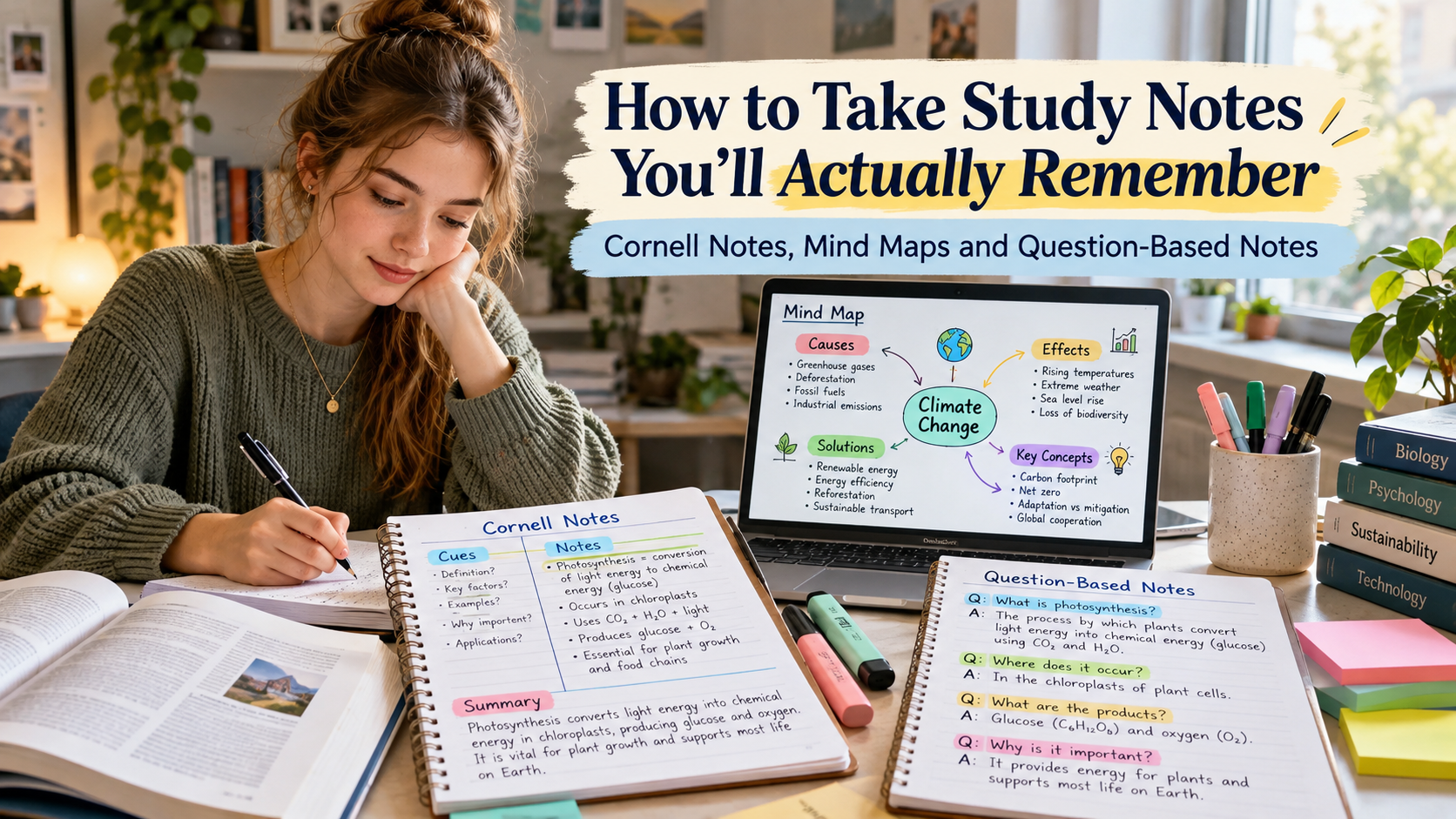
How to Take Study Notes You'll Actually Remember: Cornell Notes, Mind Maps and Question-Based Notes
A familiar scene unfolds in classrooms and libraries everywhere. A student listens carefully, fills several pages with neat handwriting, highlights the textbook, and goes home with an impressive collection of material. A few days later, the notes are still beautiful—but the student cannot explain the central idea without opening them.
What went wrong? The notes captured information. They did not necessarily become a way to learn it.
How do you take study notes you will actually remember? Capture the essential meaning during a lesson or reading, organize it so the relationships are clear, and then transform it into questions or tasks that you can answer without looking at the notes. Check your responses, correct what you missed, and return after a delay.
The most useful note-taking system is not necessarily the prettiest or the one recommended by a productivity influencer. It is the one that fits the content and helps you perform the task your course requires.
This guide compares three practical approaches: Cornell notes, mind and concept maps, and question-based notes. You'll learn how to build each one, when to use it, how to decide between handwriting and typing, and how to convert a single page into a meaningful study session.
The goal is not to turn every lesson into more paperwork. It is to make your notes a bridge from information you recorded to knowledge you can explain, retrieve, and use independently.
Why taking lots of notes doesn't guarantee remembering
Note-taking can serve two different purposes.
First, it creates an external record. You can return to details, definitions, examples, references, and questions that might otherwise disappear from your working memory.
Second, the act of taking notes can help you process what you are hearing or reading. To do this well, you must decide what matters, connect ideas, interpret explanations, and notice uncertainty.
Those purposes are related, but they are not identical. A transcript may preserve nearly every sentence while demanding little selection or organization. A short, thoughtful set of questions may preserve fewer words but create better opportunities to check understanding later.
The Australian National University's Academic Skills guidance recommends treating notes as more than a record of content: students should engage critically with the material and develop a system suited to the discipline and task.
Research also warns against declaring that notes, summaries, and active learning are always interchangeable. In a 2017 experimental study, Rummer and colleagues compared repeated note-taking, restudying, and retrieval-based activities. The relative outcomes changed with the delay before testing; after two weeks, conditions including testing supported stronger delayed learning than notes followed only by rereading in the comparisons examined. The researchers did not show that note-taking is worthless. Their work helps explain why capturing information should be followed by opportunities to retrieve it. Read the study abstract.
A useful note therefore has two jobs: help you make sense of the content now, and help you study it later.
The essential difference: collecting notes versus learning from notes
Consider two ways of recording the same biology lesson.
Recording-only notes: “Diffusion is the net movement of particles from a region of higher concentration to a region of lower concentration.”
That statement may be accurate and worth keeping. But by itself, it tells you little about whether the student understands concentration, can distinguish diffusion from related processes, or can use the idea in a new situation.
Learning-ready notes: “Diffusion: net movement down a concentration gradient. Why doesn't this require the same process as active transport? Draw an example and predict what changes if the gradient disappears.”
Now the note contains a definition, a distinction, and a question. The student still needs to attempt and check the answer; writing a question is not the same as knowing it. But the notes now offer an immediate path into meaningful revision.
Try this test with one page of your own notes:
Can you identify the three or four claims that matter most?
Can you see how the ideas relate?
Do the notes tell you what you still do not understand?
Could you cover the answers and test yourself?
Would the notes help you solve a changed question, not just repeat the lecture?
If most answers are no, you may not need a different notebook. You may need to change what you do with the page after class.
Cornell notes: how to take notes that become revision questions
The Cornell note-taking system divides a page into a large main-notes area, a narrower column for questions or cues, and a summary area at the bottom. It was developed by Cornell professor Walter Pauk and is taught by university learning-support services.
Cornell University's Learning Strategies Center describes a process of recording essential points, adding questions, reciting from the cues with the notes covered, reflecting, and reviewing over time. Stanford's Center for Teaching and Learning presents a similar question-and-cue approach.
This method is especially convenient when a lecture follows a sequence of ideas or a textbook chapter has identifiable concepts and supporting details.
How to set up a Cornell notes page
Draw a vertical line so that the left section is roughly one-quarter to one-third of the page. Reserve a small strip along the bottom for a summary.
Main notes area: During class or reading, record important explanations, examples, terms, evidence, and unresolved questions. Use concise wording rather than a word-for-word transcript.
Cues and questions area: After the lesson, write prompts that point to the main ideas. These may be factual, conceptual, or applied questions.
Summary area: Write two or three sentences explaining the big point of the page in your own words. If you cannot summarize it accurately, this may signal a need to revisit the explanation or ask for help.
The page becomes most useful after you close or cover the main notes and attempt the questions without looking.
A complete Cornell notes example: photosynthesis
Imagine that the lesson concerns factors affecting the rate of photosynthesis.
| Cues and questions — left | Main notes — right |
|---|---|
| What does photosynthesis produce? | Plants use light energy to produce sugars from carbon dioxide and water; oxygen is released in the commonly taught overall process. |
| Why can light become a limiting factor? | At low light intensity, insufficient light may constrain the rate. Increasing light can increase the rate until some other factor becomes limiting. |
| What if carbon dioxide is scarce? | More light may not increase the rate substantially if carbon dioxide availability restricts the process. |
| How would I recognize a plateau on a graph? | A plateau indicates that increasing the x-axis variable no longer changes the measured rate appreciably within the observed range; interpretation depends on the experimental conditions. |
Bottom-of-page summary: “Photosynthesis depends on several conditions. Increasing one factor may raise the rate only until another factor limits it. A graph helps show the relationship but must be interpreted in context.”
To study this page, cover the right-hand column. Answer the questions aloud or in writing. Then check the accuracy of your answers. A few days later, try a new graph or an unfamiliar example.
The key improvement is the sequence from notes to self-questioning to feedback, not the exact width of each column.
Cornell notes mistakes to avoid
Do not spend so much of the live lesson measuring columns and decorating headings that you miss the explanation. A quick digital table or pre-ruled notebook can be enough.
Do not turn the left column into a list of vague labels such as “photosynthesis,” “light,” and “graphs” if those cues are too broad to provoke a useful answer. A question like “Why does the rate stop increasing?” creates a clearer task.
Do not assume that a completed summary proves understanding. Verify your summary, especially when the content is unfamiliar or technical.
Finally, do not reread the right-hand column while claiming to have tested your memory. Cover it first, attempt an answer, and only then check.
Mind maps and concept maps: use relationships, not decoration
A mind map usually begins with a central topic and branches outward to related themes. A concept map typically makes relationships between concepts more explicit, sometimes using linking phrases such as “causes,” “depends on,” or “is evidence for.”
These formats overlap in practice, but they are not exactly the same. Concept-map research should not be treated as automatic proof that every colorful radial mind map improves grades.
Maps can be particularly useful when the learning objective involves systems, hierarchies, comparisons, cause-and-effect relationships, or connections among multiple ideas.
In a 2006 meta-analysis, Nesbit and Adesope reviewed studies of node-link concept and knowledge maps across school and postsecondary contexts. Across the studies examined, maps were associated with improved knowledge retention, although effects varied considerably by how maps were used and by the comparison condition. Read the meta-analysis.
That research supports the promise of meaningful mapping activities. It does not establish that the most intricate diagram, the most colors, or the most branches necessarily produces the best learning.
How to build a useful map in five moves
1. Choose a question, not just a decorative title. “What factors shaped the Industrial Revolution?” is more useful than simply writing “Industrial Revolution” inside a circle.
2. Identify essential concepts. Include the few major mechanisms, events, categories, or ideas you need to understand.
3. Draw genuine relationships. Label the connections when possible. “Steam power → changed → factory production” is clearer than an unlabeled arrow between two boxes.
4. Include evidence, examples, and limitations. A claim that “urbanization caused factory work” is too simplistic if the course emphasizes several interacting processes; add the specific relationship and conditions.
5. Rebuild or explain the map with the original hidden. This final action reveals whether you remember the relationships, rather than merely recognizing a finished diagram.
A map can start small. Five accurate connections you can explain are more useful than forty attractive branches you cannot justify.
Mind map example: causes and consequences in history
Suppose you are studying the expansion of industrial production. A central node could be Industrialization.
One branch contains technological change, with examples such as mechanization and new sources of power.
A second contains economic organization, with investment, factories, and labor patterns.
A third contains demographic and social changes, including urbanization and changing working conditions.
The crucial step is labeling connections. Rather than placing “urbanization” near “factories,” ask: “How did employment opportunities and migration interact?” “What evidence would show the direction of this relationship?” “Which country or time period does this explanation describe?”
After studying the completed map, hide it. Draw the main branches from memory and explain two links. Then use a new essay question to see whether the framework helps you construct an argument.
When a mind map is the wrong first choice
If the topic is a narrow mathematical procedure, a carefully explained worked example may be more immediately useful than a sprawling radial diagram.
If you are learning unfamiliar terminology with no understanding of the relationships, you may first need instruction before you can build a reliable map.
If the assignment requires an evidence-based essay, mapping can help plan an argument, but it does not replace writing and evaluating the argument.
Use a map when the relationships are the learning target. Use another method when the target is a different kind of performance.
Question-based notes: turn any chapter into a study tool
Question-based notes start from a simple idea: Write prompts that make the important knowledge retrievable and usable.
Instead of organizing every paragraph by what the teacher said, organize the page partly by what the learner should be able to answer.
This does not require a special proprietary system. You can place questions in the margin, turn headings into questions, or maintain a two-column digital document.
The scientific rationale has limits but is useful. In a 2020 experiment reported by Ponce and colleagues, fourth-grade students who answered structured questions or used a graphic organizer after reading outperformed a read-only comparison group on the comprehension and memory measures examined. A generic note-taking condition did not show the same statistically significant advantage in that study. Read the ERIC research summary.
Those findings concern particular learners and tasks; they do not prove that every self-written question outperforms every possible note-taking strategy. They do illustrate why an activity requiring students to connect, explain, or answer can be meaningfully different from copying.
Four kinds of study questions to write in your notes
Recall: “What are the three main stages?” This checks essential terminology or sequence.
Explain: “Why does increasing this factor change the outcome?” This checks causal or conceptual understanding.
Distinguish: “How is this process different from the similar one?” This checks whether you recognize a decisive feature.
Apply: “What would happen in a new case, and how would I justify the answer?” This checks whether the knowledge can be used beyond the original example.
You do not have to write all four for every paragraph. Match the prompts to the assessment.
Question-based notes example: mathematics
Suppose a student has just learned to solve equations of the form 3(x + 2) = 18.
A weak note contains only the correct steps copied from the board.
A stronger page keeps the worked solution and adds:
What does it mean to keep both sides of an equation equal?
Why can I divide both sides by three here?
Can I solve the same problem by expanding the brackets first?
How can I check the final value?
What changes in 5(x − 1) = 20?
The answers still need independent checking. For the first equation, the solution is x = 4. For the second, x = 5. Explaining why the operations preserve equality is more useful than simply remembering that “the next step is divide.”
Question-based notes example: literature
Suppose the lesson examines a character's decision in a novel. Instead of listing quotations alone, write:
What does this decision reveal about the character's priorities?
Which short passage supports that interpretation?
What alternative interpretation might another reader defend?
How does the context change the meaning of the evidence?
These questions transform notes into preparation for close reading and argument. If your exam requires a written response, go one step further: produce a paragraph and compare it with the actual rubric.
Question-based notes example: learning a language
If you are studying a new tense, ask:
When does this structure communicate the intended meaning?
Which time expressions often appear with it?
Can I form an original sentence?
Can I choose between two structures in a conversation without being told which one to use?
The questions support grammar choice, but conversation and listening practice are still needed if those are the real learning objectives.
Cornell notes vs. mind maps vs. question-based notes: which is best?
There is no universal winner. A practical choice depends on the structure of the material and the action you need to perform later.
| Approach | Most useful when… | Potential weakness | Best follow-up action |
|---|---|---|---|
| Cornell notes | Lectures or chapters have main ideas and supporting detail | Students may fill sections mechanically without meaningful questions | Cover the notes, answer cues, check, and return later |
| Mind or concept maps | Relationships, categories, systems, and comparisons matter | Decorative branches may replace accurate explanations | Reconstruct the map and explain each key connection |
| Question-based notes | Exam questions, explanations and application are central | Questions may be too easy or contain incorrect assumptions | Answer without prompts from the source, verify, and revise questions |
| Worked-example notes | Students are first learning a mathematical or technical procedure | Copying steps can create an illusion of competence | Explain the reasoning and solve a changed problem independently |
This is a Study Note Selector devised for this guide, not a psychometrically validated decision tool. It offers a reasonable choice based on the learning goal.
One lesson can combine methods. You might take Cornell notes during a lecture, create a small concept map afterward, and finish with three questions that test what the map means. Use that combination when it adds value—not because having multiple formats is automatically superior.
Paper notes or digital notes: what does the research say?
The handwriting-versus-typing debate is more complicated than “paper good, laptop bad.”
A 2024 meta-analysis by Flanigan and colleagues synthesized 24 studies from 21 articles involving college students. It found a small overall achievement advantage for taking and reviewing handwritten lecture notes, while typed notes offered a substantial advantage in the amount of information recorded. These are averages from particular study designs, not a universal prediction for each student or an instruction to reject accessible technology. Read the meta-analysis.
Earlier research on laptops attracted attention because typing can encourage verbatim transcription. However, a published direct replication of a widely cited experiment reported that the evidence did not support a clear advantage for handwriting in immediate learning through encoding alone. Read the replication abstract.
Both points can be true: the findings depend on the study design, whether students can review their notes, the time before testing, and what is measured.
There are also practical considerations. Typing may be more accessible or sustainable for some learners. Digital notes are searchable, may support assistive technologies, can integrate course materials, and may be easier to edit. Handwriting can slow down transcription in a way that encourages some students to select ideas and draw relationships. Either medium can be used poorly.
The stronger question is: Does your chosen medium help you understand the lesson, organize accurate information, ask good questions, and retrieve it later?
How to take better notes on a laptop
Use a simple heading for each major idea. Summarize rather than trying to capture every sentence verbatim. Add a cue or question beneath each section.
At the end of the lecture, hide your screen or close the document and explain the most important idea from memory. Open it to check accuracy. If distractions are a problem, use a distraction-reduced setup or an approved focus mode.
If you use accessibility tools or require typed notes, keep them. An evidence-based approach should improve learning without creating unnecessary barriers.
What if the teacher speaks too fast for any note-taking method?
Sometimes a student cannot both listen and write everything down. That is not necessarily a failure of discipline.
Prioritize the learning objective, the main explanation, a representative example, and any uncertainty you need to resolve. Use shorthand you can understand later, and leave blank spaces for details you missed.
Where permitted, consult lecture slides, course notes, a shared recording or a classmate's notes after the session to check omissions. Ask the teacher for clarification on essential points.
Do not attempt to transcribe every word if that causes you to miss the logic of the lesson. Princeton University's McGraw Center recommends focusing on central ideas, examples and relevant details rather than copying the entire lecture.
If the material moves too quickly because of an accessibility or learning-support need, appropriate school or university support may be necessary. A note template is not a substitute for those arrangements.
How to take notes from a textbook without copying the whole chapter
Textbook note-taking creates a different challenge. The information stays on the page, so students may copy extensively because it feels safe and thorough.
Try a three-pass routine.
Pass 1 — Orient. Look at the chapter title, learning goals, headings, figures and end-of-chapter questions. Ask what the text seems designed to teach.
Pass 2 — Read and select. Read one manageable section carefully. Identify the main claim, a few essential supporting details, a relationship, and anything that remains unclear. Write notes after understanding the section rather than transcribing while constantly looking at it.
Pass 3 — Convert. Turn the most important points into questions or a small map, then close the source and attempt a response.
For a 12-page chapter, this does not mean creating 12 pages of notes. The aim is to preserve what you need for future learning and practice.
If your course includes primary sources, complex proofs, or specialized notation, keep sufficient accurate detail. Concision is useful only when it does not destroy essential meaning.
How to take notes from a video or online course
Videos make it easy to confuse watching with learning. You can replay sections, pause, change speed, or use captions, but none of these actions automatically tells you what you understood.
Before pressing play, choose one or two questions you want the video to answer.
While watching, pause at meaningful transitions rather than after every sentence. Write the central idea in your own words and record a timestamp for an important example you may need to revisit.
Afterward, close the video and produce an answer or explanation. Reopen the relevant portion to check only when you need to.
A useful video note might read: “6:20 — why a limiting factor produces a plateau. Can I explain the graph without copying the narration?”
A weak video note might be only a link and a star emoji. The latter organizes a resource but provides little evidence of learning.
The Capture–Convert–Check routine: transform a page in ten minutes
Here is a practical workflow you can use whether your initial notes are written, typed, mapped, or recorded through an accessibility tool.
The Capture–Convert–Check routine is an original planning aid for this article. Its ten-minute timing is illustrative, not a scientifically established dose or validated intervention.
1. Capture: keep an accurate, useful record
Review one page or one important lesson section. Correct missing details using your course materials. Identify the main idea and a useful example.
Do not spend these minutes redecorating or rewriting everything. This is a quality check, not another full transcription.
2. Convert: write prompts that match the learning goal
Generate two or three questions.
At least one should go beyond a definition when the course demands explanation or application. Examples include “Why does this mechanism operate?” “Which source supports the claim?” or “How would I solve a new version of this problem?”
If a map is better suited to the lesson, identify two essential connections you must be able to explain.
3. Check: attempt first, verify second
Hide the source and answer the questions. Compare with accurate notes, teacher materials or a marking rubric. Record what was missing.
Then decide what deserves another review later. A correct answer today does not prove you will remember it next month, so plan a delayed check when long-term retention matters.
The educational cycle is:
Notes → meaningful question or connection → independent attempt → feedback → later return.
That sequence is more useful than measuring your learning by how full the notebook looks.
A ready-to-use question-based notes template
Copy this small structure into your notebook or notes app. It can accompany Cornell notes, a concept map, or ordinary lecture notes.
| Field | Write this | Example: ecology lesson |
|---|---|---|
| Learning target | What must I be able to explain or do? | Predict what could happen when a food-web population changes |
| Main idea | One accurate statement or relationship | Populations interact through feeding and other ecological relationships |
| Evidence or example | A relevant fact, graph, source or worked illustration | Course data showing a predator–prey trend |
| Question 1: recall | What must I remember? | What is a food web? |
| Question 2: explain | What relationship must I explain? | Why might changes in one population affect others? |
| Question 3: apply | How will I test this in a new situation? | Predict an effect of removing one species and identify limitations |
| Uncertainty | What do I need clarified? | Is this relationship direct or mediated by other populations? |
| Next check | When and how will I retrieve it again? | Answer one changed food-web question after a delay |
The template is intentionally modest. You can use one row for a short lesson or expand it for a complex chapter. The questions should be judged by accuracy and relevance to the actual curriculum, not by how many boxes are filled.
Good study questions versus weak study questions
Question quality matters. Consider these contrasts.
Weak: “What is biology?”
Stronger: “How would changing the water available to a cell affect movement across its membrane, and what assumptions are needed?”
Weak: “What is the French Revolution?”
Stronger: “Which economic and political pressures interacted in the period under study, and what evidence supports their relative importance?”
Weak: “What is a quadratic equation?”
Stronger: “How can I recognize a quadratic equation from its structure, and when should I use factoring rather than another solving method?”
Weak: “What is the past tense?”
Stronger: “Which past form fits this communicative context, and why does the meaning change if I choose the other one?”
These are examples of task alignment, not a claim that recall questions are useless. You need simple factual questions when the information itself must be retrieved. The next step is to add the explanation, distinction, or application required by your actual learning goal.
Which note-taking method works for math, science, history and languages?
Math: record reasoning, not just final answers
Keep one accurate worked example, an explanation of why each step is valid, a common error, and a fresh problem to solve.
Cornell cues can ask “Why does this step preserve equality?” A concept map may help show how formulas relate, but the actual test must include independent problem solving.
A student's note becomes more useful when it distinguishes when to choose a method from how to execute the method.
Science: use mechanisms and labeled relationships
Use a map or diagram when the content involves interacting systems. Label arrows with meaningful relationships and write questions that ask for predictions.
A page containing the terms diffusion, osmosis, and active transport might include a comparison question: “Which process needs energy input, and under what conditions?” Follow it with a scenario and feedback.
Where possible, practice interpreting data or unfamiliar diagrams. Science assessments may require evidence-based conclusions, not only definitions.
History: connect chronology, context and evidence
Use concise Cornell notes to record events and source details. A concept map can show causes, consequences and competing interpretations.
Create questions such as: “Who produced this document, when, and for what purpose?” “What does it support?” and “What evidence would challenge this interpretation?”
Keep relevant quotations and references accurate. An imaginative mind map should not quietly replace historical evidence with assumptions.
Languages: combine concise notes with actual use
Record vocabulary and grammar explanations accurately, then create prompts for original sentences and conversations.
A question-based note can ask: “How do I request this politely?” or “What changes if I describe a completed action rather than a habitual one?”
Return to the vocabulary after a delay, but also practice listening and speaking if those are your goals. An impressive notebook does not by itself create conversational fluency.
Can you combine Cornell notes with a mind map?
Yes. A particularly useful combination is to use Cornell notes for capturing a sequence and a small concept map for reconstructing a system.
Suppose you are studying climate systems.
During class, record definitions, explanations, data sources and teacher examples in the main Cornell notes column. After class, write three cue questions. Then create a compact map showing a few key interactions, explicitly labeling the relationships.
Finally, put both materials away and answer a new question about how one factor could influence another. Check against course materials.
The combined output matters only if the learner can explain and use it. Two beautiful formats that duplicate each other's content may simply increase workload.
How often should you review study notes?
The amount and timing depend on your purpose. If the goal is next week's quiz, you need meaningful opportunities before then. If the knowledge is central to a semester-long course, plan returns over a longer period.
The evidence for distributed practice and retrieval practice is stronger than any claim that every student's notes must be reviewed at a specific hour or on one fixed series of dates. The Dunlosky and colleagues evidence review is a useful starting point.
A simple routine is to convert notes into questions soon after the lesson, attempt some questions later, and return again after a delay. If you repeatedly miss an item, first make sure you understand it correctly and then schedule another attempt.
Do not treat a review calendar as proof that learning happened. What matters is whether you can answer, explain, solve, or apply after time has passed.
When note-taking becomes a form of procrastination
It can feel productive to rewrite an entire chapter in beautiful handwriting, recopy headings in different colors, and design a new digital dashboard each week. Organization has a purpose, but it can also become a way to postpone the uncomfortable task of answering questions independently.
Ask yourself: “What would I be able to do after these two hours that I could not do before?”
If the answer is “my notebook looks better,” examine whether that was the real need. Perhaps your original notes were genuinely unreadable or incomplete; correcting them would be worthwhile. But if the information was already clear, the next step may be retrieval, application, a practice problem, or feedback.
A concise note plus a checked independent answer is often more informative than three rounds of copying the same material.
Should you use AI to summarize your notes?
AI tools can assist with organization, accessibility, proofreading and question generation. For example, an approved assistant might turn your own lecture headings into a blank Cornell template or propose possible quiz prompts.
But AI-generated notes have two important limitations.
Accuracy: A model may omit qualifications, invent a citation, alter a mathematical relationship, or state a misleading simplification. Verify any consequential claim against reliable course materials.
Ownership of learning: If a tool produces the summary, connections and final answers without your involvement, you may receive polished notes without practicing the thinking needed to understand them.
A better workflow is to write an initial explanation yourself, ask for feedback or possible missing questions, verify the suggestions, and then answer those questions without the tool's response displayed.
For example:
“Here are my notes on diffusion. Suggest four possible self-test questions: one factual, one causal, one comparison, and one application. Do not answer them. Flag any question that may depend on missing or ambiguous information so I can verify it with my textbook.”
Do not upload private information about students or unapproved copyrighted course materials to a tool your school or institution has not authorized.
Digital assistance should help you take ownership of learning, not conceal the absence of understanding.
How teachers and parents can help students take useful notes
Teachers can model how an expert decides what is important. During one short explanation, show which detail belongs in notes, which example clarifies it, and which question would test it later.
Instead of requiring every student to copy an identical full-page summary, offer some choice where appropriate: Cornell cues for a lecture, a map for relationships, or question-based prompts for a performance task.
Gradually reduce scaffolding as students become more capable. A student who initially needs help distinguishing central ideas from minor details can later practice making that decision independently.
Parents can ask, “What question could you answer from that page without opening it?” or “Can you explain the connection between these two ideas?” This creates an opportunity for reflection without turning the evening into a prolonged interrogation.
Do not use the neatness, handwriting, or decorative appearance of notes as a proxy for a child's intelligence or learning ability. Check whether the student can use the ideas with appropriate support and feedback.
Professionals interested in helping learners develop effective study strategies and autonomy can explore the official Learning Coach training pathways. That pathway is a professional learning opportunity, not a claim that one branded note format guarantees academic success.
The Learning Coach English books catalogue, including You Were Never Taught How to Learn, offers additional reading on independent learning. It is supplementary material rather than the source of the scientific claims in this article.
A seven-day plan to turn better notes into real learning
This is an illustrative starter plan. It is not a validated seven-day treatment or a guarantee of better exam results.
Day 1 — Choose one real lesson. Take concise notes using your preferred medium. Identify the learning objective and the most important relationships.
Day 2 — Convert the notes. Add three useful questions or a small map with clearly explained links. Correct any factual gaps.
Day 3 — Retrieve without the page. Answer the questions or reconstruct the map from memory. Check accurately and mark uncertainties.
Day 4 — Apply the idea. Solve one new problem, interpret a changed graph, defend a different historical claim, or produce a new language response.
Day 5 — Repair the weakest link. Return to a trustworthy explanation, obtain feedback, and revise only what was inaccurate or incomplete.
Day 6 — Repeat with another lesson. Try a different format if the new task calls for it. Do not switch merely because novelty is enjoyable.
Day 7 — Reflect and plan. Which notes were easiest to turn into meaningful answers? Which required extensive correction? Which content needs another spaced review?
The outcome to track is what you can remember, explain and use, not how many pages you produced.
Frequently asked questions
What is the best note-taking method for studying?
There is no single best method for every subject and task. Cornell notes can organize sequential lectures and self-test cues; concept maps help make relationships explicit; question-based notes align study material with what you need to answer. Choose based on learning objectives, accuracy, and the quality of later practice.
Are Cornell notes better than regular notes?
Cornell notes provide a practical structure for organizing concepts, cues and summaries. The research base does not justify claiming that their page layout automatically outperforms every other note format. The potential advantage depends partly on whether students actually use the cues to explain and retrieve learning.
Are mind maps good for memorizing?
Concept and knowledge maps have evidence supporting learning and retention in several research contexts. But the studies concern specific types of mapping activities, and their findings do not prove that any colorful radial mind map is superior to other methods. Reconstructing and explaining the links matters.
Should I rewrite my notes after class?
Rewrite only when you need to correct, clarify or reorganize something important. If the notes are already usable, generating questions and checking independent answers may offer a better next step than copying the same sentences again.
Is it better to type or handwrite study notes?
A 2024 meta-analysis found an overall advantage for handwritten lecture notes on certain achievement measures among college students, while typing produced more recorded content. Other studies, including a direct replication of an influential experiment, complicate sweeping claims about immediate learning. Choose an accessible medium and use it actively.
How many notes should I take from one chapter?
As many as needed to preserve the essential ideas, supporting details and unresolved questions accurately—but not necessarily a page of notes for every page of text. The correct amount depends on the subject, purpose and complexity.
Can I study only from my notes?
That depends on whether they are accurate and comprehensive enough for your learning goals. Some tasks also require original sources, textbooks, practice problems, primary documents, listening materials or teacher feedback. A note collection is an aid to learning, not always a replacement for the course.
Should my notes be questions rather than statements?
Keep statements when accurate explanations, formulas, evidence or examples are needed. Add questions that let you test whether you can use the statements independently. In many cases, a combination is more useful than either alone.
How can I remember notes for exams?
Convert the most important ideas into retrieval questions or representative tasks; attempt them without looking; check against correct answers; and return after a delay. Match the task to the exam's demands rather than relying on familiarity with the page.
Can a note-taking app improve my grades?
An app may help you store, organize, search, and review materials. It does not guarantee better grades. The learning benefit depends on the quality of your understanding, practice, feedback, and assessment alignment, as well as access and usability.
Notes should be a starting point, not the finish line
There is nothing wrong with enjoying a well-organized notebook. Clear notes can help you find information and make sense of a complicated lesson.
But the real measure of their value appears after the page is closed.
Can you recall the central idea? Can you explain the relationship shown by a diagram? Can you answer a new question? Can you recognize what remains uncertain and decide what to work on next?
You do not need to adopt all three methods at once. Begin with one lesson. Take enough notes to preserve its meaning. Add one or two strong questions. Attempt an answer without looking. Check the result and plan a return.
Over time, your notes can become less like a warehouse of sentences and more like a tool for independent thinking.
Take notes to understand. Turn notes into questions to learn. Close them to discover what you know.
