
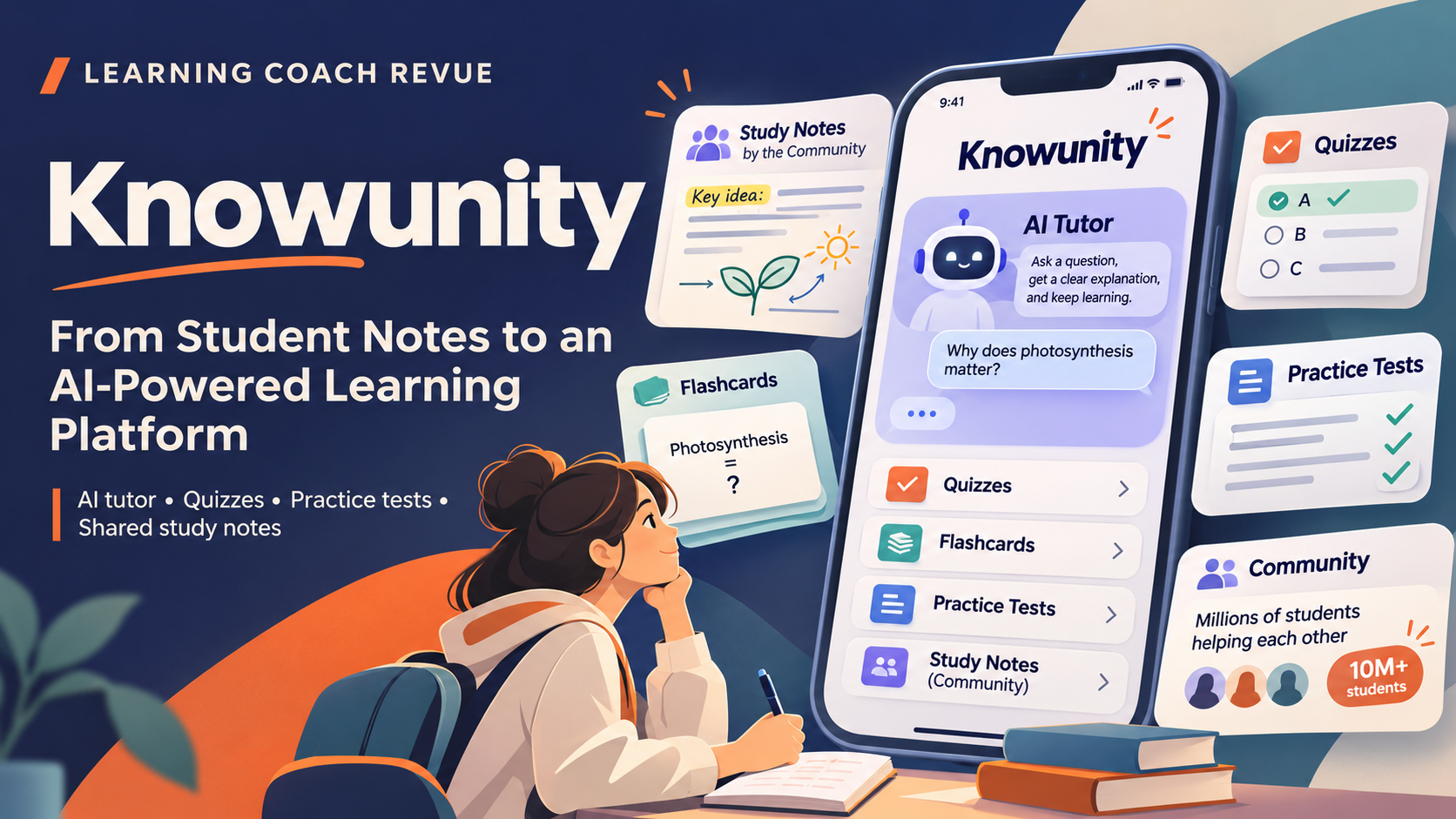
A generation of students grew up with the world's information in its pockets, yet still found itself facing an ancient problem: how to turn information into knowledge it could use alone. Knowunity began by taking seriously the explanations students were already producing for one another. Today, the German-born platform is combining that collective intelligence with artificial intelligence, seeking to make individual study support available at a scale previously reserved for digital entertainment. Its evolution raises a deeper question than whether a machine can explain a lesson: can an intelligent companion help young people become better at learning without it?
When the best explanation comes from the desk next to yours
Consider a familiar situation. A student has understood most of a biology lesson but cannot explain why the processes of photosynthesis and cellular respiration are related. The textbook supplies the definitions. A search engine returns numerous pages. A friend, who recently overcame the same confusion, draws two arrows and explains where the energy comes from and where it goes. The explanation is not necessarily more scientifically complete than the textbook. It is simply closer to the learner's immediate obstacle.
The example is illustrative, not a reported classroom encounter. It reveals a distinctive educational resource: proximity between the person who understands and the person who is trying to understand. Someone who has just learned a concept may remember the question that made it difficult, the misleading analogy that caused confusion, or the small conceptual distinction that finally made everything coherent.
Schools have always benefited from such exchanges. They usually remain local, however. Notes circulate within a class, a useful diagram is shared in a group chat, and an explanation disappears after the examination. The opportunity behind Knowunity was to turn these ephemeral exchanges into a searchable and reusable resource.
The company did not initially need generative AI to see that opportunity. Its starting point was a social problem rather than a technological one: much of the help students already provide to each other is invisible to the wider education system.
Born inside the world it sought to improve
Knowunity emerged in Sindelfingen, near Stuttgart, and is now based in Berlin. Its founders were still in secondary school when they began developing the project. Early reporting identifies Benedict Kurz, Lucas Hild, Gregor Weber, Julian Prigl and Yannik Prigl as the original team. Accounts differ slightly on the founding year: some place the beginning in 2019, while other descriptions refer to the public launch and early company development in 2020. The distinction matters less than the fact that the product was conceived from within the population it intended to serve. A 2025 founder interview and early German reporting document those origins.
Rather than attempting to reproduce a complete school curriculum from scratch, the founders built an environment where students could publish learning materials, find resources suited to their own needs and benefit from the contributions of others. It was an inversion of the usual direction of educational publishing. The learner was no longer only the destination of a resource but also one of its possible authors.
In 2022, investor redalpine reported a €10 million Series A and more than 2.4 million users. That early expansion suggested that the appeal of the concept extended beyond the founders' immediate surroundings. It did not, in itself, establish that students learned more effectively.
The next stage was to make the accumulated resources more responsive to individual needs. By June 2025, Knowunity had announced a €27 million Series B led by XAnge. Tech.eu's reporting placed total funding at €45 million and relayed the company's figures of more than 20 million users across 15 countries. These are dated adoption and financing figures, not audited measures of learning or present-day active users.
The trajectory illustrates an unusual transition in EdTech: a social platform becoming an intelligent study environment. The arrival of generative AI did not erase its original proposition. It offered a way to build a new layer of assistance around it.
What Knowunity actually offers students
The official website and current App Store listing describe a study companion that connects peer-created resources with AI-supported explanations, study planning and practice activities. Instead of assembling a separate note-taking application, flashcard deck, homework assistant and revision calendar, a student can access several stages of the study process in one environment.
The distinction between these stages is important. Finding an explanation answers a question about understanding. Preparing a quiz creates an opportunity to examine memory. Planning revision addresses organization. A mock examination can provide an indication of readiness. Each addresses a different educational need, even when all are accessible through the same interface.
A library built partly by its learners
Knowunity's community materials preserve the original identity of the platform. Students can search for notes and explanations produced by others, drawing on resources relevant to their subjects and educational levels. The benefit is diversity: a concept can be encountered through several representations rather than only the format chosen by a single publisher.
A learner struggling with algebra may find a concise visual summary more helpful than another page of continuous prose. A student preparing a history examination may discover a timeline that reveals the relationships between events. Someone who already understands the topic may instead use these materials to check the structure of a personal revision sheet.
There is an equally important responsibility. Peer-produced resources may contain factual errors, misleading simplifications or inappropriate material. A polished design and enthusiastic community response do not establish academic correctness. The platform's content and safety documentation describes reporting and moderation procedures; these are useful mechanisms, but they should not be confused with independent verification of every resource.
The library is most valuable when students compare, question and transform what they find. A shared note is a starting point for thought, not the final authority on a subject.
An AI companion that connects explanation and practice
According to the company's school AI overview and parent help documentation, its assistant can provide explanations and support practice through questions, flashcards and simulated examinations. The app listing also describes study plans organized around examination goals and support for US standardized-test preparation.
The attraction is not merely that an explanation can be generated quickly. It is that the student can remain with one problem long enough to investigate it. If a first explanation fails, a different representation can be requested; if a definition appears clear, the student can ask for an example; if the example becomes familiar, the system can provide an opportunity to attempt another question.
This creates a potential continuity between comprehension, practice and planning. Consider a hypothetical learner preparing for a chemistry test. After identifying a difficulty with balancing equations, she reviews a simple explanation, attempts an unfamiliar equation, compares her reasoning with feedback and schedules another short practice session two days later. None of these actions is technologically extraordinary. Their integration into a single study routine may be more significant than any one feature.
That possibility depends on whether the student performs the cognitive work. A beautifully generated explanation is not evidence that the person reading it has understood. An accurate answer produced by a machine is not evidence that the learner can produce an accurate answer independently.
The learning science behind the opportunity
Why retrieving knowledge matters more than recognizing it
One of the most important contributions a study platform can make is to change the activity of the learner. Many students equate familiarity with mastery. They reread a paragraph until it feels recognizable, highlight key terms and conclude that they know the material. Yet recognition under ideal conditions is not the same as recalling an explanation in an examination or applying it to a novel problem.
Research on retrieval practice has repeatedly demonstrated the educational value of trying to reconstruct previously learned knowledge. In their 2021 systematic review of applied school and classroom research, Pooja Agarwal, Ludmila Nunes and Janell Blunt examined retrieval-based activities across different educational settings. The review supports the use of recall-based practice, while also identifying questions concerning the diversity of populations and settings represented in the evidence.
Karpicke's review of retrieval research helps explain why answering a question from memory may change subsequent access to the material, rather than merely measure what has already been learned.
For Knowunity, quizzes and flashcards offer a route toward that kind of activity. But the presence of a quiz button is not equivalent to effective retrieval practice. A student who reveals the answer immediately or guesses until a green checkmark appears may engage in very little recall. The educational value comes from trying to reconstruct the answer, examining feedback and returning to the material after enough time has elapsed.
There is also a difference between memorizing a term and understanding a relationship. A flashcard might ask for the definition of inflation. A more demanding prompt could ask how an increase in production costs might affect prices, and under which conditions the result might differ. The second task invites the learner to organize and apply knowledge.
AI makes it easier to produce variations of such prompts. Whether those variations are accurate, curriculum-aligned and appropriately challenging remains a question of implementation and evaluation.
Time is part of the curriculum
Examinations encourage students to think in deadlines. Memory requires a different relationship with time. A person may feel comfortable with an idea immediately after reading it but fail to recall it a week later.
A study calendar can therefore be more than a reminder system. It can distribute practice across days, create opportunities to revisit weaknesses and reduce the pressure to concentrate every difficult task into the evening before an examination.
A 2025 meta-analytic review of applied distributed practice research examined evidence from real learning environments. Its relevance here is the broader principle that separating encounters with learning material can improve retention compared with concentrating the same work into a short period. The ideal schedule depends on the content, desired retention interval and learner's previous performance.
Knowunity describes personalized planning features, but public product descriptions do not establish that its scheduling algorithm implements a validated spacing model. That distinction creates an interesting possibility: a plan could become increasingly educational when its timing responds not only to the date of an exam, but also to evidence that a learner is forgetting something.
Imagine a student who performs well on a topic on Monday and poorly when it reappears on Thursday. A meaningful study companion would treat the discrepancy as useful information. The calendar would become a living representation of what remains fragile, rather than a fixed sequence of tasks to complete.
The hidden value of being a contributor
The community layer offers another possibility that could be overlooked in an exclusively AI-centered account. Students who create a useful note have to decide what matters, organize ideas, choose examples and anticipate what another person may misunderstand.
These activities overlap with forms of elaboration and self-explanation discussed in the National Academies' How People Learn II. Their effectiveness depends on the quality of the mental activity, not the mere production of a document. Copying material from a textbook or an AI-generated summary without processing it may provide little benefit.
The student creator occupies a particularly interesting position: learning to communicate knowledge can reveal the limits of one's own understanding. An explanation that seems clear in the author's mind may fail when someone else asks a question. Revising the explanation becomes a new learning task.
What if the next generation of study tools made this process visible? A hypothetical contributor workflow could invite students to explain why a diagram works, check its central claim against a credible source, and revise it in response to a misconception reported by readers. AI could assist with checking and accessibility without taking ownership of the intellectual work.
This possibility is specific to a community with human-created resources. It suggests that the most valuable output of a student library might not always be the documents it contains, but the competence developed by the people who build them.
The central challenge: a tutor or a shortcut?
Educational AI creates a tension between immediate performance and long-term learning. A student wants a correct answer, particularly when tired or close to a deadline. Education, however, often requires the student to spend time not knowing the answer.
In a 2025 study published in the Proceedings of the National Academy of Sciences, Hamsa Bastani and colleagues investigated generative AI assistance in secondary-school mathematics. Nearly a thousand students were involved in a field experiment comparing conventional resources with two versions of GPT-based support. The unrestricted version helped students perform during supported practice but was associated with poorer subsequent performance without AI. A version designed with instructional safeguards substantially reduced that negative consequence.
This was not an evaluation of Knowunity. Its subject matter, AI configuration and educational setting also limit the conclusions that can be transferred to other products. Nevertheless, it poses a question that every AI study platform needs to confront: what remains when the assistance is removed?
A productive tutor supplies enough help to restore progress without performing all the reasoning on behalf of the learner. For a mathematics problem, that might mean asking what information is given, offering one hint or demonstrating a related problem before inviting the student to return to the original one.
There are moments when a direct explanation is appropriate, especially when a learner lacks the foundational knowledge to make a meaningful attempt. But repeated immediate answers can create the impression of progress while leaving the underlying competence unchanged.
An informative interface could distinguish between independent success, success after a small hint and success after substantial explanation. These are different learning states. A student who can solve a problem after one prompt has made progress; a student who can solve a related problem without any prompt has demonstrated something more.
Such a distinction would also make feedback more encouraging. Instead of a binary judgment of success or failure, the learner could see assistance gradually becoming less necessary.
A companion for independent learners, not an alternative to school
The educational ecosystem surrounding a teenager includes teachers, families, peers, tutors and, increasingly, digital services. Each has a different kind of knowledge about the student.
A teacher understands the intended curriculum and observes participation over time. A parent can notice fatigue, changes in confidence or the pressure of examinations. A peer can identify a familiar misunderstanding. A digital companion can make resources available at the moment a question arises and provide repeated opportunities for practice.
These roles are complementary. It would be a mistake to evaluate Knowunity solely by asking how many functions of a human tutor it can replace. A more revealing question is whether it can make the time spent with human educators more useful.
For example, a student who arrives at a tutoring session able to identify three recurring errors has already done valuable preparatory work. Rather than spending half the session discovering what went wrong, the tutor can investigate the reasoning behind those errors. A similar opportunity exists for teachers: learners who practice before a lesson may bring more specific questions to the classroom.
This is a possible use, not a claim that the platform currently provides an integrated teacher dashboard or a validated diagnostic export. It also does not require continuous monitoring of the student. Even a simple self-generated record of unresolved questions can strengthen a learner's ability to seek help effectively.
Parents, meanwhile, can encourage a routine that values independence. Asking a child to explain one thing learned today may reveal more than asking how many minutes were spent in a study app.
Growth, access and the economics of educational assistance
Knowunity's freemium model is central to its accessibility proposition. Its subscription information describes free core access and optional paid plans. Subscription periods and precise entitlements can differ by market or device; families should consult their local purchase screen rather than assume a single global price.
The model offers a plausible path toward broad distribution: learners can encounter the product before making a financial commitment, while paid subscriptions help finance continued development. At the same time, AI inference, infrastructure, curriculum localization and moderation all have ongoing costs. A large user base does not guarantee profitability, and the financial performance of the company cannot be inferred from its investment rounds.
The company's existing community may offer an advantage over a generic chatbot. It provides an established route for reaching students and a collection of educational materials shaped by different school systems. That does not mean these materials are automatically reliable or that they can be used without attention to author rights, consent and quality.
The international expansion makes the proposition especially interesting. Educational personalization is not simply a matter of translating an interface. Terminology, assessment methods, grade levels and curricular sequences differ between countries. A mathematical concept may be introduced at a different age or with a different notation. A history question may require knowledge of a specific national examination syllabus. A genuinely useful local product must understand these distinctions.
The 2025 Series B indicates investors' willingness to finance that expansion. Adoption figures reported at the time suggest interest, but neither the size of the investment nor the breadth of distribution measures the durability of what learners acquire.
There is a further economic question: which educational functions remain available to students who cannot pay? A freemium learning service has the potential to broaden access, but its actual equity impact depends on limits, connectivity requirements, device availability and the quality of free versus paid assistance. It cannot solve structural inequalities by itself.
Safety, trust and the responsibilities of a student platform
A learning companion used by school-age students must meet a higher standard than a general productivity application. It may receive questions about personal difficulties, uploaded notes, photographs of schoolwork or information concerning learning habits. Students may not recognize which details should remain private.
Knowunity publishes safety and content guidance and describes moderation tools in its subscription information. The App Store privacy disclosure is also a useful starting point for understanding developer-reported data practices. These documents describe policies and declared practices; they are not an independent security audit.
Families and institutions need to consider age eligibility, data retention, the treatment of uploaded material, how AI providers process information, deletion options and the procedures available when a response is harmful or inaccurate. The answers can differ by jurisdiction and product version. Young learners should avoid uploading identifiable student records, medical documents or private information about classmates.
Academic trust deserves equal attention. A confidently stated false explanation can become part of a student's revision notes, then be reproduced in an examination. Providing visible links to original curriculum materials where possible, distinguishing community resources from generated explanations, and making it easy to report errors could help build a culture of verification.
The most constructive approach is not to expect an AI system to be infallible. It is to make the process of checking information a normal component of study. Learning to recognize uncertainty, compare sources and revise an explanation may be among the most important new competencies of the AI era.
Beyond the Innovation: measuring what the learner can do alone
Imagine a future study companion that becomes less prominent as a student becomes more capable. At the beginning of a difficult chapter, explanations and prompts are frequent. As the learner succeeds, the interface offers fewer hints and introduces questions that require applying the same knowledge in a different context. Eventually, it invites the student to complete a short assessment with all help unavailable.
A result from that independent assessment could be more meaningful than a count of tasks completed with assistance. It could also transform the meaning of engagement: success would not always mean spending more time in the app. Sometimes success would mean needing the app less.
Another possibility concerns the community. If students could trace how a resource improved through successive contributions, they could observe knowledge as something constructed and corrected collectively. The process would require moderation, attribution and clear permission from contributors, as well as safeguards against popularity becoming a proxy for correctness.
A third horizon involves examination preparation. Rather than generating more and more questions, a study system could make visible the difference between knowing an answer, explaining a principle and transferring the principle to an unfamiliar context. That would make a revision plan responsive to the depth of understanding, not just the number of correct answers.
These are editorial scenarios, not announced Knowunity features. Each would require careful design, validation and resources. They nevertheless emerge naturally from the platform's combination of student authorship, interactive AI and study planning.
What would convincing evidence of impact look like?
The scientific case for recall-based practice and appropriately distributed revision is stronger than the product-specific evidence available for this dossier. Public adoption statistics and testimonials can help explain demand, but they are insufficient to establish causal effects on achievement, independence or well-being.
A useful independent evaluation might compare students following ordinary study routines, students using a resource library and students using the integrated AI companion over several weeks. Baseline attainment, curriculum, total study time and access to outside tutoring would need to be considered. The most revealing outcomes would include delayed, unassisted assessments; transfer to unfamiliar problems; the ability to estimate one's own mastery; and the amount of support needed to recover from errors.
It would be equally useful to examine who benefits. A learner with strong existing study habits may use the assistant to extend practice, whereas a learner who has not developed those habits may use it mainly to complete assignments. Average effects can obscure meaningful differences between these populations.
This investigation did not identify a controlled, independent product-specific evaluation sufficient to support a claim that Knowunity improves grades or retention. That is a limit of the available evidence, not a demonstration that the product is ineffective.
Discovering Knowunity
Students and families can explore Knowunity's official website, its iOS application or its Android application. The free access described by the company allows prospective users to investigate the experience before considering a subscription. Local terms and available functionality should be checked directly.
One practical way to explore the platform is to choose a topic already studied at school, attempt to explain it without assistance, identify a specific gap and then use an explanation or practice activity to address that gap. A few days later, attempt a different question on the same topic without opening the app. The exercise is not a scientific evaluation, but it may reveal whether the tool is helping develop independent competence rather than simply accelerating task completion.
For a wider perspective on learning technologies, see Learning Coach Revue's overview of UK EdTech companies working on AI tutors, assessment and independent learning.
The future of educational technology may depend less on how quickly a machine learns to give answers than on how well it learns to leave room for the human being to discover them. Knowunity's original insight — that students can help each other understand — remains relevant in that future. Artificial intelligence can extend the reach of that insight. Its greatest contribution may ultimately be to help learners discover what they are capable of doing on their own.
References and further reading
Knowunity. Official platform, AI study companion, subscription information and content and safety.
Deutsche-startups.de (15 August 2025). Founder interview with Benedict Kurz.
redalpine (2022; updated 2025). Series A investment announcement.
Djurickovic, T. (13 June 2025). Knowunity raises €27M to scale its personalized AI tutor globally. Tech.eu.
GreenGate Partners (June 2025). Series B financing announcement.
Agarwal, P. K., Nunes, L. D., & Blunt, J. R. (2021). Retrieval practice in schools and classrooms: systematic review. Educational Psychology Review.
Karpicke, J. D. (2021). Practicing Retrieval Facilitates Learning. Annual Review of Psychology.
National Academies of Sciences, Engineering, and Medicine (2018). How People Learn II.
The Distributed Practice Effect on Classroom Learning: A Meta-Analytic Review of Applied Research (2025).
Bastani, H., et al. (2025). Generative AI without guardrails can harm learning. PNAS.

