
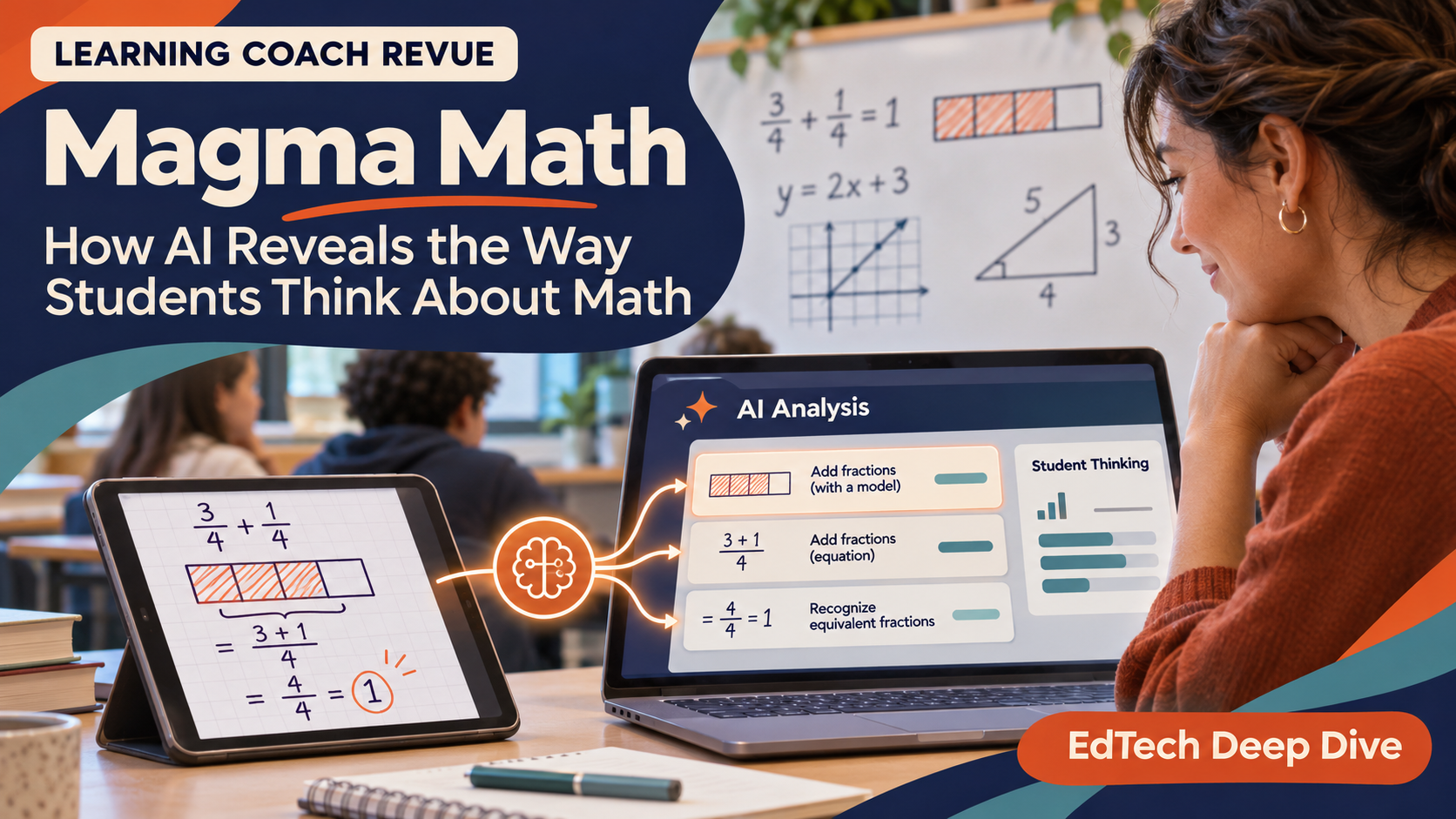
A correct answer can conceal a misunderstanding. An incorrect one can reveal a promising strategy. What happens when mathematics technology stops treating the answer as its principal unit of information and starts paying attention to the work that produced it? Born in Sweden, Magma Math is developing an AI-supported classroom platform around that deceptively simple question. Its most interesting contribution may be less about automating mathematics than about making mathematical thinking available to the people who teach it.
The invisible half of a math lesson
Consider a hypothetical fifth-grade class working on the question: which is greater, three quarters or five eighths? Three students select three quarters. One has converted both fractions to eighths. Another has pictured two identical rectangles divided into equal parts. A third believes that a fraction with a smaller denominator is always larger. All three have arrived at the same answer. Only two have demonstrated reasoning that will reliably survive a different problem.
Now imagine another student choosing five eighths after drawing eight equal sections, shading five, and comparing that image with an incorrectly partitioned second rectangle. The result is wrong, but the work exposes an idea worth developing. A teacher who sees only four answer choices has considerably less information than one who sees four approaches.
This is one of the persistent tensions of mathematics education. Teachers need to understand how pupils construct knowledge, but they also have a classroom to manage, an instructional sequence to follow and finite time to examine each learner's work. By the time a stack of exercises has been corrected, the moment at which a misconception could have shaped the lesson may have passed.
Digital education has frequently solved this problem at the wrong level. It has made answers easier to collect, scores easier to calculate and progress easier to display. Those improvements are valuable, but they do not necessarily tell the teacher why a pupil is struggling. Indeed, an efficient multiple-choice interface may make the very thing a teacher wants to observe harder to express.
Magma Math belongs to a different tradition. Its central premise is that students should be able to work mathematically in a digital environment without reducing their thinking to a typed answer. It combines the familiar expressive freedom of written mathematics with the immediacy of classroom software.
That combination changes the meaning of educational data. Instead of merely recording whether the learner succeeded, the platform can make the intermediate representations, choices and errors available for instructional interpretation. It offers something more consequential than a faster gradebook: a possibility of shortening the distance between evidence and teaching.
From a Swedish idea to an international classroom platform
Magma Math traces its origins to Sweden in 2015. Its founders, Henrik Appert and Arvid Giljam (also spelled Gilljam in some public sources), set out to address a practical difficulty in mathematics teaching. The company operates under the Magma Math name internationally and has also used Matteappen in Sweden. Its legal documentation identifies Radish AB and Radish Education, Inc. as entities involved in developing and providing the service.
In the company's account of its early development, Appert describes an instructional bottleneck: discovering what pupils misunderstood only after the class had moved on. The problem was not simply that checking exercises took time. It was that the information obtained through checking them arrived too late.
The idea subsequently expanded beyond its domestic market. In November 2024, Five Elms Capital announced a $40 million Series A investment in Magma Math. A company announcement dated October 20, 2025 reported another $10 million from the same investor, intended to support international expansion and AI development. That announcement also described support from the Gates Foundation for teacher-facing tools that interpret student work.
These announcements establish the scale of the company's ambitions, not the size of its educational effect. Capital provides the resources for software engineering, curriculum mapping, school implementation and research. It cannot substitute for any of them. In an industry in which schools are increasingly surrounded by AI products, Magma's positioning is distinctive because its primary relationship remains with classroom instruction.
The original problem also travels well. A Swedish teacher, an American elementary school teacher and a British mathematics department may work with different curricula and classroom norms, but each needs to know more about pupils' reasoning than a final score alone can convey.
Sources: Magma Math press and founder information, Five Elms Capital, Series A announcement, October 2025 funding announcement.
A digital workspace that preserves the language of mathematics
Mathematics is unusually dependent on the relationship between symbols and space. A fraction bar, a diagram, a number line, a column of calculations or a pair of equivalent equations can convey relationships that are cumbersome to express in ordinary prose.
The design challenge for a mathematics platform is therefore not merely to present questions. It is to provide an environment in which pupils can construct answers using the representations the subject demands.
Magma's student workspace incorporates a digital writing canvas. Learners can record their working, draw representations and revise their solutions rather than being restricted to a single answer field. Teachers assign mathematical problems and inspect the resulting work through an instructional interface. The platform also offers curriculum-aligned material, progress information and classroom-level analysis.
This is a supplemental K–12 system rather than a claim to replace the whole mathematics curriculum. Its value depends on the relationship between the tasks selected and the learning intentions of the classroom. A beautifully designed interface cannot compensate for questions that measure something other than what the teacher intends to teach.
In neuroergonomic terms, the canvas is interesting because it can act as an external workspace for cognition. A learner does not have to retain every intermediate quantity or relationship in working memory. A diagram can remain visible while the next step is considered. A previous calculation can be revisited instead of reconstructed. Written work thus has a dual function: it supports thinking while it takes place and preserves traces of that thinking for later examination.
A digital canvas is not automatically easier than paper. Writing with a trackpad may introduce friction, smaller screens can constrain spatial organization, and some pupils need physical manipulatives or assistive technology. Whether digitization helps depends on the interaction between the learner, the task and the device. The meaningful comparison is not digital versus analogue in the abstract, but whether the available interface enables each learner to express mathematical ideas without unnecessary effort.
Explore Magma Math's platform.
What the teacher sees while the class is still learning
The most important difference between conventional correction and real-time formative assessment is temporal. Feedback delivered while a class is still exploring a concept can change what happens in the next five minutes. Feedback delivered after the unit has finished may only document what happened.
Magma's product overview describes dashboards that summarize class performance, surface common errors and let educators examine individual solutions. The platform's instructional workflow has also been documented by Instruction Partners' AI Learning Tour, which describes teachers reviewing ongoing activity and using selected student solutions to facilitate discussion.
The resulting teaching possibilities are best understood through an illustrative example. Suppose a class is solving 24 × 15. Several pupils calculate 24 × 10 and 24 × 5, then combine the two results. Another uses 15 × 20 plus 15 × 4. A third correctly applies the standard multiplication algorithm. A fourth adds 24 × 10 to 5, forgetting that both terms must be multiplied by 24.
A teacher who encounters those approaches in a shared workspace can decide whether the class needs more calculation practice or a discussion of distributivity. Rather than interrupting every pupil who has made a mistake, the teacher can choose a representative solution and explore the mathematical relationship it exposes.
The software reduces the logistical cost of collecting examples. The teacher still determines their mathematical relevance, the sequence in which they should appear and whether the class is ready to discuss them.
This is important because instructional visibility has several levels. The first is knowing who has completed a task. The second is knowing which answers are correct. The third is seeing the written or drawn work. The fourth is interpreting what that work may suggest about understanding. The fifth is deciding what teaching response is appropriate.
The first two are comparatively straightforward to automate. The later levels require context, inference and judgment. An AI system can help organize evidence at those levels, but it cannot eliminate the uncertainty inherent in interpreting another person's thinking.
Instruction Partners: Magma Math classroom tool overview.
The AI layer: from handwriting to instructional hypotheses
What does artificial intelligence contribute when a platform already lets pupils show their work? The problem is one of scale. A teacher may be able to interpret a single written solution quickly. Interpreting thirty solutions, detecting recurring errors and selecting useful examples in the middle of a lesson is another matter.
Magma has investigated AI for mathematical handwriting and student assistance over several years. A Swedish innovation project coordinated by Radish AB, supported by Vinnova and conducted with Halmstad municipality between June 2023 and October 2024, included development of a chatbot and advances in the analysis of handwritten calculations.
The project report, supplied by the participants themselves, recorded approximately 1.86 million chatbot uses following launch across Sweden, the United States and the United Kingdom. It reported that the student satisfaction objective had been met but the teacher objective had not. Crucially, it did not establish an improvement in learning attributable to the chatbot.
That qualification is more informative than an impressive usage total. A pupil may interact with a chatbot because it provides reassurance, helps interpret a question, offers a clue or is simply available. Those interactions have different educational meanings. Counting them does not establish that the pupil subsequently understands the mathematics.
The company's 2026 help documentation describes another application: educators can author open-ended questions that are evaluated by AI. Teachers may specify answer criteria, examine individual responses, add feedback and change a grade. That creates a practical opening for assessments in which a student explains or justifies a solution rather than choosing an option.
It also creates a new challenge. A system interpreting written reasoning has to distinguish between a mathematically incorrect argument, a valid alternative approach, an incomplete explanation and an ambiguous handwritten symbol. Consider a student who writes a correct geometric argument using an unconventional notation. The model might misread it, even if an experienced teacher understands the intended meaning.
For that reason, review and override mechanisms are not peripheral interface details. They are pedagogical safeguards. A useful classification is provisional: it brings a possible issue to the educator's attention rather than declaring that the software has identified the definitive cause of a pupil's difficulty.
There is an important distinction between making student work visible and making student thinking visible. The former is a technological achievement; the latter is an educational interpretation. An algorithm can process traces, but mathematical understanding is not a directly observable variable. The strongest implementation keeps that distinction clear.
Sources: Vinnova, AI within math education, project 2023-01155, Magma Math, teacher-created AI-graded open-ended problems.
Why comparing two solutions can be more powerful than seeing one
One of the more compelling applications of this architecture is not individualized AI tutoring. It is the collective mathematics discussion.
A classroom contains multiple ways of representing the same problem. A teacher who can bring those approaches into a shared conversation has access to a rich source of learning material generated by the pupils themselves.
Magma's help documentation describes the ability to pin selected work and conceal identifying information or answers during a presentation. Its AI discussion routines are intended to help educators derive discussion prompts from submitted solutions. The software thereby supports a practice that has been studied in cognitive science and mathematics education long before generative AI became commonplace.
In a 2007 experiment published in the Journal of Educational Psychology, Bethany Rittle-Johnson and Jon Star randomly assigned 70 seventh-grade learners to study algebraic equation-solving strategies either through direct comparison of alternatives or through consideration of the methods separately. Comparison supported procedural learning and flexibility. Subsequent research has explored the importance of the particular examples selected and the learners' prior knowledge.
Why might comparison help? Consider the equation 4(x + 3) = 20. A pupil can distribute first, obtaining 4x + 12 = 20, or divide both sides by four, obtaining x + 3 = 5. Both methods produce x = 2. Seeing one method establishes a procedure. Examining both can reveal when different operations are legitimate and why one sequence may be simpler.
The learning opportunity resides in the relationship between the examples. Which mathematical properties make the two paths equivalent? When would dividing first produce a less convenient expression? Can a method be correct but inefficient? These questions connect procedural performance with conceptual organization.
A 2020 synthesis by Rittle-Johnson, Star and Durkin further examines the conditions under which comparing strategies promotes mathematics learning. Comparison is not a universal prescription. A novice who lacks familiarity with either procedure may be overwhelmed by seeing both at once. Careful sequencing, prompts and appropriate prior knowledge matter.
The interesting contribution of a platform such as Magma is that examples need not always be manufactured before the lesson. They can originate in the actual work of classmates. The examples are therefore relevant to the present task and potentially to the specific misunderstandings that have emerged.
But the teacher's work remains intellectually substantial. Selecting two nearly identical solutions may reveal little. Selecting radically different ones without a guiding question may confuse. A productive comparison is an instructional design decision, not an automatic consequence of displaying more work.
Original experiment: Rittle-Johnson & Star (2007); Rittle-Johnson, Star & Durkin, research synthesis; Magma Math: pinning student solutions.
Feedback that teaches students to notice
Another reason mathematical work matters is that it gives feedback something to refer to. A message saying that an answer is wrong may stimulate another attempt, but it provides little guidance about what needs to change. A message that identifies a relevant relationship, without immediately giving away the solution, may support a more meaningful revision.
Wisniewski, Zierer and Hattie's 2020 meta-analysis brought together 435 studies, representing more than 61,000 participants, and estimated an overall standardized feedback effect of d = 0.48. The average conceals substantial variation across different feedback designs. Information content matters; feedback is not one uniform intervention.
A 2024 systematic review devoted specifically to mathematics education also differentiates feedback directed at the task, the problem-solving process and learners' self-regulation. One aim is to help the student become capable of recognizing and resolving errors rather than always depending on external correction.
The distinction becomes concrete with a familiar fraction misconception. A pupil writes 1/2 + 1/3 = 2/5. An answer-only system can report that the result is incorrect. A process-oriented prompt might direct attention to the meaning of a denominator. A self-regulatory question could ask the pupil to estimate whether adding a positive quantity to one half can result in a quantity smaller than one half.
That last prompt does not require the learner to remember the addition rule before engaging in reasoning. It invites the learner to detect inconsistency independently. The error becomes a resource for developing monitoring skills.
Immediate digital feedback can shorten the correction cycle, but timing is not always synonymous with quality. If every hesitation triggers an AI hint, pupils may lose opportunities to plan, struggle productively and check their own work. If support is delayed indefinitely, an unproductive misconception can persist.
This is where adaptive assistance has an important design opportunity. Instead of optimizing for the speed with which a student reaches a correct answer, a system could optimize the conditions under which the student eventually needs less assistance. Such a system would treat a reduction in dependence on hints as a valuable outcome.
That remains a research and design possibility, not an established Magma feature or demonstrated effect. It illustrates why the science of feedback matters when evaluating the emerging generation of AI mathematics platforms.
Sources: Wisniewski, Zierer & Hattie (2020); Feedback in mathematics education research: a systematic literature review (2024).
Differentiation without losing the shared classroom
Personalized learning is often imagined as thirty students progressing through thirty separate digital sequences. That model can help address particular learning needs, but it risks diminishing opportunities for pupils to discuss mathematics together.
Magma's classroom-centered approach opens another possibility: differentiation can occur around a common mathematical objective.
Imagine a class exploring proportional relationships. Some learners represent equivalent ratios using a table; others use a double number line; a more advanced group develops an algebraic expression. The tasks may differ in complexity or representation, yet the class can reconvene around the same mathematical idea.
The teacher can use evidence from pupils' work to decide who needs an additional example, who is ready for a challenge and who has a strategy that would benefit others. The platform may support this process by making differences easier to notice. However, flexible grouping depends on sound tasks and professional judgment, not merely on sorting learners by previous scores.
A static label such as low ability can obscure the fact that a learner may understand spatial relationships exceptionally well while struggling to recall multiplication facts. In contrast, a temporary instructional grouping organized around a specific misconception can change as soon as the student demonstrates new understanding.
For a differentiated classroom, the relevant unit of adaptation is therefore often the current need, not the supposed permanent identity of the pupil.
Magma's documentation describes text-to-speech and translation across more than 140 languages. These tools may reduce language barriers for multilingual students when the mathematical demand of a problem is the intended focus. They do not guarantee accessible instruction: translated terminology needs checking, not every mathematical representation is equally accessible, and students may require specific accommodations or alternative input methods.
The goal is not simply to ensure that every pupil can open the same digital resource. It is to ensure that each can meaningfully participate in the mathematical activity.
What the evidence actually says
The most useful product-specific evidence available in the public record is a November 2025 report prepared by Meetal Shah and Nicole Law at Instructure for Magma Math. The company commissioned the evaluation, which is indexed by ERIC as ED678117 and was designed to meet the US Every Student Succeeds Act's Level II moderate-evidence criteria.
During the 2024–25 school year, researchers examined a matched sample of 1,686 students in grades four through eight in an Ohio public school district: 843 users and 843 comparison pupils. The outcome was performance on the i-Ready Mathematics assessment, with statistical adjustment for initial achievement and selected pupil characteristics.
The results were not uniform. For grades four and five, the estimated standardized difference was Hedges' g = 0.12, statistically significant at p = .003. For grades six through eight, g = 0.07 and the difference did not meet the conventional significance threshold. The volume of submitted solutions and the average number of writing strokes were not significantly associated with spring mathematics scores within either grade band.
The elementary finding is encouraging but modest. The middle-school finding is inconclusive, not evidence of a comparable demonstrated gain. And the design is observational rather than randomized, leaving room for unmeasured differences between groups. The study evaluates the platform as implemented, not the causal contribution of an individual AI feature.
The lack of a simple relationship between activity metrics and scores is especially interesting. A student who submits many solutions may be practicing efficiently, repeatedly guessing or revising with purpose. A learner who uses many strokes may be explaining thoroughly or struggling with notation. Neither quantity necessarily measures understanding.
It would be tempting to interpret every additional digital trace as evidence of learning. The report gives a reason to resist that temptation. What matters is not simply how much activity the software captures, but how the activity is structured and interpreted.
The Vinnova project presents a complementary caution: adoption of a chatbot was documented, while learning benefits remained uncertain. Together, these sources suggest that activity, satisfaction, pedagogical quality and attainment deserve separate measurement.
A future evaluation could randomize comparable classrooms to different instructional uses of the same platform: ordinary digital practice, teacher-led strategy comparison and AI-supported misconception analysis. Delayed assessments could measure transfer to unfamiliar problems, while independent raters evaluate mathematical explanations. Such a design would begin to isolate what the technology adds beyond access to digital exercises.
The question is not only whether Magma Math works. It is which practices supported by Magma Math work, for whom, in which subjects and at what stage of learning.
Shah & Law (2025), Magma Math ESSA Level II Study (2024–25), ERIC ED678117.
A business model built around the teacher's time
The economics of educational technology are often discussed in terms of the price of a subscription. For a school, the deeper question is the instructional value purchased with that subscription.
Magma's public offering is oriented toward schools and districts. The US website provides a demonstration request, and its terms describe potential subscription fees for teachers or administrators. A universally applicable public per-student price could not be established from the documentation consulted. Procurement therefore requires a quote that reflects the institution's circumstances.
The potential economic value lies in several places. Reducing manual correction can free teacher time. Access to reusable curriculum-aligned tasks can reduce preparation effort. Timely evidence may help educators target intervention more accurately. A common environment can support conversations among colleagues about recurring learning difficulties.
None of these benefits should be assumed from product design alone. A tool can save ten minutes in correction while adding fifteen minutes of preparation, device troubleshooting and dashboard interpretation. A school evaluating the return on its investment needs to examine the net change in work, including training, administration and integration costs.
For leaders, aggregate information may support curriculum decisions when interpreted in context. If several classes encounter the same misconception, the question may shift from individual remediation to the way a topic has been introduced across a school. That possibility is more useful than a simple ranking of classrooms by percentage correct.
There is also a compelling distinction between selling automated tasks and selling increased teacher capacity. The first proposition is easily commoditized as competing AI tools improve. The second depends on reliable workflows, trusted mathematical content, thoughtful professional development and integration with the daily realities of education.
Magma's investment history suggests resources are available to develop that institutional infrastructure. Its economic sustainability and the magnitude of realized time savings cannot be inferred from funding announcements. But the choice to work through schools rather than exclusively through a consumer app aligns the business model with the educational environment in which its central innovation has the greatest relevance.
Official demo request; Terms of use.
The responsibilities of an observant technology
A platform that captures children's written solutions gains access to richer educational information than one that stores only grades. That can improve teaching, but it also increases the importance of responsible data governance.
Magma's privacy documentation identifies categories of information associated with accounts and user-created work. For a school considering adoption, the material questions include the purposes for which student submissions are processed, retention and deletion arrangements, access permissions, third-party AI processing and the applicable contractual commitments concerning model training.
The answers may differ by jurisdiction and agreement. A public privacy policy should be considered alongside the institution's data processing agreement, local safeguarding requirements and accessibility obligations. The existence of a privacy statement or compliance assertion is not equivalent to an independent security audit.
The ethical dimension extends beyond data storage. If an automated assessment incorrectly interprets the reasoning of a pupil with an atypical handwriting pattern, a disability or a different linguistic background, a teacher might receive a misleading signal. That risk needs to be addressed through careful evaluation across learner groups and through accessible mechanisms for correcting the system.
Likewise, showing student mistakes to the class can support discussion only where the classroom culture makes it safe to be wrong. Concealing names is helpful but not sufficient: classmates may recognize a solution, and repeated presentation of errors associated with particular pupils can create anxiety. The teacher must preserve the dignity of the learner while examining the mathematics.
There is a difference between formative observation and surveillance. The former is purposeful, proportionate and tied to a learning decision. The latter can accumulate data because doing so is technically possible. A mature educational technology respects the distinction.
Beyond the Innovation: a map of reasoning, not a map of scores
The most intriguing future for a platform that collects mathematical work may not be a more elaborate gradebook. It may be a dynamic representation of mathematical strategies.
Consider an explicitly hypothetical extension: a class is learning division. Rather than reporting only proficiency by standard, a system clusters several ways in which students have approached a problem — repeated subtraction, partitioning, multiplication facts, area models and the conventional written algorithm. The teacher can inspect the evidence behind each cluster, correct mistaken classifications and select examples to discuss.
Over time, the record could reveal changes in how a particular learner approaches related tasks. A pupil who initially relies on repeated subtraction might begin recognizing multiplicative structure. Another might learn to select different representations depending on the numbers involved. Instead of treating every change in method as inconsistency, the teacher could see growing flexibility.
Such a map would be educationally meaningful only if its categories were grounded in mathematics education, its uncertainty were visible and the learner were not reduced to a permanent cognitive label. It would require annotated examples, validation against expert judgments and ongoing attention to linguistic and accessibility differences.
A second horizon concerns teacher professional learning. A shared, carefully de-identified collection of student solutions could enable mathematics departments to compare how different tasks elicit reasoning. One question might generate several distinct approaches; another might produce correct answers without much evidence of understanding. This could provide a new way to study task quality collaboratively.
The classroom evidence would become a resource for the adults who design learning, not only a measure of the children who experience it. Schools would need clear governance for reuse, meaningful permission where required, appropriate de-identification and control of access.
A third horizon is the pupil's own relationship with learning evidence. Imagine learners occasionally revisiting two of their own solutions from different points in the term and identifying what changed in their understanding. They might explain why a new representation is more useful, compare the efficiency of strategies or recognize a misconception they have overcome.
The resulting portfolio would differ from a simple collection of completed exercises. It would tell a story about the development of mathematical competence. For pupils who tend to interpret difficulty as evidence of fixed inability, a concrete record of changing strategies could help make progress intelligible. That motivational benefit would need empirical testing rather than being presumed.
These are possible developments, not descriptions of verified current functions. They follow from a broader educational idea: if technology helps us preserve evidence of learning, the next challenge is to use that evidence to develop the capacity to learn.
Discovering Magma Math in practice
For mathematics teachers, instructional coaches and school leaders, the most revealing way to explore Magma is to begin with a familiar learning objective rather than a list of features.
A demonstration of fraction equivalence, proportional reasoning or algebraic equations can reveal how pupils enter their work, how ambiguous solutions appear to teachers, how examples can be selected for discussion and how AI judgments can be reviewed.
The key questions concern instructional fit. Does the workspace support the representations that matter in the school's curriculum? Can educators distinguish an incorrect answer from an incomplete or unconventional argument? Is it possible to compare solutions without exposing learners? Does the technology reduce the total administrative burden? What evidence does the institution have of learning, beyond usage statistics?
The official website and platform walkthrough request provide entry points for schools. The US help center offers further information on classroom workflows and specific functions.
This article is a documentary investigation, not a hands-on classroom trial. The examples involving fractions, multiplication and algebra are illustrative scenarios, not observations of actual Magma classrooms.
The future of mathematics is not an answer machine
Generative AI has made obtaining a mathematical answer easier than ever. That development forces education to reconsider what it values. If the answer alone becomes abundant, what becomes scarce?
The capacity to formulate a question. To choose a representation. To identify an assumption. To recognize that a result is implausible. To compare an unfamiliar method with a familiar one. To explain why something must be true.
Magma Math is interesting because it directs technological attention toward those less visible dimensions of mathematics. Its promise is not that AI knows what every pupil thinks. It is that educators may gain better access to evidence that previously remained dispersed across notebooks, unfinished diagrams and quiet moments of uncertainty.
The evidence available so far provides grounds for cautious interest, especially in upper elementary education. Much remains to be established about the contribution of specific AI tools, long-term learning, equity and implementation across contexts.
But the underlying direction is worth examining. The most valuable technology in a mathematics classroom may be the one that helps teachers see more, pupils explain more and both spend more time on the ideas behind the answer.
A correct answer is the end of a calculation. Understanding why it is correct is the beginning of mathematics.
Selected references
Magma Math. Platform overview; press and news; AI-graded open-ended problems. Accessed November 25, 2026.
Five Elms Capital. Magma Math secures $40 million in Series A funding (2024).
Magma Math (2025, October 20). Additional $10 million funding announcement.
Vinnova (2024). AI within math education. Project reference 2023-01155, updated November 15, 2024. Participant-reported project summary.
Instruction Partners. Magma Math classroom tool overview. Accessed November 25, 2026.
Shah, M., & Law, N. (2025). Magma Math ESSA Level II Study (2024–25). Instructure. Commissioned by Magma Math.
Rittle-Johnson, B., & Star, J. R. (2007). Does comparing solution methods facilitate conceptual and procedural knowledge?. Journal of Educational Psychology, 99(3), 561–574.
Rittle-Johnson, B., Star, J. R., & Durkin, K. (2020). How can cognitive-science research help improve education? The case of comparing multiple strategies to improve mathematics learning and teaching. Current Directions in Psychological Science.
Wisniewski, B., Zierer, K., & Hattie, J. (2020). The power of feedback revisited: A meta-analysis of educational feedback research. Frontiers in Psychology, 10, 3087.
Feedback in mathematics education research: a systematic literature review (2024).
Magma Math. Privacy policy and terms of use. Accessed November 25, 2026.

