
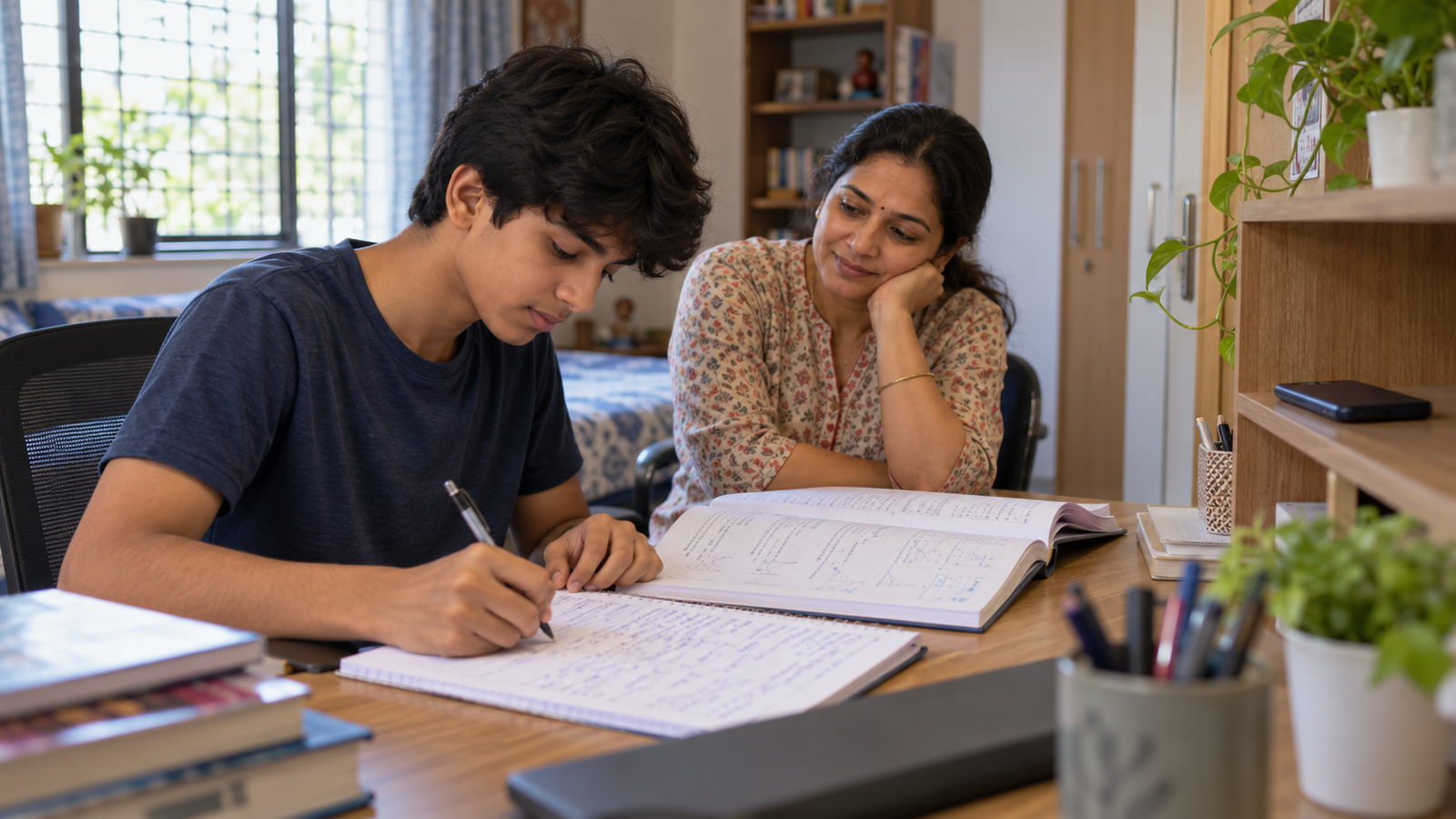
Board exam preparation becomes harder when a phone is always within reach. A student may open a WhatsApp class group to check an assignment, notice a reel, reply to a friend, and return to Mathematics twenty minutes later. Parents see hours at the desk but little completed work. The solution is not necessarily confiscating the device. It is a clear, negotiated family plan that protects focused revision, keeps useful digital resources accessible, and gives the teenager increasing responsibility for their own attention.
For Indian families preparing for CBSE, ICSE, ISC or state-board examinations, start with three decisions: where the phone stays during a study block, when it can be checked, and how the family will respond if the plan breaks down. Test the agreement for seven days, review what actually happened, and adjust it together.
Why phones become a problem during board exam revision
Most teenagers use their phones for several legitimate purposes: school announcements, PDFs, recorded lessons, question banks, transport coordination and contact with friends. The same device also contains entertainment, social media, games, notifications and conversations that can interrupt learning.
The challenge is not simply the number of screen hours. It is what happens during the minutes reserved for effortful learning. A short interruption may break a chain of reasoning in Physics, disrupt an essay plan in English, or cause a student to lose track of the steps in a Maths problem. Repeated switching can turn an apparently long revision session into several disconnected attempts to restart.
Research offers a useful caution. Ward and colleagues, in a 2017 study with adult participants, found that the presence of a participant's own smartphone could reduce performance on certain measures of available cognitive capacity, even when the device was not being used. This does not prove an identical effect for every Indian teenager, but it supports a sensible experiment: keep the phone out of sight and reach for tasks requiring sustained thought.
A phone-free study block does not mean a screen-free education. A laptop used for a specific lesson or official question paper may be appropriate. What matters is whether the student has a clear learning task, a defined start and finish, and fewer competing cues.
The first family conversation: replace accusations with observation
A difficult conversation often begins with “You are always on your phone” and ends with “You never understand me.” Neither statement identifies the actual obstacle.
Try this opening instead:
“We both want you to feel prepared for the exams. The phone seems to interrupt some revision sessions, but it also helps with schoolwork. Can we design a routine that protects your study time without cutting you off from everything?”
Ask the teenager to describe a recent study session. Which subject was planned? When was the phone picked up? Was it needed for learning, used for a break, or opened automatically? What made returning to the task difficult?
Listen before proposing a rule. A student who checks a class group for homework updates has a different problem from one who scrolls because a chapter feels overwhelming. A teen who is worried about marks may use their phone to escape a stressful task. A family plan should address the actual pattern rather than assume the student lacks discipline.
The parent’s role is to help the learner recognise patterns and choose manageable changes. The student remains responsible for practising the new routine. That distinction is important: the goal is independent attention, not permanent parental surveillance.
Step 1: map the phone's useful and distracting roles
Create a two-column inventory with the teenager. Keep it practical rather than moralising.
| Phone use during exam season | Agreed response |
|---|---|
| Downloading school worksheets or official sample papers | Download before the study block when possible |
| Accessing a recorded concept explanation | Use a preselected lesson with a clear finish point |
| Checking class-group announcements | Check at two agreed times, unless something urgent arises |
| Calculator or dictionary when permitted for home study | Prefer a separate calculator or printed reference where practical |
| Short-form video and unrelated social feeds | Save for a defined break or after the planned work |
| Family contact and safety | Agree on an accessible emergency-contact route |
No single category should be treated as universal. A student with online tuition, assistive technology needs or changing school instructions will require tailored exceptions. A parent working late may need the student to remain reachable.
Choose one or two high-distraction behaviours to address first. Attempting to reform every digital habit overnight creates friction and makes it hard to judge whether the experiment works.
Step 2: build phone-free revision blocks the teenager can own
Start with the study task, not with a timer. “Study Science for two hours” is vague. “Complete eight numericals from the Electricity chapter, check the solutions and write down two errors” gives the learner a finish line.
A workable starting pattern is:
The student writes one visible task and the materials needed.
The phone moves to a agreed location outside the immediate study area; notifications are silenced where safe and appropriate.
The student studies for a manageable block, perhaps 25–40 minutes, adjusted to stamina and task complexity.
A short break follows, with the type of phone use agreed in advance.
The student records what was completed and what needs another attempt.
These durations are trial settings, not scientifically guaranteed optimum intervals. Some students work best for shorter bursts; others can maintain a longer period of concentration. The objective is a task that can be completed without repeatedly negotiating the next step.
For an online lesson, the student can keep the required device but close unrelated tabs, disable nonessential alerts, and place the phone elsewhere. For a practice-paper session, mirror the permitted conditions of the actual exam as closely as practical.
The American Academy of Pediatrics recommends a tailored family media plan that can include screen-free homework areas, reduced notifications and device-free periods before sleep. Families can adapt those principles to the demands of board exam revision.
Step 3: decide where the phone lives during study time
An agreement is easier to follow when the physical routine is unambiguous.
Option A — Shared charging spot: A shelf or tray in a common room becomes the default place for phones during independent revision. This can work in homes with enough space and trust.
Option B — Bag or drawer away from the desk: If there is no common study room, the phone can remain out of sight with alerts off. This offers a lower-friction starting point.
Option C — Essential-use mode: Where the student needs a phone for the lesson itself, open only the relevant file or app. Use a written task, a planned endpoint and, where available, device focus settings.
Whichever option you choose, settle the exception for emergencies. For example, parents may call twice if urgent, or a particular contact can bypass Do Not Disturb. Never create a study rule that makes a child unsafe or unreachable when contact is necessary.
Avoid turning every check into an argument. If the family agrees that phones are parked during Maths revision, the parent should not demand constant proof that the student is obeying. Focus on the agreed routine and review the outcome together.
Step 4: make breaks predictable, not forbidden
A complete phone ban for weeks can appear appealing when examinations are close. It may also create resentment, secret use or tension around legitimate school communication.
Instead, agree on a few phone-check windows. They might follow two completed revision blocks, occur after lunch and at the end of an afternoon session, or sit between scheduled tuition classes. The exact hours depend on school, coaching, travel and household routines.
Breaks do not have to involve a screen. Walking, stretching, getting water, talking with family or stepping outside can help create separation between demanding tasks. If a short phone break routinely turns into a much longer session, ask what makes stopping difficult. Changing the type of break may be more effective than adding a harsher penalty.
The parent should model the agreement where possible: avoid unnecessary notifications, scrolling and calls during a shared quiet period. Teenagers are more likely to see the routine as a household learning choice when the adults follow comparable boundaries.
Step 5: protect sleep more strongly than total revision hours
A common exam-season mistake is to judge dedication by how late a teenager studies. The apparent gain from midnight revision may come at the expense of sleep, attention and emotional regulation the next day.
Guidance cited by the US Centers for Disease Control and Prevention recommends 8–10 hours of sleep for adolescents aged 13–18. The CDC also advises keeping devices away from bedtime and, where suitable, charging phones outside bedrooms. These recommendations are relevant to Indian families even though the public-health source is American.
Build the evening backwards from a realistic wake-up time. Decide when demanding revision ends, leave a short wind-down period, and agree that social feeds and class-group discussions will not continue indefinitely into the night.
A parent can help by reducing last-minute questions about marks, ranks and unfinished chapters just before bed. If a student is highly anxious, exhausted or consistently unable to sleep, it is important to address the underlying issue rather than only policing the screen.
Step 6: replace passive revision with tasks worth focusing on
A quieter desk is useful only if the study method is effective. Students can spend hours without a phone yet still rely on repetitive rereading that creates familiarity without reliable recall.
A major review by Dunlosky and colleagues identified practice testing and distributed practice as broadly useful learning techniques. During board preparation, that means closing the notes and attempting questions from memory, checking the answers, then returning to difficult material over several days.
Try this structure for one chapter:
Before studying: Write one question the chapter should answer.
During studying: Read or watch only what is needed to understand the concept.
Without looking: Solve a problem, sketch a process, write a definition or explain the idea aloud.
After checking: Mark the error as a concept gap, recall gap, careless slip or question-reading mistake.
Next session: Revisit the topic briefly before moving on.
For Science, the student might explain why a circuit behaves a certain way, then solve related questions. For History, they might reconstruct a timeline and defend a cause-and-effect link. For languages, they might plan and write an answer without consulting a model response.
This learning-focused approach reduces the temptation to treat “sitting without a phone” as the achievement. The achievement is becoming able to recall, explain, apply and correct.
A seven-day family plan for board exam preparation
Use the table as an editable starting framework. It is not a test of obedience and does not require buying an app.
| Day | Parent and teenager agree to do | Evidence to review |
|---|---|---|
| Day 1 — Notice | Observe two ordinary study sessions; identify useful and distracting phone checks without blame | One or two repeat interruption patterns |
| Day 2 — Choose | Agree on the phone location, emergency exception and first check window | A short written agreement |
| Day 3 — Start small | Run two task-based protected study blocks | Tasks finished and number of unplanned checks |
| Day 4 — Improve | Remove one extra distraction: alerts, autoplay, spare tabs or group notifications | Whether restarting the work became easier |
| Day 5 — Test independently | Teen starts the first block without a parent reminder | Self-initiated start and completed recall task |
| Day 6 — Protect evenings | Test a device wind-down and a consistent sleep plan | Sleep opportunity and next-day alertness |
| Day 7 — Reflect | Hold a calm ten-minute family review and choose what to keep | One improvement, one obstacle and next week's adjustment |
A paper notebook is enough. Record completed tasks rather than obsessively tracking minutes. A useful success signal might be “I finished and checked four questions before opening the phone,” not “I had zero screen time.”
If the first attempt fails, do not reset the entire week as punishment. Ask which part was unrealistic. Perhaps a group announcement arrived during the block, the task was too difficult to begin, or the break was too open-ended. Change one variable and test again.
A family agreement you can copy into a notebook
Our goal: Protect enough uninterrupted revision time for meaningful progress while keeping communication, rest and wellbeing intact.
Our first study task: ___________________________
Our phone location during revision: ___________________________
Our planned phone-check windows: ___________________________
Our emergency contact arrangement: ___________________________
Our bedtime device boundary: ___________________________
When the plan slips, we will: describe what happened, identify the obstacle, agree on one adjustment and restart the next block.
We will review the plan on: ___________________________
Both parent and teenager should be able to request a review. If an adult's work call, loud television or frequent interruption undermines the quiet period, that is part of the household problem too.
What to do when your teen refuses the arrangement
Resistance is information, not automatically defiance. Begin with a question: “Which part of the plan feels unfair or unworkable?” The answer may involve privacy, fear of missing school updates, friendships, anxiety or the sense that the family has no trust.
Offer limited but real choices: the phone can stay in a bag or on the common-room shelf; the first block can start at 5:00 or 5:30; check windows can follow either one long block or two shorter ones. Keep non-negotiable safety and household responsibilities clear while allowing the teen to own the method.
If arguments escalate, end the discussion before it becomes a contest. Return to it at a calm time. Avoid public humiliation, comparing siblings, threatening to destroy devices or attaching the teenager's worth to marks.
For persistent difficulties with focus, sleep, anxiety or mood, a learning routine is not a substitute for appropriate support from a qualified professional. Teachers or school counsellors may also help identify whether workloads, academic gaps or social difficulties are involved.
When the phone is essential for coaching classes and digital study
Many Indian students use phones to access online coaching, PDFs, NCERT materials and teacher messages. A useful family plan cannot pretend these needs do not exist.
Try a single-purpose session: choose one recorded lecture, write the concept being learned, use headphones only if suitable for the home setting, and close unrelated applications. Afterwards, put the device away and attempt a few questions on paper. This separates viewing a lesson from demonstrating learning.
A downloaded PDF can be printed if affordable and helpful, but printing everything is unnecessary. What matters is the boundary between the tool needed to learn and the stream of unrelated stimuli that competes with it.
If a student must check a class group during the day, appoint two predictable checking times. A genuine urgent message can be handled through the agreed exception. Schools and tuition teachers can help families by keeping deadlines and instructions organised rather than expecting an instant reply to every message.
Three mistakes families should avoid
Mistake 1: demanding perfect phone control from day one
A plan built around flawless self-control often collapses after a single lapse. Teach recovery: notice the distraction, put the phone back, reopen the written task and do the next step. Improvement in restarting is a real skill.
Mistake 2: measuring only screen time
Two students with the same amount of screen use may have very different learning experiences. One may complete deliberate tasks and then enjoy time with friends; the other may repeatedly interrupt every difficult question. Review the quality of study blocks, not just a device report.
Mistake 3: using exam marks as the daily enforcement tool
A low score can reveal a knowledge gap, an exam-technique problem or stress. It does not prove the phone caused it. Separate the conversation about distraction from the conversation about learning errors. Make the plan responsive to evidence rather than blame.
How learning coaching changes the parent's role
Traditional reminders usually focus on compliance: “Put the phone away,” “Sit down,” “Study now.” A learning-coaching conversation focuses on planning and self-observation:
“Which task needs your best concentration today?”
“At what point do you normally reach for your phone?”
“What would make the first ten minutes easier to begin?”
“How will you know this session helped you learn?”
“What should we change if the plan proves unrealistic?”
These questions move ownership gradually from adult control to learner self-regulation. The student learns to identify an attention barrier, estimate its effect, select an action and review the result. That is a broader skill than obeying a temporary phone rule.
Learning Coach distinguishes a Learning Coach Parent, who supports their own child, from a professional Parent Coach who works with other families. Its approach emphasises educational learning skills and autonomy, not diagnosis or medical treatment. Parents and educators curious about that approach can explore the Learning Coach training pathways. The exact availability and admission conditions for individual specialisations should be checked on the official page.
For a related perspective on emotion, confidence and learning readiness, see The Learner’s Emotional System.
Frequently asked questions
Should parents take away a phone until the board exams are over?
Not as an automatic first response. Phones can be important for study materials, social contact, accessibility and safety. A time-limited, negotiated arrangement is often more practical. Families can choose firmer boundaries when appropriate, but should explain them clearly and preserve essential contact.
How long should a phone-free study session last?
Start with a task the student can finish and a time interval they can realistically sustain. A 25–40-minute trial is an example, not a universal rule. Change the length according to age, subject, fatigue and the student's response.
Are focus apps necessary?
No. A tray outside the room, a notebook and clearly planned breaks may be sufficient. Device settings can help with notifications, but no app replaces a meaningful task or a workable family agreement.
What if the student needs WhatsApp for class updates?
Schedule checks around revision blocks, download materials in advance and agree on exceptions for genuinely time-sensitive messages. The objective is to avoid open-ended checking, not to lose contact with school.
What if my child becomes more anxious when the phone is removed?
Ask why. The phone may be serving a social, emotional or practical function. Adjust the arrangement and consider support from a school counsellor or relevant healthcare professional when anxiety or distress is significant or persistent.
The takeaway: protect attention while teaching autonomy
Board exam preparation does not require a war between parents and phones. It requires a routine where a teenager knows the task, removes avoidable interruptions, studies with methods that produce real recall, and retains reasonable control over breaks and communication.
Start with two protected blocks, one clear phone location and an agreed emergency exception. Let the student test the plan, collect evidence and help revise it. The long-term objective is not merely a quieter exam season—it is an independent learner who can direct attention when it matters.
References
American Academy of Pediatrics — How to Make a Family Media Plan. Practical family guidance on shared media rules, notifications and screen-free periods.
Ward et al. (2017) — Brain Drain: The Mere Presence of One’s Own Smartphone Reduces Available Cognitive Capacity. Experimental study with adults; results should not be generalised uncritically to every adolescent.
Dunlosky et al. (2013) — Improving Students’ Learning With Effective Learning Techniques. Review of learning strategies, including practice testing and distributed practice.
US Centers for Disease Control and Prevention — Sleep and Health. Adolescent sleep recommendations and relevance to attention and learning.
Ministry of Education, India — Pariksha Pe Charcha 2026. Context on the importance of exam stress and student wellbeing in India.
