
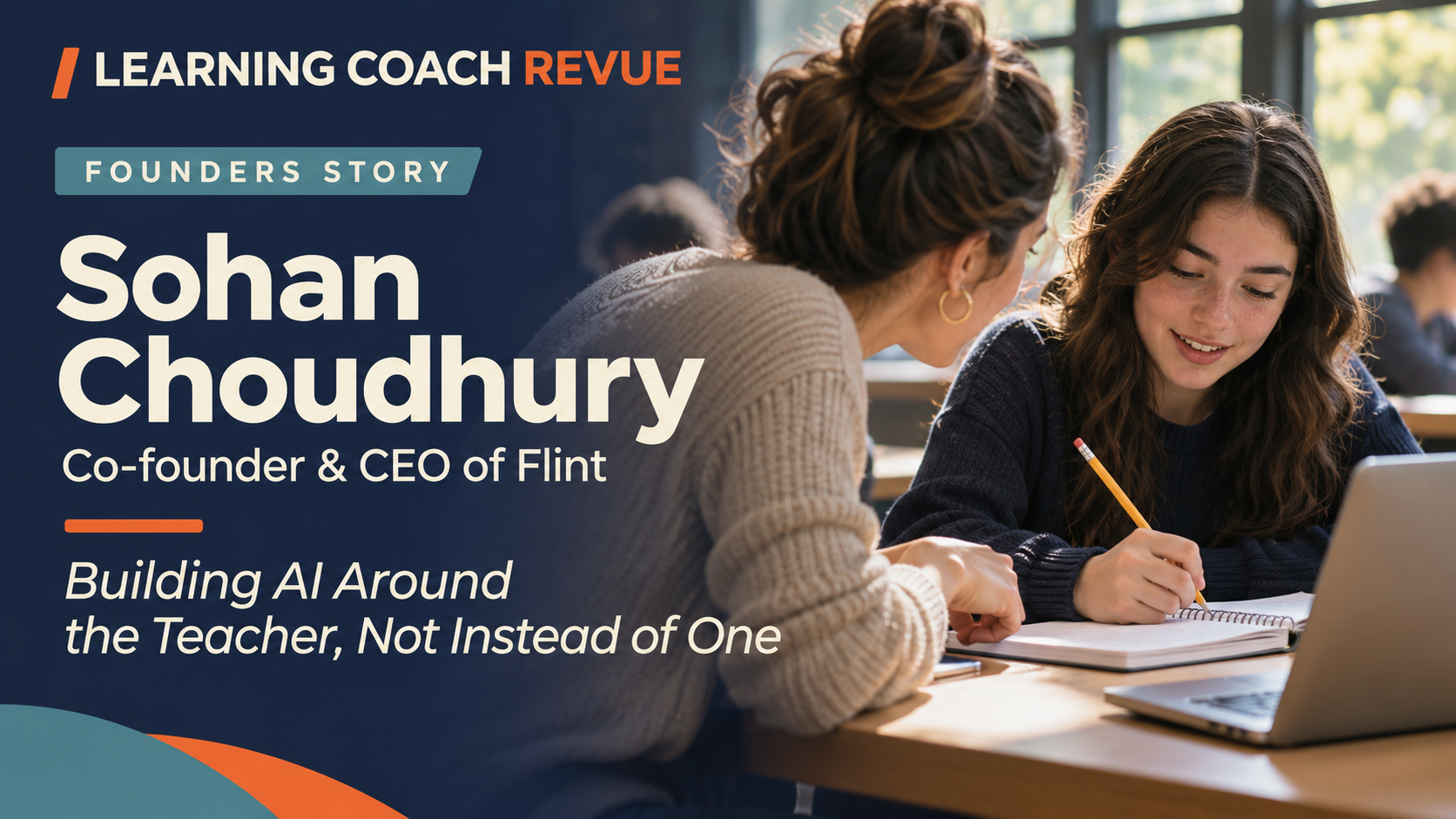
He left Georgia Tech to build a video-conferencing startup, entered Y Combinator with an idea that did not survive its first encounters with reality, and went on to co-found Flint. Sohan Choudhury's journey offers a revealing glimpse into what it takes to build educational technology around the people who actually teach—and why the next great challenge for artificial intelligence may be learning to protect the very effort that makes us human.
A flight to Atlanta
In his account of Flint's first two years, published on May 25, 2025, Sohan Choudhury describes a revealing moment in the company's development. Growth was accelerating, yet the founders were becoming aware that they did not understand their customers as well as they needed to. When a school mentioned an upcoming meeting with its department heads in Atlanta, Choudhury and his co-founder, Jinseo Park, arranged overnight flights to attend it.
It was not a product launch. Nor was it an occasion designed to impress investors. According to Choudhury, the conversations generated enough insights to guide subsequent development for weeks. The episode, recorded in his public reflection on building Flint, captures an enduring tension in technology entrepreneurship: software can be distributed almost instantaneously, but understanding the people it serves takes time.
In education, that tension is especially pronounced. A school is not a collection of interchangeable users. It is an institution where a biology teacher, a language department, a student struggling with reading and a school administrator each inhabit a different reality. Their definitions of a successful technology may differ considerably.
The question behind Flint, an American education technology company founded in 2023, is how to reconcile the individual attention each learner needs with the collective organization of a school. The question behind its CEO's story is equally interesting: how does someone trained to build software learn to understand an institution whose most important work cannot be reduced to software?
Before Flint: learning that entrepreneurship was possible
Choudhury studied computer science at the Georgia Institute of Technology, where he was a Stamps Presidential Scholar, according to his ASU+GSV Summit biography. His route into entrepreneurship was not simply an extension of his technical education. Georgia Tech's CREATE-X initiative introduced him to an alternative to the conventional engineering career he had previously envisaged.
In a March 2025 interview published by Georgia Tech, he explained how the program gave him an opportunity to pursue his own projects and access to advisers as he developed his first company. The institution was also celebrating his inclusion in the 2025 Forbes 30 Under 30 cohort.
That experience is worth examining through an educational lens. Entrepreneurship programs can change more than a participant's repertoire of practical skills. They can make a previously invisible career imaginable. A student who has only observed conventional routes into employment may not recognize that designing and testing a business is also a possibility. Access to mentors, peers, prototypes and real customers can transform an abstract ambition into an actionable option.
Choudhury has also publicly credited his parents with instilling a profound respect for education. In his 2025 anniversary reflection, he associated their immigration to the United States with their dedication to learning. This is a personal account, not evidence of a single causal explanation for his later choices. But alongside the Georgia Tech interview, it reveals the place education occupies in his public understanding of his own journey.
In 2020, he left university to work on a video-chat business. His personal website identifies that company as Gatherly, a venture he worked on for three years before its eventual acquisition. The pandemic had made the limitations of remote interaction a widespread practical concern. A video platform and a classroom learning platform may seem unrelated, yet both present a similar design challenge: how can digital environments accommodate interactions that are richer than the simple exchange of information?
His first startup also brought him into contact with Jinseo Park. Their later partnership at Flint was not the result of an abstract search for complementary résumés. It followed direct experience of working together. That kind of evidence about a potential co-founder—the way someone makes decisions, responds to setbacks and interprets user needs—is difficult to obtain from an interview alone.
When the first idea is not the right one
The timing of Flint's emergence matters. The release of ChatGPT in late 2022 precipitated a wave of questions about the integrity of schoolwork. For educators, a tool that could produce a plausible essay, generate solutions or summarize a chapter could also bypass the intellectual activity an assignment was intended to elicit.
Choudhury and Park approached this environment as a design opportunity. In his Georgia Tech interview, Choudhury recalled the suspicion surrounding AI in schools when the business began in May 2023. Rather than accepting cheating as the inevitable educational application of the technology, the founders explored how it might serve teachers and students.
Yet the route to the resulting platform was not straightforward. His two-year reflection explains that he entered the Summer 2023 Y Combinator batch as a solo founder with an idea centered on enabling teachers to create video games. He subsequently moved beyond that concept, reconnected with Park and developed the business around a different understanding of educational needs.
The initial idea is instructive precisely because it was not the one that prevailed. A founder may correctly recognize the existence of an important problem while initially proposing the wrong solution. Changing the solution is not necessarily evidence of inconsistency; it can be evidence that observation has overtaken imagination.
The Y Combinator company profile preserves an early description of Flint's focus on helping teachers produce and differentiate classroom resources. Its more recent positioning emphasizes personalized learning within schools. These public records suggest an evolution from assisting teachers in preparation toward participating more directly in the instructional experience.
The continuity is the teacher. What changes is the point at which the technology intervenes: before the lesson, during it, after it, and eventually across the organization of learning.
That evolution illustrates a difficult aspect of entrepreneurship. An early feature may acquire loyal users even when it does not represent the full potential of a company. Moving beyond it requires preserving what users value while reconsidering the assumptions that shaped the original product. Moving too early can destroy trust; moving too late can leave an organization optimizing a narrow problem long after the wider opportunity has become visible.
The co-founder as a partner in discovery
In Flint's public materials, Choudhury is identified as co-founder and CEO, and Park as co-founder and CTO. Both were associated with Georgia Tech before Flint. Their roles are complementary, but the partnership deserves to be understood as something more consequential than a division between a commercial leader and a technical leader.
Educational technology is a field where engineering decisions frequently become pedagogical decisions. How much context a tutor retains, what happens when a learner makes a mistake, how a teacher edits an activity, and which behaviors trigger an alert all encode assumptions about instruction.
A product leader can specify that a learner should not receive the answer immediately. An engineer then has to turn that principle into something robust across ambiguous questions, different subjects and varying levels of prior knowledge. The question becomes more complicated when a student is frustrated, when the AI's own explanation is incorrect or when the assignment genuinely requires direct instruction.
The founders' earlier experience working together is relevant in that context. In his May 2025 retrospective, Choudhury emphasizes Park's product judgment and technical abilities. The Association of Technology Leaders in Independent Schools also identifies the two leaders in their respective roles.
This is the significance of the collaboration: a company working at the intersection of education and AI needs repeated negotiation between what is technically possible, what is desirable for an educator and what is safe for a child. No single discipline supplies all the answers. Product decisions improve when the questions can travel freely across those boundaries.
The same applies to Flint's relationship with the teachers who use it. They bring expertise neither a founder nor an engineer can acquire merely by reading a textbook on pedagogy: an understanding of actual students, actual school cultures and the consequences of instructional choices.
The paradox of personalized education
In November 2025, Choudhury and Park published a joint letter announcing Flint's $15 million Series A. They framed the opportunity around a familiar mismatch in classrooms: one student needs more explanation, another is ready to advance, and a third has difficulty seeing the relevance of the lesson. The same instructional sequence is not necessarily appropriate for everyone.
The founders' announcement describes a vision for supporting different learners within the same school environment. The central question is not whether every student should follow an entirely separate curriculum. It is whether shared educational goals can coexist with more flexible pathways toward those goals.
This distinction becomes clearer when we imagine a teacher working with twenty-five students. One learner has misunderstood a concept because of unfamiliar vocabulary. Another understands the vocabulary but applies a faulty rule. A third can perform the procedure and cannot explain why it works. Giving the class three more examples may help some students, but it will not necessarily address the three different difficulties.
Individual diagnosis, appropriately timed feedback and a chance to attempt another problem can change the learning opportunity. AI makes it possible to imagine more such interactions within ordinary classroom constraints. But its ability to generate dialogue does not automatically mean it has identified a misconception correctly.
The intellectual achievement of a school is not to produce twenty-five completed worksheets. It is to help twenty-five people become capable of thinking and acting with greater independence. That is a demanding standard for any personalized learning technology, including Flint.
Choudhury's public emphasis on the teacher is particularly important here. Teachers are not simply facilitators of content delivery; they interpret hesitation, recognize changes in confidence, select meaningful tasks and manage the collective life of a class. AI might increase the number of interactions available to students, but the educational value of those interactions depends on how they are designed and interpreted.
The science of assistance: when helping becomes an obstacle
Research gives us a useful way to evaluate the broader ambition behind Flint. In 2025, a team led by Hamsa Bastani published Generative AI without guardrails can harm learning: Evidence from high school mathematics in the Proceedings of the National Academy of Sciences.
The researchers studied nearly a thousand high-school mathematics students in Turkey, comparing a conventional generative AI interface, a tutor designed with instructional safeguards and a condition without access to generative AI. The important distinction was between performance while assistance was available and performance when the assistance was removed. Unguarded assistance could help students solve practice problems while undermining subsequent independent performance. The safeguarded design substantially mitigated that harm.
This experiment did not evaluate Flint. Its results cannot be used as a certificate of effectiveness for Flint, nor can the findings be assumed to transfer identically to other subjects, age groups or school systems.
What it does provide is a scientifically grounded distinction between assistance that improves the immediate output and assistance that helps develop a durable capability. The former can make a learner look more successful without making that learner more capable. The latter often requires the tool to exercise restraint.
Consider a hypothetical student solving an algebra problem. A tutor could identify the correct answer, display the full procedure and ask whether the student understood. The learner might respond affirmatively without being able to reproduce the reasoning. A different tutor could ask which operation would preserve the equality, then request an explanation and present a structurally similar problem without assistance. The second interaction is less convenient, but it provides a better opportunity to observe and develop understanding.
The distinction suggests a deeper opportunity for the people building educational AI: the most useful feedback may occasionally be a question, a pause, or an invitation to try again.
A technology capable of generating virtually any answer must also learn when giving an answer is educationally inappropriate. This is not simply a safety setting; it is a philosophy of instructional design.
Turning teachers into collaborators, not spectators
The Atlanta meeting described at the beginning of this portrait matters because it represents a recurring problem in EdTech: the distance between adoption and understanding. An institution can purchase a tool and a founder can receive positive feedback while significant problems remain invisible in daily practice.
Choudhury's comments to Georgia Tech also describe the revealing experience of asking potential users to pay after receiving encouraging feedback. A willingness to commit a school budget exposes questions about value that compliments do not resolve. Educators must consider their time, their students' needs, other priorities and the cost of supporting a new system.
This is why the CEO's work involves more than articulating an ambitious technological vision. The ASU+GSV biography describes Choudhury's direct involvement with teachers and school leaders adopting AI. His account of early Flint development suggests the value of maintaining access to classroom perspectives even when the organization becomes larger.
In a school, feedback about a feature often contains several layers. A teacher who asks for a simpler interface might be expressing concern about lesson time. A department head who asks for standardized reporting may be trying to make assessment decisions defensible. A student who repeatedly seeks an answer may need better instructions, emotional reassurance or a more accessible task rather than a more powerful model.
The founder who takes these requests literally may build many features without solving the underlying problem. The founder who interprets them too freely may impose a theory on people who already understand the setting better. The productive space lies between those extremes: investigate the request, understand the context, prototype, observe the results and reconsider.
The economic logic is also important. Flint offers a teacher entry point and institutional plans, as described in its pricing information and school-plan documentation. An individual educator can explore the approach before a larger organization makes a commitment; institution-level adoption entails additional coordination, governance and integration. This model creates opportunities for teacher-led discovery, but it does not remove the financial and implementation barriers faced by schools with limited resources.
For founders, the challenge is to distinguish the metrics that show a product is being purchased from those that show it is becoming educationally valuable.
The $15 million milestone—and the responsibility it creates
On November 5, 2025, Flint announced its Series A round of $15 million. Axios reported the financing the following day. Patron's investment announcement identifies Patron and Basis Set as co-leads. This was a meaningful financial milestone for a company founded only two years earlier.
In the founders' letter, the company also reported partnerships with hundreds of schools and monthly use by hundreds of thousands of students. These are company-reported historical figures from November 2025, rather than independently audited current totals. They describe reach, not proof that students learned more.
The distinction between fundraising, adoption and learning outcomes is crucial. Capital allows a company to employ people, improve infrastructure, support schools and investigate difficult problems. School adoption indicates that institutional buyers see sufficient potential value to try or retain a solution. Neither alone establishes long-term educational efficacy.
A venture-backed company operating in schools faces an unusual combination of expectations. Its investors may value growth, while schools need dependable support and long-term stability. Teachers want manageable workloads. Children need systems that protect privacy, avoid unreliable guidance and respect their developing autonomy. Parents need clarity about what the technology can and cannot do.
The challenge of leadership is making those requirements coexist without allowing the easily measured ones to dominate the less easily measured ones. A faster feedback system may create value, but only if its accuracy and instructional relevance are sufficiently reliable. Greater activity on a platform may represent genuine engagement or merely more time in front of a screen.
As Flint grows, the most informative indicators would include not only active users but also independent assessments of delayed retention, students' ability to transfer knowledge, teacher workload measured across complete instructional cycles, and the distribution of benefits across different learner groups. These are analytical possibilities, not claims about measurements Flint has already conducted.
From AI tutor to agentic learning infrastructure
By October 2026, Choudhury's publicly articulated ambitions had broadened. In his October 30 article explaining Flint's agentic LMS direction, he discusses a learning management system conceived around AI-supported instruction rather than around traditional administrative functions alone. Flint's product update log records additions involving assessment, class organization and gradebook workflows in October and November 2026.
The evolution is significant for understanding the founder. It connects the earlier focus on teacher resources and tutoring to a wider question about school infrastructure: what might change if educational tools were designed to help people act on learning information, instead of simply storing it?
The word agentic requires careful interpretation. A system that can take steps toward a goal may be able to organize activities, help assemble feedback or coordinate elements of an instructional workflow. Those capabilities should not be confused with autonomous educational judgment. The consequences of mistakes increase as a tool becomes more deeply involved in assessments, records or decisions concerning individual students.
A school adopting such a system needs meaningful human oversight, clear permissions, mechanisms for reviewing actions, and credible data protections. These are requirements of the category, not an allegation of specific failures at Flint. Schools and families can examine Flint's public information for educators and its policies, and evaluate their own legal and pedagogical requirements before implementation.
The expansion also brings an opportunity for a founder who has spent years cultivating relationships with educators. Teachers' observations can inform not only the conversational design of a tutor but the way activities, assessments and follow-up decisions fit together.
One particularly interesting development is Flint's AI literacy course for teachers, documented in November 2026. Its presence acknowledges a fundamental organizational reality: access to new technology is not synonymous with the capacity to use it well. Teacher learning is part of educational innovation, not a secondary matter to be dealt with after software deployment.
Beyond the innovation: the art of making assistance disappear
Imagine a classroom in which an AI tutor gradually reduces its support as a learner's competence increases. Early in a topic, the student receives frequent prompts. Later, the tutor asks the learner to choose a strategy independently. Finally, the student solves an unfamiliar problem without the technology. The teacher sees evidence of this transition, not just a score from assisted practice.
This is a hypothetical design direction, not a description of a verified Flint feature. Its inspiration lies in the pedagogical distinction between scaffolding and dependency: effective support is adjusted to a learner's needs and withdrawn when it is no longer necessary.
A related possibility concerns the learner's awareness of their own progress. Before receiving assistance, a student might estimate their confidence in an answer. After trying a comparable task alone, they might reconsider that estimate. Over time, the student could develop a more accurate understanding of what they know and what still needs work. Such information, carefully designed, could enrich a teacher's interpretation of learning.
There is a paradox in this vision for AI companies. Commercial software often seeks recurring engagement; education seeks growing independence. The learner who can solve a problem without help may interact less frequently with a tutoring system. Yet from an educational perspective, that reduction could be a success.
An educational business does not necessarily have to choose between sustainable revenue and student independence. Schools may value an infrastructure that helps teachers guide successive learning journeys, rather than one that maximizes each child's reliance on a chatbot. A system's usefulness can increase at the institutional level even as individual students become less dependent on its assistance.
The most consequential innovations in this space might ultimately be those that make the technology less visible when a learner is ready to proceed alone.
A founder's story still being written
Sohan Choudhury's path from CREATE-X to Gatherly, Y Combinator and Flint shows that the creation of educational technology is itself a process of learning. There were early assumptions to discard, collaborators to find, institutional practices to understand and an expanding set of responsibilities to confront.
It would be premature to declare that Flint has solved the problem of personalized education. Public materials and reported adoption establish an active enterprise with a substantial ambition, not definitive proof of long-term learning gains. This portrait is based on publicly available interviews, documents and research; Learning Coach Revue did not conduct a new interview or independently test the product for this article.
But the direction of Choudhury's work raises a question worthy of attention from anyone interested in education. If technology can give students access to almost unlimited explanations, examples and feedback, what will remain scarce?
Perhaps the answer is discernment: knowing which explanation matters, when to intervene, how to recognize a misconception, and when to allow someone to struggle productively. Teachers cultivate that discernment throughout their careers. Founders who work alongside them have the opportunity to translate parts of it into new forms of support without pretending to replace its human source.
Readers can explore Flint and its resources for teachers, and discover our complementary Learning Coach article on Flint's personalized AI learning experiences.
The remarkable ambition of educational AI is not that it might answer every question a child asks. It is that, with thoughtful design and thoughtful teachers, it might help that child become someone who can ask better questions—and eventually answer more of them alone.
Sources and further reading
Sohan Choudhury. Personal website. Biography, last updated November 2024.
Georgia Tech Research News Center. Beyond Tech: CREATE-X Entrepreneurs Make Forbes 30 Under 30. March 3, 2025.
ASU+GSV Summit. Sohan Choudhury, speaker biography. 2025.
Sohan Choudhury. Reflecting on 2 Years of Building Flint. May 25, 2025.
Y Combinator. Flint company profile.
Association of Technology Leaders in Independent Schools. Flint, Inc..
Flint. Announcing Flint's $15M Series A. November 5, 2025.
Axios. Flint raises $15 million to put AI tutors in schools. November 6, 2025.
Patron. Our Investment in Flint. November 6, 2025.
Bastani, H., Bastani, O., Sungu, A., Ge, H., Kabakcı, Ö., & Mariman, R. (2025). Generative AI without guardrails can harm learning: Evidence from high school mathematics. PNAS, 122(26), e2422633122. DOI.
Sohan Choudhury. Why We're Building an Agentic LMS for K-12. October 30, 2026.
Flint. What's New; Pricing; Teacher and school plan; AI literacy course and certification.

