
Spaced Repetition for Beginners: When to Review and How to Build a Study Schedule
You studied the chapter on Monday. By Wednesday, it seemed familiar. On Friday, you could still recognize the diagrams. Then, the following Tuesday, your teacher asked a question that should have been easy—and the answer was almost gone.
Your first instinct might be to study for longer next time. Perhaps you need another two-hour session, better notes, or more determination. But there is a different question worth asking: What if the problem is not only how you study, but when you return to what you learned?
That is the idea behind spaced repetition. Instead of studying a topic repeatedly in one long sitting and then abandoning it, you return to the material across multiple sessions, giving yourself chances to remember it after time has passed.
How should beginners use spaced repetition? Start by learning one manageable topic, plan short reviews across several days or weeks, try to retrieve the information before looking at your notes, and change the next review date according to what you can actually remember. You can begin with paper, a basic calendar, or simple flashcards. You do not need a complicated app.
This guide answers the questions students usually face: When should I review? Is the famous 1-3-7-day schedule scientifically proven? How do I combine new lessons with old ones? What should a review session contain? And what do I do if I have an exam in a week rather than a month?
The goal is not to build the perfect calendar. It is to make remembering over time part of your normal way of learning.
What is spaced repetition? A simple explanation
Spaced repetition is a study approach in which you revisit important material on more than one occasion, with time between reviews. The intervals may be short at first and longer later, depending on the learner, task and retention goal.
Imagine two students preparing for an exam in four weeks. Sophie studies a biology chapter for three consecutive hours on the first Saturday. She rereads the summary, makes notes, and feels confident. She does not touch the chapter again until the evening before the exam.
Marcus studies the same content for an initial session, then briefly revisits it after a delay. During those reviews, he closes the notes and tries to explain the process, checks the details he missed, and returns to the chapter at later points. His total study time need not be greater than Sophie's to create more opportunities to check retention.
The relevant difference is the distribution of learning opportunities over time, not whether one learner owns better stationery.
In scientific research, this principle is often called distributed practice or the spacing effect. A major 2006 review by Cepeda and colleagues examined findings from hundreds of experiments and concluded that the time between learning episodes matters for later retention. The best spacing in the studies depended partly on how long learners needed to remember the material. Read the research review.
Spaced practice does not mean reviewing every topic forever. It means designing a realistic series of returns while the material is still relevant.
Why can spacing work better than cramming?
Cramming is massed practice: many encounters with material in a relatively short period. It may create a strong sense of readiness because the same examples and phrases are still readily available. Sometimes it can support very short-term performance. But it offers fewer opportunities to test what remains accessible after time has passed.
A review after a delay changes the task. You cannot rely as easily on having just seen the answer. You have to reconstruct an idea, recognize a gap, and make a decision about what needs more work.
Research by Rohrer and Pashler, published in 2007, examined how dividing study across sessions can improve later retention without simply increasing study time. Their findings do not prove that every short spaced session beats every long one, but they challenge the assumption that repeating everything immediately is always the best use of limited study time. Read the article.
In 2016, learning researcher Sean Kang reviewed the implications of spacing for education, noting that spaced review can support retention and that combining it with retrieval practice is especially promising. That paper discussed learning and instructional choices; it was not a test of a single universal calendar app or a branded school program. Read Kang's review.
Think of spacing as giving learning a second, third, and fourth occasion to prove itself. The point is not to make studying feel harder for the sake of difficulty. It is to expose what survives when the original reading is no longer fresh.
Spaced repetition versus active recall: what's the difference?
The two strategies are related, but they answer different questions.
Spaced repetition asks: When will I return to this topic?
Active recall asks: What will I do when I return?
You can space your study and still spend every session passively rereading. You can also actively retrieve a fact five times in the same minute without ever returning after a delay. Those routines do not test the same thing.
A useful combination is to schedule a return and start by attempting the answer without notes. Only after trying do you check, correct, and relearn anything missing. This makes the scheduled review a genuine test of retention rather than a familiar-looking page.
For example, on Monday you learn the meaning of opportunity cost. On Thursday, rather than immediately reading the definition again, you answer: “What is the opportunity cost of choosing to work a part-time shift instead of attending a concert?” You then compare your reasoning with the course explanation. A week later, you answer a new scenario that uses the same principle.
That sequence exercises memory, explanation and application. It also gives you information about whether the next review should come sooner or later.
The evidence base supports both distributed practice and practice testing as useful techniques. The 2013 Dunlosky and colleagues review rated both highly relative to several commonly used methods. The review should not be read as saying they replace instruction, understanding, or feedback.
When should you review? There is no magic schedule
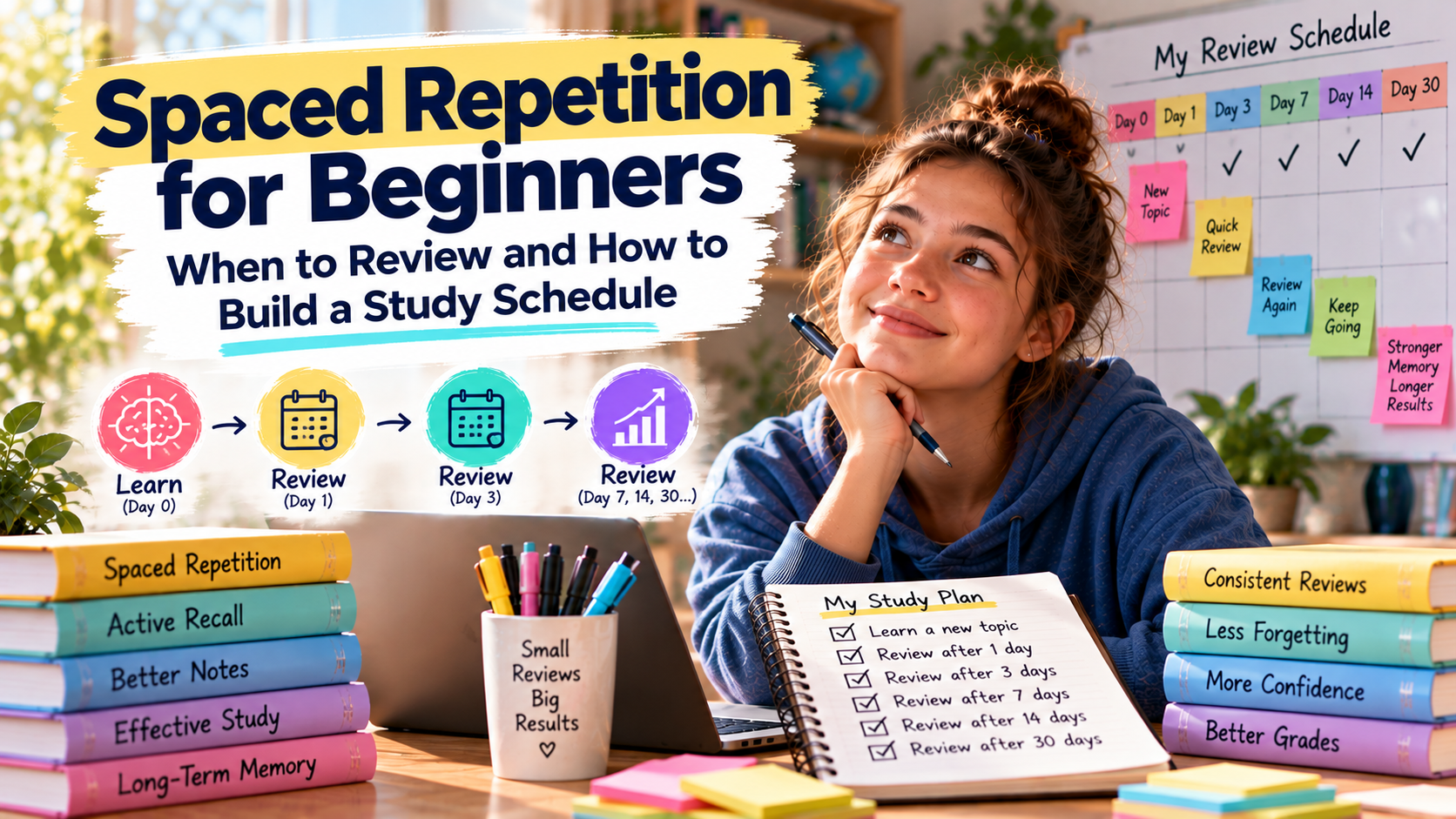
Online advice often presents a fixed timetable: review one day later, again on Day 3, Day 7, Day 14 and Day 30. That can be a convenient reminder system, but it is not a scientifically established set of ideal days for every subject, learner, and deadline.
The timing that works well depends on several variables. You may need to remember a vocabulary list for next week's quiz, a historical argument for an exam in six weeks, or mathematical techniques across an entire semester. The initial difficulty matters, as does your previous knowledge and the quality of your earlier practice.
In a 2008 experiment involving more than 1,350 participants, Cepeda and colleagues varied the interval between study sessions and measured memory after delays ranging up to a year. The interval associated with better later retention changed with the length of the final retention delay. That result is a powerful warning against pretending that one schedule is optimal for every learning goal. Read the study.
There is also a distinction between equal and expanding intervals. Equal spacing might mean a short review every three days. Expanding spacing might mean returning after one day, then three days, then a week. A 2014 experiment by Kang and colleagues found advantages for expanding spacing in average recall across a four-week vocabulary-learning period, but equivalent performance on a later final test in the conditions examined. A 2022 meta-analysis of second-language learning likewise found equal and expanding schedules statistically comparable overall. So expanding intervals are a reasonable organizing choice, not the only valid scientific approach. See the 2014 study and the 2022 meta-analysis.
A practical beginner's rule is therefore: review after a meaningful delay, check accuracy, and adapt the next interval. Use the calendar to support learning, not as proof that learning occurred.
A simple starting schedule you can adapt
If you want a concrete example, choose one chapter today and plan several returns over the next month. Here is a sample rather than an optimal algorithm.
| When | Main goal | What to do without notes first | What to change afterward |
|---|---|---|---|
| Day 0 — Learn | Build a clear first understanding | Explain the idea after the initial lesson | Correct misunderstandings before scheduling |
| Day 1 — First return | Check early retention | Recall facts, steps or an explanation | Relearn missed parts; shorten interval if needed |
| Day 3 — Second return | Retrieve after a longer gap | Answer a new question or reconstruct a diagram | Mark reliable versus uncertain topics |
| Day 7 — Third return | Check understanding in another context | Solve a changed problem or explain a comparison | Keep difficult material in the nearer review cycle |
| Day 14 — Fourth return | Maintain knowledge after more time | Attempt a mixed set of questions | Increase the gap for secure material |
| Day 30 — Longer check | Test delayed recall and application | Use an unfamiliar exam-style question | Schedule another return only if relevant |
A topic forgotten on Day 3 does not have to wait until Day 7 merely because the example says so. Relearn the missing idea, then check it sooner. A topic recalled confidently on Day 7 might not need repeated daily attention. Your review results—not loyalty to a set of dates—should drive the adjustments.
This sample works best for material that will remain relevant for a month or more. If your exam is in five days, you need a different plan. If you have six months, your intervals may grow substantially longer.
How to build your own spaced-repetition study schedule
A usable schedule should connect content, dates, review actions and evidence. You can create one in a notebook, a paper planner or a spreadsheet.
Step 1: Decide what must be remembered, and until when
Start with the learning goal. Are you preparing for Friday's test or building knowledge for next year's course? The time horizon matters because the spacing needed for short-term use differs from what may be useful for longer retention.
Be specific about what a successful answer would look like. “Know biology” is too broad. “Explain how the nephron filters blood and predict how a change in water availability affects urine concentration” gives you a task that can be checked.
If the goal includes multiple forms of knowledge, separate them. One list may cover essential terms; another may cover causal explanations; a third may cover problem-solving procedures. A calendar cannot compensate for unclear expectations.
Step 2: Divide the material into sensible units
Choose topics small enough to review meaningfully but not so fragmented that their relationships disappear. For history, a unit might be the causes of one movement and the evidence behind them. For language learning, it might be a manageable group of words alongside original sentence production.
Keep related concepts connected. Studying a collection of isolated labels is not the same as understanding the system those labels describe.
Step 3: Put the first return in your calendar
After an initial learning session, schedule the next review rather than trusting yourself to remember it spontaneously. Put the task in clear terms: “Wednesday 5:20 p.m. — explain cellular respiration from memory and check the graph question.” Avoid vague calendar blocks saying only “study.”
The Cornell Learning Strategies Center recommends specific study appointments and regular cumulative review. For students with crowded days, short, dependable appointments may be easier to maintain than heroic plans requiring hours of uninterrupted time.
Step 4: Start every review with retrieval
Before reopening the chapter, attempt a relevant answer. Write it, say it, sketch the diagram, or solve the problem. Then compare your work with a reliable source or marking criteria.
This step prevents a review session from becoming another passive reread. For a clear introduction to retrieval, the Learning Coach Study Smarter collection also includes the dedicated beginner guide Active Recall for Beginners: How to Study Without Rereading Your Notes; use it as the companion method once available on the public blog.
Step 5: Decide whether to shorten, maintain or extend the gap
Use a simple qualitative decision rule. If you cannot explain the idea accurately, address the learning problem and return sooner. If your answer is mostly correct but uncertain, keep a relatively near review. If you can explain and apply it accurately without prompts, allow a longer interval.
This is a practical feedback rule, not a medical or psychological scale and not a claim of an experimentally optimal interval.
Step 6: Leave space for new material and real life
A good schedule cannot require you to review every previous lesson every day. Plan a modest review budget and keep room for new instruction, assignments, sleep, physical activity and other commitments.
If ten topics arrive on the same afternoon, group them, prioritize those connected to an upcoming assessment, or reduce the size of your review tasks. The goal is a routine that remains feasible across an ordinary semester.
A 30-day spaced repetition example for beginners
Suppose you have four weeks before a science exam. You need to review four topics: cell structure, diffusion, photosynthesis and respiration. You also receive new lessons during those weeks.
Rather than rereading all four topics every evening, use a rolling schedule. Learn or refresh one important topic, then arrange spaced returns and a later mixed review. Here is one illustrative plan, not a measured optimum.
| Period | Main work | Spaced review task | Evidence to record |
|---|---|---|---|
| Days 1–3 | Understand cell structure and diffusion | Return to cell structure on Day 2; diffusion on Day 3 | Accurate labeled diagrams and explanations |
| Days 4–7 | Learn photosynthesis | Retrieve older topics on Days 5 and 7; test photosynthesis after a delay | Answers without notes and corrected misconceptions |
| Days 8–14 | Learn respiration and connect topics | Schedule returns for each topic across the week | Ability to explain relationships and changed examples |
| Days 15–21 | Practice mixed questions | Review weak topics earlier; secure topics less often | Performance on new graphs, scenarios and exam questions |
| Days 22–30 | Prepare for the exam | Use cumulative recall and final targeted correction | Accuracy and explanation on representative tasks |
The most valuable part of the calendar is not the printed dates. It is the short note after each review: “Photosynthesis — terminology secure; graph interpretation uncertain.” That note tells you what tomorrow's effort should address.
A good study plan becomes more precise with each attempt. It is a living record of what you can do, not a decorative promise to work harder.
What should you do during a spaced review session?
A review should sample the kind of performance you are eventually expected to produce.
For a factual topic, you might retrieve a list, a definition or a sequence without notes. For a conceptual topic, explain why the process works and give a fresh example. For mathematics, solve a problem and explain why you selected that method. For a foreign language, recall vocabulary and use it spontaneously in a sentence or conversation.
A five- to fifteen-minute review block may be a convenient starting size for one manageable topic. That is a scheduling suggestion, not a scientifically proven ideal duration. Complex topics may require longer periods, explicit instruction or guided practice.
Start with the question, attempt your response, then check. If you cannot answer, do not endlessly stare at a blank page. Return to a correct explanation, work through one example, and create a more accessible question before testing again.
Do not confuse a completed checklist with secure memory. The session has worked educationally when it gives you evidence about what is remembered and what needs another learning opportunity.
Spaced repetition for mathematics, science, history and languages
Spaced repetition is not restricted to vocabulary flashcards. The schedule can organize repeated opportunities to practice different kinds of knowledge.
Mathematics: return to procedures, but vary the problems
A student learning quadratic equations can schedule several returns to the topic. However, repeating the same solved example does not establish that they can select and apply the right method. Use varied problems, check assumptions and explain why a procedure works. Sometimes the review should revisit a prerequisite skill rather than another attempt at the final problem.
For mathematics, spacing and interleaving are related but not identical. Spacing distributes practice across days; interleaving mixes different types of problems so the student must recognize which method applies. Do not assume every lesson should become a random mixture before the procedures are understood.
Science: retrieve mechanisms and interpret new data
A flashcard asking “What is osmosis?” may be useful, but a science assessment may ask you to predict movement of water under unfamiliar conditions. Include questions about the mechanism, relationships, diagrams and the limits of a generalization.
When reviewing after a week, ask a different question from the one answered immediately after the lesson. This helps check whether the idea can be used beyond the familiar wording.
History and literature: space explanations and arguments
Return to key events, causes, perspectives and evidence. Reconstruct a brief timeline, then answer an interpretive question: Which cause was most influential, and what evidence supports that judgment? A student studying literature might recall a claim about a character and support it with evidence from a new passage.
The purpose is not to memorize whole essays sentence by sentence. It is to make essential knowledge and ways of reasoning accessible when the prompt changes.
Languages: combine vocabulary and communicative use
Words and basic forms are especially convenient for spaced flashcards, but a learner also needs listening, pronunciation, grammar and production in context.
A 2022 meta-analysis of second-language research by Kim and Webb and colleagues found meaningful benefits of spaced over massed practice, while also observing that timing, task type and outcome measurement affect results. The study is a good reason to use spacing, not to claim that flashcards alone develop full language proficiency. Read the meta-analysis.
Use the word in a new sentence, retrieve a verb form without prompts, and practice understanding it in a different voice or context.
How to use flashcards and spaced-repetition apps intelligently
Digital tools can help you organize many review dates. Some allow you to rate how well you recalled an answer and suggest when to see it again. The benefit is convenience: the calendar becomes easier to maintain when the number of facts grows.
You can achieve the core method with paper cards and a few labeled boxes, a spreadsheet with next-review dates, or a digital app. No particular commercial platform is required by the learning science.
Whatever tool you choose, inspect the cards it produces. A card asking only “Photosynthesis?” may encourage a memorized phrase rather than useful understanding. A stronger prompt might ask you to explain the inputs, outputs and why light intensity sometimes stops being the limiting factor.
If software automatically generates questions from a PDF, verify both the questions and the answers. Poor prompts can optimize a streak while leaving conceptual gaps invisible. A correct card score is not the same thing as mastery of an essay, experiment or mathematical proof.
You can discover additional learner-focused reading in the Learning Coach English books catalogue. The title You Were Never Taught How To Learn is listed for students and lifelong learners; it is supplementary educational reading, not independent evidence for a particular app or schedule.
What if you miss a review day?
Missing one review does not erase what you have learned. It also does not mean the schedule was pointless. Return when you can, test yourself before reopening the answer, correct what you missed, and adjust the next interval.
Avoid “catch-up punishment”: scheduling six hours of repetitive review because you missed two short appointments. Instead, triage the backlog. Which topics are most important for upcoming tasks? Which have become difficult to remember? Which can wait longer?
A sustainable routine recognizes that students have classes, work, family responsibilities, fluctuating attention and changing deadlines.
When the schedule repeatedly fails, revise it. Perhaps you added too many new flashcards each day. Perhaps the reviews require more time than you budgeted. Perhaps you are attempting to maintain everything indefinitely. Keeping fewer important topics active may be more useful than collecting hundreds of untouched reminders.
How to use spaced repetition when the exam is only seven days away
Spacing is still relevant when time is short, although a seven-day schedule cannot create the same long-term intervals as a month-long plan. You also need to prioritize learning gaps rather than attempting to review every page equally.
On Day 1, identify the examinable topics and attempt a short diagnostic quiz. Spend most of your learning time on high-priority gaps. On Days 2 and 3, return to those topics with retrieval and corrected examples. In the middle of the week, use mixed, representative exam-style tasks. Toward the end, revisit the areas that remain uncertain, protect sleep and avoid replacing all rest with last-minute rereading.
The schedule might include short reviews of yesterday's material alongside the new work of today. But do not assume that a fixed 1-3-5-day pattern guarantees exam performance. Match the available time to the real assessment objectives.
If the exam is tomorrow, focus on essentials, attempt representative tasks, correct the biggest misconceptions, and maintain reasonable rest. Last-minute spacing opportunities are limited; an organized plan is still better than searching for the perfect formula you cannot realistically implement.
Common spaced-repetition mistakes that make studying less effective
Mistake 1: Scheduling without ever checking memory. An alert that says “review chemistry” does not prove learning happened. Use a real question before checking the notes.
Mistake 2: Treating a suggested timetable as a scientific law. Day 1-3-7-14-30 may be a helpful starting template, but the best intervals vary with retention goal and task.
Mistake 3: Using only easy fact cards. Definitions can matter, yet many school assessments require explanation, evidence, problem solving and transfer. Review those performances too.
Mistake 4: Keeping every item in daily rotation. This makes the routine unmanageable and spends too much time on information that may already be secure. Adjust frequency.
Mistake 5: Repeating an incorrect answer without feedback. A confident mistake needs checking and correction, not endless rehearsal.
Mistake 6: Expecting spacing to replace understanding. Returning to a concept ten times will not necessarily repair an unlearned prerequisite or a misleading explanation. Learn it correctly before scheduling another attempt.
Mistake 7: Measuring streaks instead of competence. Consecutive review days are not educational outcomes. Ask what you can remember and do without help after a delay.
How teachers and parents can support spaced repetition
For teachers, the most effective introduction may be surprisingly small. Begin a lesson with a few low-stakes questions about last week's topics. Include occasional questions from earlier units, not just yesterday's reading. Give feedback that helps students notice patterns in what they remember and what needs reteaching.
The U.S. Institute of Education Sciences' 2007 practice guide recommends spacing learning over time and using quizzes to revisit important content. This recommendation is about organizing instruction, not outsourcing teaching to a flashcard app.
For parents, ask a child to explain one thing they learned yesterday or earlier in the week without consulting the textbook first. If the explanation is inaccurate, help locate a trustworthy source or contact the teacher. The purpose is to support autonomy, not to turn every evening into a surprise examination.
Both groups can gradually hand over scheduling decisions to the learner: “Which topic needs another review?” “What tells you that?” “When would a sensible next check be?” This shift is central to learning how to learn. The person using the calendar should increasingly understand why the next review is there.
A broader discussion of supporting independence is available in Learning Coach's published guide to building student independence in the classroom.
How do you know whether your spaced repetition plan is working?
Look beyond the number of review sessions. Ask whether you can answer accurately without notes, after longer delays and in unfamiliar situations.
Track a few meaningful observations: “I explained the concept correctly after five days,” “I remembered the definition but could not apply it,” or “I solved a new problem without a worked example.” These observations help you decide whether to change the interval, practice format or level of instruction.
If your retention seems weak, do not immediately assume that the interval alone is the problem. The first learning session may have been incomplete. The review questions may be too easy. Feedback may have been inaccurate. Or the final exam may demand a different form of reasoning from the one you rehearsed.
A learning coach or teacher can help by observing these patterns with the student and proposing a next experiment rather than simply telling them to review more often.
Frequently asked questions
Is spaced repetition better than cramming?
For durable learning across many studied contexts, distributed practice is generally better supported than packing repetitions into a single session. Cramming may still improve short-term familiarity, but it does not provide as many chances to test and strengthen retention over time. Results depend on content, schedule and how learning is measured.
What is the best spaced repetition schedule for beginners?
There is no universal best interval sequence. You can try an example such as Day 1, Day 3, Day 7, Day 14 and Day 30 after initial learning, then adjust to the difficulty, deadline and quality of your recall. Do not interpret those dates as a validated prescription.
Should I review every day?
Not necessarily every topic every day. Regular study may be useful, but individual topics can return at different intervals. Frequent reviews of difficult content and less frequent reviews of secure content can make the workload manageable.
What if I forget an answer during review?
Use the gap as feedback. Check whether you understood the idea initially, review the correct explanation, try another retrieval attempt and schedule an earlier return. Failure to remember on one occasion is not proof of a fixed memory limitation.
Can spaced repetition work without flashcards?
Yes. You can schedule practice questions, diagram reconstruction, explanations, short essays, problem solving or oral responses. The defining feature is returning to important learning across time, not using a particular app.
Is spaced repetition the same as the Pomodoro technique?
No. Pomodoro structures work and break periods within a session. Spaced repetition structures when you return to information across sessions and days. You can use both without confusing their purposes.
Does spaced repetition work for mathematics?
It can support retaining procedures, concepts and problem-solving strategies over time. However, you still need instruction, varied problems and feedback. Memorizing formulas alone is not equivalent to understanding when and how to apply them.
A better calendar is one that changes with your learning
There is a moment in many study sessions when a familiar page creates an illusion of mastery. The words look easy; the next review feels unnecessary. Then the exam arrives, and the answer is harder to reconstruct than you expected.
Spaced repetition replaces that uncertainty with a better habit. Learn the idea. Return after time has passed. Try to remember before looking. Check honestly. Then decide when—and how—you should practice again.
The calendar matters because it creates the opportunity. Your reasoning, retrieval and feedback are what make the opportunity educational.
Start with one topic and one planned return. You can expand the system once it proves useful in your real timetable. The long-term goal is not perfect compliance with notifications. It is growing independence: being able to recognize what you know, what you have forgotten and the next reasonable step.
Teachers, tutors and aspiring academic coaches who want to help learners develop that independence can explore Learning Coach professional training, including the current pathways and participation requirements. A sustainable learning routine is not a promise of guaranteed results; it is an increasingly informed way to work with what each learner actually needs.
