
Why Do I Forget Everything I Study? How to Remember What You Learn
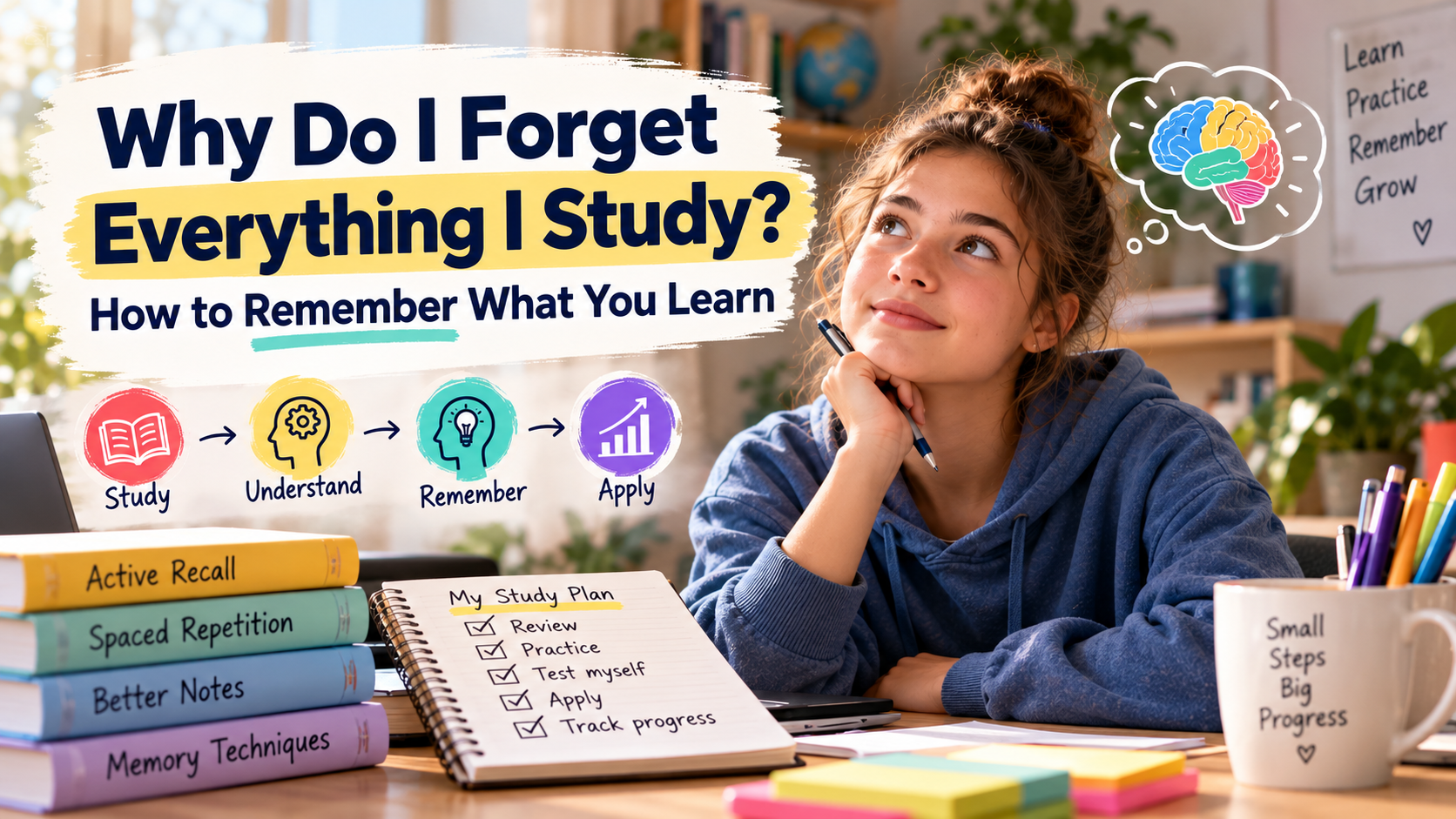
You close your notebook after two hours of studying. The chapter makes sense. You recognize every definition, and when you read the examples, the steps look obvious. Then someone asks you to explain the topic without your notes. The answer disappears.
The experience is frustrating because you did the work. You highlighted paragraphs, watched the lesson again, copied important sentences, and spent the time you were supposed to spend. Yet the next day, or in the exam room, it feels as though none of that effort stayed with you.
Why do you forget everything you study? Often, the information was not learned in a way that made it easy to retrieve later. Sometimes it was never fully understood; sometimes it was learned but not practiced after a delay; sometimes it can be recognized in familiar notes but not recalled independently; and sometimes fatigue, stress, distraction, or a mismatch between study and test tasks makes retrieval harder. Forgetting is normal. The useful question is not simply how many hours you studied, but what you were able to remember, explain, and use after your materials were closed.
There is no universal memory trick that fixes every problem. There is, however, a better way to find where learning broke down. This guide explains the difference between familiarity and durable learning, offers a practical Memory Gap Finder, and walks you through a seven-day plan you can adapt to any subject.
Why do I forget what I study so quickly?
Forgetting is not necessarily evidence that you have a bad memory. Memory is selective, and remembering depends on more than exposure. To use an idea in an exam, you first need to pay attention to it, make enough sense of it to connect it with other knowledge, retain it over time, and retrieve it when the question changes.
Think of a student preparing for a biology exam. Maya spends forty minutes rereading a chapter about photosynthesis. The words become familiar. She can finish sentences in her head because the textbook supplies most of the cues. But when the teacher asks, “Why does light intensity affect photosynthesis, and when would increasing it stop making much difference?” Maya remembers some vocabulary without being able to reconstruct the explanation.
She has not necessarily forgotten every fact. She may be recognizing terms without being able to organize the mechanism or apply it to a new scenario. More rereading would make the passage feel even more familiar, while leaving the underlying difficulty partly untouched.
This difference matters. Researchers Henry Roediger and Jeffrey Karpicke found that practicing retrieval can improve delayed memory for prose passages compared with additional restudying, even when repeated reading creates strong short-term familiarity. Their 2006 experiments do not mean that reading is useless or that every study task should be a quiz. They show why feeling fluent while looking at material is not a reliable test of what you will recall later. Read the research abstract.
It helps to distinguish four checkpoints: Did you understand the idea? Could you remember it without seeing it? Could you remember it after a delay? Could you use it when the question looked different? Each checkpoint calls for a somewhat different response.
The four memory gaps: where does your learning break down?
Instead of labeling yourself “forgetful,” observe one real example of a topic that went badly. Your answer may reveal a specific learning gap rather than a permanent weakness.
Gap 1: You never fully understood the material
A definition can be memorized without its meaning being clear. You might repeat “opportunity cost is the value of the next best alternative” but struggle to explain why choosing to work a Saturday shift can mean giving up time with friends or another paid opportunity.
Try an explanation test. Put the book aside and answer three questions in ordinary language: What does this idea mean? Why does it work that way? What is a concrete example that is not copied from the lesson? If the answer collapses immediately, return to the explanation, prerequisite concepts, or a worked example before asking yourself to memorize more.
Sometimes the missing ingredient is earlier knowledge. A student who struggles to remember a procedure for solving quadratic equations may need help with factoring, signs, or algebraic manipulation. No amount of flashcard review can replace instruction in a prerequisite that never became secure.
Gap 2: You recognize the answer but cannot retrieve it
Have you ever looked at a multiple-choice question and thought, “I know this when I see it,” then gone blank on a short-answer question? Recognition and unaided recall are different tasks. The textbook may be providing hints you do not notice until they disappear.
To test this gap, close the material. On a blank page, reconstruct the main ideas, steps, formulas, or relationships from memory. Do not aim for a polished answer. Write what comes back, mark what is missing, then compare your version with a reliable source. This is a practical form of retrieval practice, sometimes called blank-page testing, described by Cornell's Learning Strategies Center.
A failed first attempt is useful information. If you miss a definition, check it and try again later. If you cannot explain the relationship between two concepts, practice the relationship rather than repeating each definition in isolation.
Gap 3: You remember it tonight but not next week
A study session may produce a convincing performance today without providing enough opportunities to remember the same information later. One marathon review followed by six days of no practice leaves you with little evidence that the learning will last.
Distributed practice, often called spaced practice, spreads learning opportunities across time. The U.S. Department of Education's What Works Clearinghouse practice guide recommends reviewing material after meaningful delays, alongside testing and explanatory questioning. There is no universally correct one-day, three-day, seven-day sequence for every learner and topic. The interval should be adjusted to the deadline, difficulty, prior knowledge, and feedback from your attempts.
The important change is to return to a subject after enough time has passed that you need to reconstruct the idea, instead of relying on immediate familiarity.
Gap 4: You can recite the notes but cannot use the idea
Memorizing the formula is not the same as choosing it in an unfamiliar problem. Remembering the causes of an event is not the same as weighing their relative importance in a historical argument. Repeating an English sentence is not the same as responding in a conversation.
Here the problem may be transfer, not simple memory loss. Work on a fresh problem that uses the same underlying concept but changes the surface details. Explain why your method fits, what assumptions it depends on, and how you would check the result.
For a wider explanation of transferring strategies into authentic tasks, read From Brain Games to Real Learning. The essential point is that success on one familiar exercise does not automatically establish independent use elsewhere.
The Memory Gap Finder: a ten-minute self-check
You do not need an app, personality test, or complicated dashboard to begin. Choose one topic you recently studied and set aside ten minutes. Use a sheet of paper divided into four spaces. The goal is to find the next instructional move, not to score yourself as intelligent or unintelligent.
| Check | Question to answer without notes | What difficulty may suggest | Useful next action |
|---|---|---|---|
| Explain | Can I explain the main idea and give my own example? | Incomplete understanding or prerequisites | Revisit the explanation; work through a model |
| Recall | Can I retrieve the key details, steps or facts unaided? | Dependence on visible cues | Try short blank-page recall with feedback |
| Delay | Can I answer again tomorrow or several days later? | Learning has not held across time | Schedule another retrieval attempt |
| Transfer | Can I use the concept on a changed question? | Practice too closely matched the example | Try varied problems and explain method choice |
Here is how Maya might use the finder. She can explain photosynthesis when the book is open, but with it closed she remembers only the words light, carbon dioxide, glucose, and oxygen. First she reconstructs the causal process in her own words, using a simple diagram. She checks what she left out, then explains how a plant's environment changes the process. The following afternoon, she repeats the explanation without a diagram. Finally, she interprets a new graph relating light intensity to the rate of photosynthesis.
Her result might be: understanding is improving, unaided recall still requires practice, and application to data is not yet reliable. That is a far more actionable finding than “I have a terrible memory.”
This tool is an informal learning reflection, not a standardized memory assessment or a diagnostic test. It also does not establish why someone has persistent memory problems outside studying.
How to remember what you study: build a better learning cycle
A useful study routine has four parts: understand something, retrieve it, check it, and return to it after a delay. The sequence is simple, but each stage asks you to do a different kind of mental work.
First, learn for meaning rather than copying for completeness
Before reading a chapter, look at its headings, essential diagrams, and assigned questions. Ask what problem the chapter is trying to solve. After a short section, stop and describe the idea without borrowing the textbook's wording.
For science, explain a process and predict what would happen if one condition changed. For history, connect an event to its causes and consequences, then decide which evidence supports an interpretation. For mathematics, study one worked example and then attempt a related problem yourself, explaining why each step is valid. For language learning, construct your own sentence or response instead of repeating a model mechanically.
These are not interchangeable activities. Facts, explanations, procedures, arguments, and fluent performance make different demands. Your strategy should follow the kind of knowledge you need to demonstrate.
Then, retrieve before you reread
At the end of a short study block, put your resources away. Write down the essential ideas, draw the diagram again, solve a question, or explain the concept aloud. Try to remember before checking. When something does not come back, mark it honestly rather than immediately peeking at the answer.
Now reopen the correct source and compare. Your notebook becomes a feedback tool instead of the main evidence that learning has occurred. Correct errors precisely: identify the missing step, not just the sentence to highlight. If the information is fundamentally unfamiliar, learn it properly before pushing yourself to retrieve it again.
A 2021 review by Kathleen McDermott describes retrieval practice as a broadly useful approach for supporting retention across different materials and learners. The review does not suggest that effort alone is enough: high-quality material, appropriate task difficulty and corrective feedback still matter. See the research review.
Return after a delay and adjust the interval
The following day, begin with a brief closed-book check. If most answers are accurate and well explained, the next review may be spaced farther away. If the idea has become inaccessible, shorten the interval, correct misunderstandings, and practice again.
Do not interpret spaced repetition as a promise that information will stay forever. It is a way to distribute opportunities for retrieval. The subject matters too: a chemistry equation, a historical comparison, and pronunciation in another language may require different forms of practice, even if each benefits from revisiting material over time.
Studying only the newest topic while abandoning older ones is a common planning problem. Give yesterday's learning a small place in today's session. Some days, reviewing a topic for five purposeful minutes will be more informative than spending another half hour making today's notes look perfect.
Finish with a task that looks different
Your last step is not “I can repeat it.” It is “I can do something with it.” Change a variable, use a new example, respond to a different type of question, or explain the result to someone who cannot see your notes.
For algebra, mixed problem sets help you practice identifying the correct method, not just following repeated steps. For a history essay, use familiar knowledge to answer a fresh prompt. For vocabulary, write a short exchange in which the new words genuinely fit the meaning. You are looking for flexible understanding, not a memorized performance.
Why rereading, highlighting and beautiful notes can mislead you
Rereading can be useful when you are still trying to understand a complex explanation. Highlighting can help you locate a crucial passage. Well-organized notes can support subsequent review. The mistake is treating those activities as proof that you can remember or use the material.
A paragraph becomes easier to process after repeated exposure. That ease can be mistaken for readiness. In their influential review of ten learning techniques, Dunlosky and colleagues judged practice testing and distributed practice particularly useful across a range of circumstances, while highlighting and rereading alone offered more limited benefits as general study strategies. The judgment concerned the research available and the techniques examined, not every possible way of using a textbook. Read the research review.
Try this comparison on your next topic: spend the first part of a session reading for comprehension and selecting essential material. Spend the second part answering questions without the book. If you cannot answer, look for what is missing, relearn it, and test later. You may produce fewer highlighted pages, but you will obtain much better evidence about your readiness.
For related advice on working toward independence with appropriate support, the Learning Coach guide to student independence explains why choosing a strategy and checking the result matter more than appearing busy.
Does sleep affect how much you remember?
Yes. Adequate sleep supports memory formation and learning. Sleep is not a substitute for studying, but inadequate sleep can make attention, understanding, and later retrieval harder. The U.S. National Institutes of Health notes that sleep supports the formation of long-term memories and that insufficient or poor-quality sleep can undermine focus and clear thinking. NIH guidance on healthy sleep.
That matters when you are tempted to trade a whole night's rest for one final round of reading. Staying awake longer is not equivalent to learning more. If you are already exhausted, a shorter review and adequate sleep may be a better choice than repeatedly reading without being able to explain what you see.
Stress deserves attention too. A high-pressure test can make retrieval harder, but a forgotten answer is not automatically proof of anxiety. Notice whether you can answer calmly in a quiet setting, after a delay, and on an unfamiliar prompt. The pattern helps you decide what to practice or whether to seek support.
If memory difficulties are persistent, worsening, widespread in daily life, or accompanied by significant changes in sleep, mood, attention, or functioning, talk with a qualified healthcare professional. A study routine cannot identify or treat a medical or psychological cause.
A seven-day plan to remember more of what you learn
You can test a better learning process over one week without rebuilding your entire timetable. This is a practice plan, not a scientifically validated seven-day treatment or a guaranteed improvement schedule. Choose one manageable chapter or skill; use your school's required materials and adjust the workload to your circumstances.
Day 1 — Find the starting point. Read one short section carefully. Explain its central idea, then attempt the Memory Gap Finder. Record the specific point where the answer became uncertain. Stop before adding new study tools that distract from the task.
Day 2 — Retrieve and repair. Without reopening the chapter first, reconstruct the key content. Compare your work against accurate materials. Correct missing ideas, then try one fresh example. Write down what changed from yesterday.
Day 3 — Revisit after a delay. Begin with a closed-book check. If you remember the facts but cannot explain them, work on the causal connection. If you understand the idea but forget the words, practice retrieving the important language and definitions.
Day 4 — Mix related problems. Combine the original topic with one or two nearby concepts. In math, ask yourself which method applies before doing the calculation. In science, compare similar mechanisms. In history, distinguish two causes or interpretations.
Day 5 — Explain it to a listener. Teach the idea in plain English to a classmate, family member, or empty room. Avoid reading a script. Ask yourself which questions a beginner would raise. Mark anything you cannot answer and return to a reliable explanation.
Day 6 — Practice the real performance. Use a short past-style question, an unfamiliar prompt, a small writing task, or an applied problem. Work under reasonable conditions without excessive prompting. Compare your answer with clear criteria or an accurate model.
Day 7 — Review the evidence and plan the next return. Revisit the topic without notes. Compare the result with Day 1: What can you now explain unaided? Which mistakes have changed? What remains unreliable? Schedule a later review based on that evidence rather than declaring the topic finished because seven days have passed.
What you noticeWhat to do nextI can recognize it but cannot recall it.Use closed-book questions and check against an accurate source.I can recall facts but cannot explain the concept.Study the mechanism, prerequisites and examples.I remember today but forget after several days.Schedule shorter reviews across time with retrieval.I remember the lesson but fail new questions.Practice varied applications and justify strategy choices.I cannot concentrate or feel consistently exhausted.Adjust conditions, sleep and workload; seek support if difficulties persist.
Keep the log brief. The object is to make a decision about learning, not to produce another assignment for yourself.
How should you adapt the method to each subject?
A useful memory strategy is always tied to a learning goal. For biology, you may need to retrieve vocabulary, reconstruct a system, and interpret a new diagram. Flashcards can help with definitions, but not by themselves with a causal explanation. After recalling the terms, ask what changes when a variable is increased, reduced, or removed.
In mathematics, rote repetition of one solution format can disguise a gap in conceptual understanding. Begin with a worked example if necessary, complete a related problem with support, and then attempt a varied problem that requires choosing a method. Explain why your answer is reasonable, and return to prerequisite skills where errors cluster.
In history and literature, you may remember names and quotations without being able to form an argument. Practice recalling the evidence, then answer a question that requires interpretation: What supports this claim? What challenges it? Which detail would change your conclusion?
In a foreign language, knowing a translation is not the same as using a word in context. Retrieve vocabulary, construct original sentences, listen for familiar phrases in a different voice, and practice responding without preparing every word. Mistakes can guide the next practice choice when feedback is accurate and supportive.
The point is not to abandon every preferred method. It is to ask whether the method produces the performance the subject actually requires.
Can AI help you remember, or can it do too much of the thinking?
An AI assistant can generate questions, suggest a different explanation, or help you spot a possible gap in a practice answer. But if it immediately supplies the finished explanation, you may simply recognize the correct response without building the ability to produce it independently.
A safer learning sequence is to study the source, attempt an answer on your own, ask for a hint rather than the full solution, and then verify the feedback against authoritative course materials. You can request three questions that gradually increase in difficulty, but you should still do the retrieval and reasoning yourself.
For a broader look at when AI assistance supports or replaces student thinking, see Claude for Learning: AI Tools for Students and Teachers. Remember that AI explanations and references can be wrong; checking them is part of studying, not an optional final polish.
What if I still forget everything despite trying these methods?
Start by examining the size of the assignment. Trying to remember hundreds of unfamiliar facts after one rushed session is a very different task from retrieving ten well-understood concepts. Narrow the immediate goal, identify essential prerequisites, and make room for repeated practice.
Look at the conditions, too. Are you interrupted every few minutes? Is the material in a language you are still learning? Are you sleeping poorly? Do you have a clear model of what a successful response looks like? Are the exam questions asking for reasoning when your study routine rehearsed definitions only? Each question points toward an actionable adjustment.
An educator, tutor, or learning coach can help by observing what happens during a real task rather than declaring that a student lacks motivation. A learner who cannot explain the concept may need direct instruction; one who understands it but loses track of steps may benefit from planning supports and guided practice. The comparison of academic coaching and tutoring explains how to distinguish those needs.
Emotions also matter. Fear of getting an answer wrong can discourage students from testing themselves honestly. If this is familiar, The Learner's Emotional System offers a broader Learning Coach perspective on confidence, belonging, and the emotional conditions surrounding learning. This book is an additional educational resource, not a clinical treatment or a substitute for the scientific references below.
Frequently asked questions
Why can I remember a lesson while studying but forget it in an exam?
Your notes provide cues, and a familiar example may hide gaps in retrieval or application. Exams may also require you to reconstruct an answer under different conditions. Practice some closed-book recall and changed questions, not just rereading the original example.
How many times should I reread something to remember it?
There is no universal number. Read until you understand the essential idea, then test whether you can retrieve and apply it. Use mistakes to decide what to read again rather than relying on a fixed rereading count.
Is active recall better than flashcards?
These are not competing categories. Flashcards can be one form of active recall if you try to answer before turning the card over. For essays, diagrams, explanations, and problem solving, use retrieval tasks that resemble the skill you need.
Should I study the same subject every day?
Frequent short sessions may be useful, but not every topic requires daily review forever. Space your practice according to difficulty, retention, priorities, and the date you will need the knowledge. Check your recall rather than assuming the timetable alone proves learning.
What if I keep forgetting formulas?
First check whether you understand what the symbols mean and when the formula applies. Retrieve the formula from memory, practice its use on varied problems, and explain how to check the result. Some formulas require memorization; using them intelligently requires more.
Stop asking how long you studied. Ask what you can do now.
The next time you close your notebook and feel that everything has vanished, resist the urge to add another hour of highlighting. Choose one idea. Explain it. Retrieve it without cues. Check what you missed. Return after a delay. Try it in a different question.
That sequence will not eliminate forgetting. It can make forgetting more informative. Instead of seeing a blank answer as a judgment about your ability, you can treat it as evidence about which part of learning needs attention next.
For parents, teachers, tutors, and aspiring learning professionals who want to help students make these decisions themselves, explore Learning Coach training and review the current pathways and requirements. The long-term goal is not a learner who depends on reminders and explanations forever, but someone who increasingly knows how to check their own understanding and choose the next useful step.
