
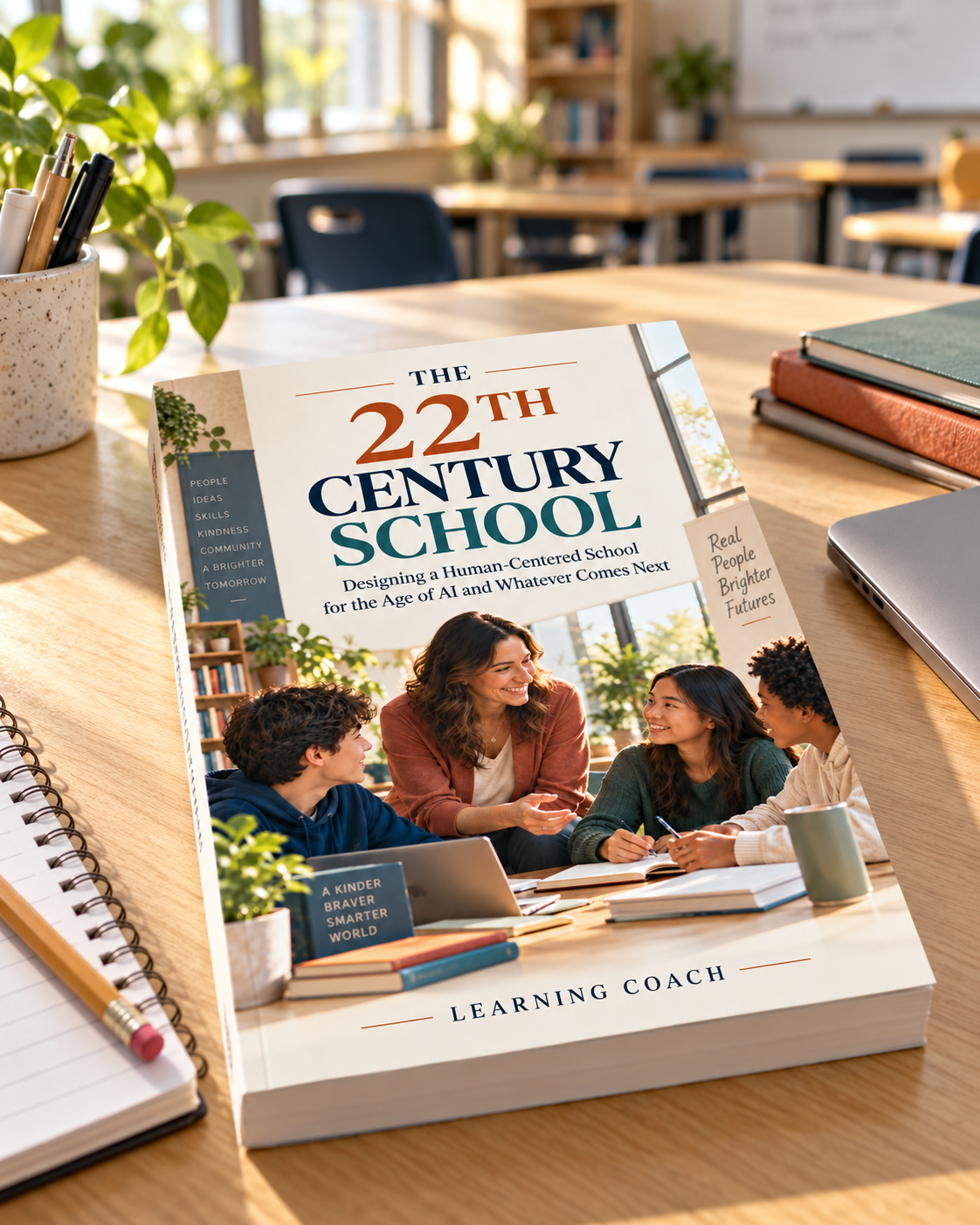
The 22nd-Century School
Designing a Human-Centered School for the Age of AI and Whatever Comes Next
AI can already explain, adapt and answer. But who will help a child build judgment, confidence, character and the ability to learn? This book imagines a school built to remain deeply human—even as technology keeps changing.
The learner is the reason.
What kind of school can remain coherent when technology keeps changing?
This is the central question of The 22nd-Century School. Today's debates often ask whether students should use AI. The book asks something larger: what must a school become so it can thrive with AI—and with whatever arrives after it?
“Which new tool should schools adopt?”
New platforms, policies and devices are added to old structures, often without reconsidering what the whole school is actually designed to do.
“What kind of human beings should education help form?”
Begin with the learner's capacities, relationships, judgment and humanity. Then let technology serve that enduring purpose.
Beyond adding AI to the old school. Redesign the school itself.
The book's vision is not a classroom filled with gadgets. It is a coherent educational philosophy that can withstand decades of unpredictable change.
Keep the human at the center
Technology can expand access to explanations, practice and feedback. A child's growth also requires belonging, ethical guidance, relationships and a trusted human presence.
Move from transmission to transformation
School should measure more than the content delivered. It must nurture deep understanding, transferable skills, self-regulation and the capacity to keep learning.
Redefine the educator's contribution
The Learning Coach brings diagnosis, motivation, judgment, attention, character and individualized support into the foreground—without diminishing the importance of expertise.
Build for a changing century
Design a school whose values remain stable while its tools evolve through AI, robotics, immersive environments and technologies still beyond our imagination.
Let technology help explain. Let humans help learners become.
The book argues for a partnership rather than a competition between teachers and machines. Intelligent tools may take on repeatable instructional tasks; the educator's deeper human responsibilities become more visible, not less important.
Explore the chaptersA journey from the school we inherited to the school we can design.
Explore the book's 11 parts and 49 chapters. Select any part to see the chapter themes drawn from the manuscript's table of contents.
01The School That Brought Us Here
- Before We Criticize the Old School
- A Short History of Teaching
- The Philosophy Behind the Old School
02Why We Must Think One Century Ahead
- Why the Next School Must Be Designed for the Next Century
- The Frankenstein Problem: When Reform Replaces Design
- AI Is Not the Last Disruption
03Why Today's School Is Under Pressure
- When Teaching Does Not Become Learning
- The Global Learning Crisis
- The Teacher Under Pressure
- The New Student: Screens, Distraction, and Fragile Attention
04AI Changes the Question
- The Technology That Speaks Back
- What AI Can Do Better Than the Old System
- What AI Cannot Do
- What Comes After AI: AGI, Robotics, and the Long Horizon
05What a 22nd-Century School Becomes
- From Transmission to Transformation
- The Human at the Center: Introducing the Learning Coach
- The Rise of the Learning Coach
- What the Learning Coach Actually Does
- Coach, Tutor, Mentor: Drawing the Distinctions
- The Coach–AI Partnership
- The Coach Across a Learner's Journey
06The New Pedagogy
- Deep Learning vs Surface Response
- The Rhythms of Real Learning
- Assessment Redesigned
- Building Inner Capacities
- The Formation of Character
- The Architecture of the School Itself
07Beyond the School's Walls
- Parents and the New Partnership
- The Wider Community
- Renegotiating the Contract with Society
- Equity, Access, and the Risk of New Divides
08The Road Map
- How a Single School Begins to Transform
- Training the Learning Coach
- The Policy Question
- The Work of School Leaders
09The Long View
- The Lifelong Learner
- Work in an AI World
- Human Flourishing in the AI Era
- The Slow Century Ahead
10Drawing the Threads Together
- The Child at the Center Revisited
- The Integrated Answer
- What AI Demands of Us
- What Only Humans Can Give
11The Conclusion
- The School That Is Already Being Built
- A Letter to the Teacher
- A Letter to the Child
- What We Promise Each Other
- The Slow River and the Long Light
- Tuesday Evening, Twenty Years Later
Chapter titles reflect the supplied book manuscript; the concluding text follows Part 11.
There is a child at the center of every educational decision.
The book opens with a twelve-year-old at a kitchen table, caught between a printed worksheet, an unreliable school platform and an AI assistant able to explain the same problem immediately.
The question is not whether the machine can supply an answer. It is whether the adults and institutions around that child can build an education in which understanding, attention, agency and humanity grow together.
The 22nd-Century School honors the achievements of mass education while making the case for something more coherent than endless reforms and technological patches.
In the AI era, every learner deserves more than teaching. Every learner deserves a Learning Coach.— The 22nd-Century School · Learning Coach
For anyone who believes the future of education must remain human.
The author addresses the people who teach, lead, care for, coach and create the conditions in which learning happens.
Teachers & tutors
Reconsider the human contribution to learning when explanation and practice can be increasingly supported by AI.
School leaders
Explore how to move beyond isolated reforms toward a coherent design for learning, assessment and school culture.
Parents & families
Understand why the child's development cannot be left entirely to the school—or to the screen.
Learning coaches
Discover the rationale for a profession centered on autonomy, motivation, judgment and long-term learner development.
Policymakers
Consider long-horizon choices about equity, teacher preparation, access and the public purpose of education.
Education innovators
Think beyond the next platform and ask how technology can reinforce an enduring philosophy of human learning.
About the book
A few quick answers before you explore the full argument.
View the Amazon listingIs this book about replacing teachers with AI?
No. Its central argument is that the educator's human role becomes more important as routine explanations, repetition and some individualized support can be assisted by intelligent tools.
Does the book predict what classrooms will look like in 2100?
No. The century-long perspective is a design discipline, not a technological forecast. It asks which educational principles can remain stable even while tools change.
Does it include practical directions for school transformation?
Yes. Part 8 addresses how one school begins to transform, the preparation of Learning Coaches, policy questions and school leadership. The book is a broad educational argument rather than a step-by-step technical manual.
Who is the author?
The book is published under the name Learning Coach, an organization dedicated to developing skilled Learning Coaches who help learners learn more effectively and confidently.
Where can I find the book?
Use the Amazon links on this page to view the listing and see the currently available formats, prices and delivery options for your location.
Don't just ask what AI can teach. Ask what only humans can give.
Across 49 chapters, The 22nd-Century School proposes a longer view: preserve what school achieved, reconsider what it is for, and design the partnership between educators, learners and technology around human flourishing.