

Khan Academy: From YouTube Lessons to AI Tutors (2004–2026)
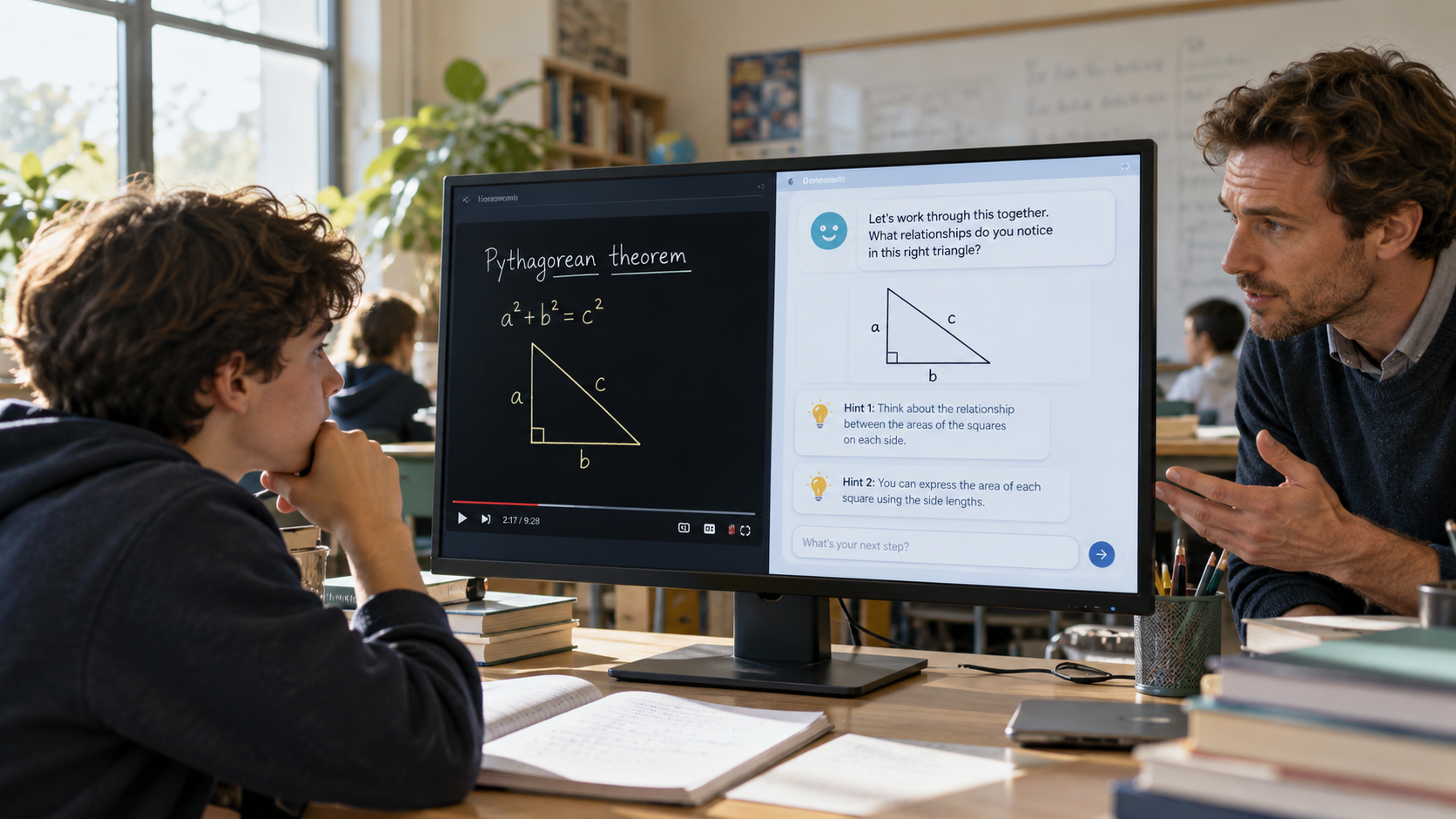
In 2004, a teenager in New Orleans was struggling with mathematics. Her cousin, a finance professional living in Boston, offered to help from a distance. The tools were rudimentary: a telephone, instant messaging, and a digital drawing pad. There was no artificial intelligence, no polished learning platform, and certainly no plan to build one of the world's best-known educational nonprofits.
That small experiment became Khan Academy. More than two decades later, its educational philosophy is confronting a different question. If an AI tutor can explain a problem, ask follow-up questions, and respond instantly, how do we make sure the student—not the software—does the learning?
Khan Academy is a nonprofit learning platform founded by Sal Khan that grew from remote family tutoring in 2004 into a global library of lessons, mastery-based practice, and teacher tools. In 2023 it launched Khanmigo, an AI tutor and teaching assistant. By 2026, its strategy had shifted toward embedding AI directly into guided practice, classroom workflows, and measurable learning outcomes. That evolution is not a straight triumphal story. Its most instructive chapters include both successes and candid evidence that making a tutor available is not the same as getting students to learn with it.
2004–2006: The unlikely beginnings of Khan Academy
Salman “Sal” Khan was working in finance when he began tutoring his cousin Nadia, who was having difficulty with mathematics. From Boston, he helped her in New Orleans through conversations and online drawing tools. As more relatives asked for help, the arrangement became difficult to schedule. Khan started developing practice software and recording explanations that students could replay whenever they wanted.
In his own account, Khan describes beginning the tutoring in 2004; the software and instructional-video approach took shape in 2005–2006. By 2006, lessons were appearing on YouTube. The familiar early format—an invisible instructor, handwritten diagrams, a dark background, and a calm voice—was a practical solution rather than a cinematic invention. It reduced production demands and let viewers concentrate on the reasoning.
The innovation was not simply making math videos. Traditional tutoring is limited by the tutor's available time. Recorded explanations can be paused, replayed, and shared without repeating the same lesson for each person. A student who feels embarrassed asking a teacher to explain fractions for the third time can review an explanation privately, then try again.
There was also a hidden pedagogical insight: the problem was not always ability. Sometimes the learner had an unresolved gap from an earlier topic and needed time to fill it. Khan's experience with Nadia helped shape a lasting argument against treating every student as if they should move through the curriculum at exactly the same speed.
Source: Sal Khan recounts the 2004 story in a Khan Academy interview; see also his conversation with Adam Grant.
2008–2012: A personal project becomes a global nonprofit
As an audience beyond his family began finding the lessons, Khan Academy evolved from a YouTube channel into an organization. The nonprofit was established in 2008, and in 2009 Khan left his finance career to work on the educational project full time. Philanthropic backing, including support associated with the Gates Foundation and Google in the early expansion period, helped the initiative develop beyond a one-person video operation.
Its mission was deliberately broad: a free, world-class education for anyone, anywhere. That formulation matters. Khan Academy was not built around tuition fees or the assumption that high-quality resources should be reserved for wealthy households. It put accessibility at the center of its identity, even though providing the technology, localization, staff, and infrastructure would always require funding.
By the early 2010s, Khan Academy was becoming more than a collection of explanations. Exercises, feedback, skill tracking, and teacher dashboards made it possible to connect watching a concept with practicing it. The platform's impact on educational discussion was amplified by Khan's 2011 TED talk, “Let's use video to reinvent education”, which popularized the idea of using video before class and teacher time for more active help.
This period also revealed a limitation in the phrase “online education.” Video can distribute instruction, but it cannot by itself diagnose why a learner is stuck, build confidence, or adapt classroom relationships. Khan Academy's next developments increasingly addressed those questions with software and teacher-facing information.
The educational idea beneath the technology: Mastery learning
At the heart of Khan Academy is mastery learning: students should have opportunities to understand and practice prerequisite concepts rather than automatically moving on because a calendar has advanced. The idea has a longer history than the platform, notably in the work of educational psychologist Benjamin Bloom, but Khan Academy helped make it visible to large numbers of teachers and families.
Imagine two students beginning algebra. Both are expected to solve equations, but one still misunderstands negative numbers. If the class proceeds in lockstep, the second learner may appear unmotivated when the deeper obstacle is a prerequisite skill. Targeted practice and feedback can reveal the gap more clearly.
Khan Academy's model generally joins three functions. An explanation introduces or clarifies a concept. Practice gives the student chances to retrieve and apply it. Feedback helps the student identify mistakes and try again. Teacher-facing data can show patterns across students so that intervention is more focused.
None of this makes the software a substitute for skilled instruction. Mastery is more than a badge or a streak, and a student's answers on a platform are not a complete picture of conceptual understanding. But the central premise—that learning should be responsive to demonstrated understanding—would later become the basis for its AI strategy.
2012–2019: From video library to educational ecosystem
Khan Academy broadened its subject coverage and partnerships, while creating a more structured experience for schools, teachers, parents, and independent learners. Its materials grew to encompass mathematics, science, computing, economics, history, and other subjects. Interactive learning experiences increasingly sat alongside the videos.
The organization also tested its ideas beyond the screen. Khan Lab School opened in 2014 as an independent school designed to explore student-centered and mastery-oriented practices in a real educational setting. It is a related institution, not evidence that Khan Academy's free online platform became a tuition-based school. The distinction matters when assessing the nonprofit's wider network.
Mobile learning also advanced. In 2015, Khan Academy described a more interactive iPad experience that combined its content with personalized practice rather than simply offering videos on a smaller screen.
That decade's larger lesson was that delivering content was only one part of an education system. Good learning depends on the quality of activities, motivation, opportunities to correct errors, and adults who interpret students' needs. Teachers were increasingly not the audience that digital learning would make obsolete, but the people whose work could be strengthened by it.
Sources: Khan Lab School opening announcement and Khan Academy's interactive iPad expansion.
2020–2022: The pandemic reveals both the value and limits of free learning
When the COVID-19 pandemic disrupted schooling, free digital resources became unusually important. Khan Academy already had lessons and practice that could be accessed outside school hours, and the organization expanded support for families, teachers, and students navigating remote learning.
But the pandemic also exposed the digital divide. Reliable internet, a quiet room, parental support, an appropriate device, and the habit of independent study are not equally distributed. A platform can remove the price of a lesson without removing every barrier to benefiting from it.
Sal Khan also co-founded Schoolhouse.world in 2020, a separate nonprofit focused on free, peer-led tutoring and academic support. That initiative illustrates something easy to miss in an AI-centered narrative: the Khan educational ecosystem still valued human explanation and student-to-student interaction.
When generative AI emerged, therefore, Khan Academy was not approaching personalization from a blank slate. Its existing practice engine, teacher tools, and mastery framework gave it a structure within which an AI assistant might have a more specific educational role.
Source: Khan Academy's explanation of its partner educational organizations.
2022–2023: Khanmigo and the arrival of GPT-4
In 2022, Khan Academy began exploring OpenAI's emerging language models. On March 14, 2023, alongside the public introduction of GPT-4, it announced a limited pilot of Khanmigo, an AI-powered assistant for learners and teachers.
The proposition was more ambitious than a chatbot that gives answers. Khanmigo was designed to behave like a conversational guide: offer hints, ask students to explain their reasoning, support exploration of a problem, and help teachers create instructional materials. For language arts and humanities, conversational formats also opened opportunities for debate, close reading, and writing feedback.
The ambition echoed a long-standing desire for one-to-one support. However, it is important to distinguish a human tutor, who can build a relationship, interpret emotions, and understand a student's history, from an AI tutoring system, which responds to the information and context made available to it.
The initial pilot was deliberately limited because language models can be wrong, including when performing mathematics. They can sound certain while misunderstanding a question, generate inappropriate text, or accidentally encourage a learner to copy rather than reason. The organization said it would test the system, gather feedback, and put safeguards around student interactions.
In classrooms, there were two distinct potential users. A student could ask Khanmigo for assistance on a difficult exercise; a teacher could use its tools to generate lesson plans, prompts, rubrics, or practice materials. Confusing these two use cases would make later claims about impact difficult to evaluate.
Sources: OpenAI's original Khan Academy GPT-4 case study and Khan Academy's 2023 AI timeline.
2024–2025: AI tools move closer to teachers and school systems
Khanmigo's growth was not only about a student's chat window. The teaching assistant gained tools for planning and assessment, and Khan Academy worked to make those tools available through systems teachers already used. In September 2024, Khan Academy announced the integration of its teacher tools into Canvas LMS for eligible U.S. educators.
Its partnership with Microsoft helped expand teacher access internationally. By December 2025, Khan Academy reported that Khanmigo for Teachers was available in a pilot across more than 180 countries and territories, with additional experimental languages. That is a statement about the reach of the teacher product—not a claim that every student worldwide has identical access to Khanmigo tutoring.
The financial and operational reality is also worth recognizing. Khan Academy's traditional core content remains freely available, but AI models create computing, safety, and support costs. The precise availability and terms of Khanmigo differ by user, age, region, and institutional arrangement and should be checked on the official site rather than assumed from the mission statement.
The scale of the wider nonprofit is substantial. Its 2024–25 annual report recorded 189.6 million registered users, 104.9 million yearly active learners, 66.8 billion cumulative learning minutes, and 2 million people who had access to Khanmigo at some point during that school year. These measures are not interchangeable: registration is not active engagement, access is not meaningful AI usage, and neither automatically demonstrates improved achievement.
Sources: Canvas integration, international teacher rollout, and 2024–25 annual report.
The evidence question: Does Khan Academy actually improve learning?
The evidence base for Khan Academy practice is more mature than the evidence for generative AI tutoring. They should never be collapsed into a single claim.
A 2024 report described a randomized controlled trial involving approximately 11,000 students, conducted with University of Toronto researcher Philip Oreopoulos. In relevant elementary mathematics settings, students whose teachers devoted structured time to Khan Academy practice achieved test-score gains of 0.12–0.17 standard deviations relative to the control group after around 35 minutes of weekly use.
Separate large observational studies have associated sustained Khan Academy practice with greater-than-expected learning growth. One analysis across roughly 350,000 students reported an association between at least 18 hours of practice during a school year and about 20% greater-than-expected gains. But association is not automatically causation: highly engaged classrooms may differ from less engaged ones in teacher support, expectations, or resources.
A peer-reviewed analysis published in 2026 examined more than 200,000 students and used within-teacher and within-school changes in usage to estimate the effects of computer-assisted learning in real classrooms. It found modest positive mathematics effects, with stronger projected results at greater use levels. As with all evidence, design, setting, and outcomes matter.
These findings support the value of structured practice. They do not prove that putting a generative chatbot beside every exercise adds the same benefit.
Sources: 2024 randomized trial summary, Khan Academy's efficacy report, and 2026 peer-reviewed study.
2026: Khan Academy admits the first AI model was not enough
One of the most consequential turns came from Khan Academy's own leadership. In July 2026, Sal Khan publicly acknowledged that the first version of Khanmigo, introduced three years earlier, had not changed student learning as much as the organization had hoped. He emphasized that this was not a declaration that AI tutoring had failed; it was a recognition that an impressive conversational tool did not automatically produce consistent learning gains in classrooms.
The problem was partly one of integration. A student already struggling with a problem might not choose to open a separate assistant, formulate a good question, and participate in a useful dialogue. Students can avoid the very productive effort that creates understanding, even when an AI responds politely and accurately.
Khan Academy's response was to redesign the experience. The nonprofit described a major rethink beginning in January 2025, followed by pilots during the 2025–26 school year and a wider classroom rollout in 2026.
In the revised approach, AI support becomes less of a side conversation and more closely embedded in practice. Students can be prompted to justify an answer or reconsider a step, while teachers receive more actionable information about progress and obstacles. The goal is for AI to support thinking through a problem, not outsource the thinking itself.
Sal Khan also stressed that language models still had limitations in generating dependable, curriculum-aligned content dynamically. That strengthened Khan Academy's decision to combine AI with expert-created lessons and practice rather than treating generated content as a replacement for a designed curriculum.
Sources: Sal Khan's July 2026 reflection and Khan Academy's account of its redesigned classroom pilots.
August 2026: A major field experiment puts AI tutoring to the test
The strongest test of the narrative is not whether an AI explanation sounds convincing. It is whether students learn more as a result.
An August 2026 NBER working paper, One Click Away: AI Tutoring with Khanmigo in a Two-Year School Experiment, by Philip Oreopoulos and Nina Low, reported a two-year cluster-randomized trial in 18 Tennessee middle schools. Students assigned to use Khan Academy with Khanmigo during existing remedial mathematics periods experienced gains of approximately 1.3 national percentile ranks per term, equivalent to 0.06–0.08 standard deviations across a school year. The authors reported an implied 0.14-standard-deviation effect for a full year of active participation; that latter number is a participation-adjusted estimate, not a separate observed treatment effect.
The results were encouraging in one respect: this intervention had a positive measured effect in the study setting. But the gains resembled those documented for computer-assisted mathematics practice without AI support. The experiment therefore does not establish a large incremental learning advantage from Khanmigo itself.
The usage data help explain why. Although 96% of students tried Khanmigo at least once, the median student sent messages on only about one-third of practice days. They consulted it in just 17% of sessions in which they made a mistake. Many interactions were short clicks or answer-like messages rather than meaningful dialogue.
The implication is both uncomfortable and valuable: educational AI may be limited less by the ability to generate an explanation than by whether students are willing, able, and encouraged to use that explanation for sustained reasoning.
The researchers' findings concern a particular intervention in particular schools. They do not prove that all AI tutoring is ineffective—or that the redesigned 2026 Khanmigo will succeed. Those are different empirical questions.
Primary source: Oreopoulos and Low, NBER Working Paper 35620, August 2026.
From OpenAI to Gemini: What changed in 2026?
The evolution of Khanmigo is also a story of partnerships, not a single technology provider. The first Khanmigo pilot was built with OpenAI's GPT-4. Later teacher-facing deployments drew on Microsoft's Azure OpenAI Service. In 2026, Khan Academy and Google.org announced work using Google's Gemini models for new classroom features.
In August 2026, Khan Academy and Google described two particularly concrete developments. First, new AI-powered interactive diagrams helped students visualize mathematics and science ideas during learning. Second, an enhanced Practice My Knowledge tool let teachers generate targeted multiple-choice questions, review and edit them, assign scored or unscored practice, and examine structured results.
Those changes are educationally significant because they connect AI outputs to teacher control, practice tasks, and feedback. A generated question should still be checked for accuracy and curriculum fit. An interactive diagram should help a student explain a concept, not merely admire a visual effect.
Google's public announcement said six engineers worked with Khan Academy during a Google.org fellowship. Khan Academy reported preliminary signs of improved engagement and next-problem correctness in its AI development work. Preliminary product measures are not the same as independent evidence of long-term learning gains.
The current picture is therefore not “Khan Academy abandoned OpenAI for Google.” Different models and partnerships have served different stages and tools. What changed most was the design principle: select AI capabilities that support a specific instructional action and then test whether the action helps.
Sources: Google's August 2026 announcement and Khan Academy's Google.org update.
What teachers, parents, and school leaders can learn from this evolution
The Khan Academy story suggests a practical framework for evaluating educational technology: the learning process must remain more important than the interface.
For teachers, begin with the concept students need to master. Use short explanations and deliberate practice, then identify where they struggle. If an AI assistant is available, ask it for hints or alternative representations that students must evaluate. End with an independent task: can the learner now solve a similar problem and explain why the method works?
For parents, use freely available Khan Academy lessons to support a child without turning every interaction into a race to finish homework. Encourage the child to articulate their first attempt, name what is confusing, and compare a new explanation with what they already know. The best question after a successful exercise may be, “Could you teach me how you did that?”
For school leaders, ask harder questions than how many accounts were created. What share of students used the tool consistently? Which skills improved? Were gains measured independently? Did benefits reach learners who were struggling most? Were teachers trained and given time to use the information? What safeguards protect minors and student data?
For educational coaches, the central challenge is especially familiar: assistance should eventually build independence. A useful coaching conversation identifies a learner's goal, asks what they have already attempted, selects a manageable next action, checks the result, and helps them transfer the method to a new problem. AI can support parts of that sequence, but an adult still contributes judgment, trust, context, and responsibility.
This is where Khan Academy's evolution intersects with Learning Coach's focus on learning autonomy. The important question is not whether a teacher can explain more efficiently; it is whether the learner acquires strategies for doing increasingly complex work without continual prompting. Readers interested in this professional stance can explore Become a Learning Coach and the broader Learning Coach professional training overview. These are Learning Coach resources, not Khan Academy products, partners, or evidence for Khanmigo's effectiveness.
The unresolved questions for AI education
Khan Academy's next challenge is a research challenge as much as a product challenge. Can an assistant recognize when a learner needs a question rather than an explanation? Can it fade help at the right moment? Can it distinguish a correct final answer from understanding? Can schools verify the quality and safety of its outputs without imposing impossible workloads on teachers?
Equity is equally important. A child with abundant support at home may use AI thoughtfully, while another may have limited connectivity, little guidance, or significant learning gaps. Lowering the price of access helps, but it does not automatically eliminate unequal circumstances.
There are also tensions between engagement and learning. A lively chatbot may increase time on task while doing too much of the cognitive work. Conversely, an intentionally demanding tutor may feel less entertaining but support durable understanding. The crucial outcomes are retention, transfer, independence, and equitable progress—not the length of an AI conversation.
Finally, the field needs more evidence that isolates AI's added value from the benefits of strong instructional content, well-structured exercises, dedicated practice time, and effective teachers. Khan Academy deserves scrutiny precisely because its nonprofit mission and longstanding instructional platform give it the opportunity to ask those questions carefully.
Khan Academy's story is about learning, not the latest technology
A cousin needed help with mathematics in 2004. Recorded videos made that help reusable. A nonprofit made lessons widely accessible. Practice tools helped students work toward mastery. Teachers gained visibility into learning. In 2023, Khanmigo brought conversational AI into the picture. By 2026, Khan Academy had learned that the next frontier was not making AI speak more fluently, but weaving support into the difficult moments when students actually think.
That is the enduring thread from Nadia's first tutoring session to a classroom using Khanmigo: the purpose of educational technology is not to make answers effortless; it is to help people become more capable of finding, testing, and explaining answers themselves.
Whether the new generation of AI tutoring fulfills that purpose will depend on evidence still being gathered. Khan Academy's most valuable contribution may be its willingness to continue testing the difference between an impressive tool and a meaningful learning experience.
Frequently asked questions
Who founded Khan Academy, and when?
Sal Khan began tutoring his cousin in 2004, developed software and YouTube explanations in the following years, and established Khan Academy as a nonprofit in 2008. The founding story should distinguish the initial tutoring project from the formal nonprofit organization.
Is Khan Academy free?
Its core educational lessons and exercises are free. Khanmigo features and eligibility can differ by student, teacher, institution, region, and current program terms. Check official Khan Academy information for the exact offering.
What is Khanmigo?
Khanmigo is Khan Academy's AI-powered learning assistant and teacher-support tool, first piloted in 2023. It aims to guide student reasoning rather than simply return answers, while providing educator planning and practice tools.
Did Khan Academy replace OpenAI with Google?
No simple one-provider replacement accurately describes the history. Khanmigo began with GPT-4, teacher access expanded through a Microsoft partnership, and new 2026 features involved Google's Gemini models. Features, availability, and underlying models may evolve.
Does research prove Khanmigo is better than traditional practice?
Not yet as a general claim. Khan Academy practice has a substantial evidence base, while the August 2026 randomized experiment found gains in a Khanmigo-supported intervention that were similar to gains observed with non-AI practice software. Demonstrating the AI component's additional effect remains an important question.
