

Finland’s 2026 Learning Support Reform: What Changes for Schools and Students?
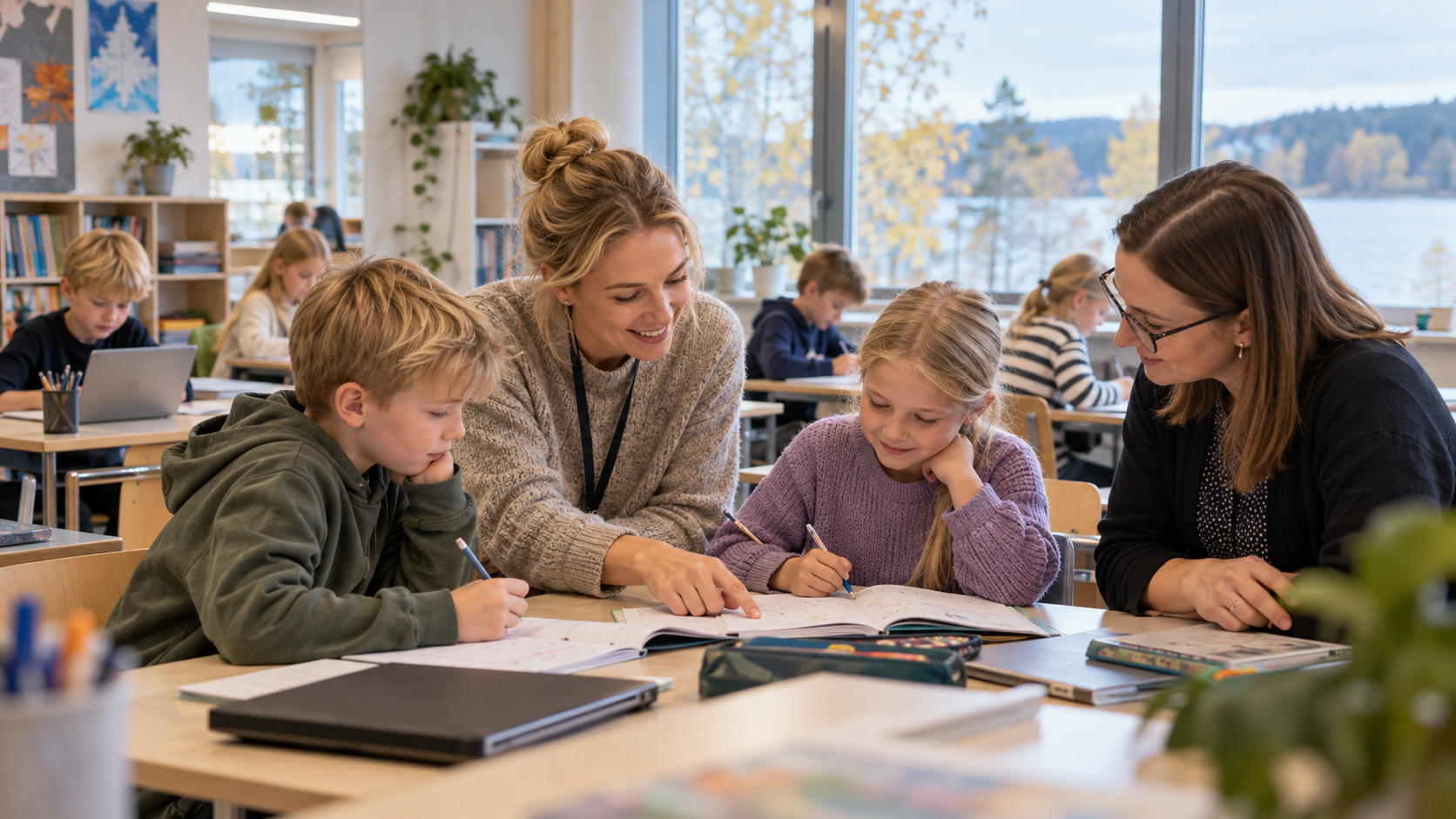
Imagine a Finnish primary-school classroom on a rainy October morning. A pupil has been reading the same paragraph for several minutes without understanding it. The teacher wants to help, but several classmates also need attention. Another adult joins the group, asks the pupil to explain what the words mean and offers a different route into the text. The pupil eventually succeeds—and can explain what helped.
This is an illustrative scenario, not a report from a visited Finnish school. Yet it captures the question behind one of Finland's most consequential current education reforms: Can schools deliver support sooner, without turning children into permanent recipients of adult help?
The Finnish learning support reform changed the basic framework in August 2025, and important remaining provisions entered into force in August 2026. On 14 September 2026, the Finnish National Agency for Education issued additional curriculum changes that education providers must reflect in local curricula. The reform seeks earlier, better-organized help, including support in ordinary teaching groups and more individualized arrangements where necessary. But legal change is not the same as proven improvement in children's learning. Finnish National Agency for Education: September 2026 update; August 2026 implementation notice.
The real test is not simply whether a support system has been renamed. It is whether a pupil receives the right help, at the right moment, makes measurable progress and develops the confidence and strategies to learn with increasing independence.
What happened in Finnish education in 2026?
It is easy to describe this as a completely new 2026 reform. That would be misleading. Finland's main legislative overhaul of learning and school-attendance support took effect on 1 August 2025, when the previous categories of general, intensified and special support began to be replaced in basic education by an approach distinguishing support available to teaching groups and measures targeted to individual pupils. The Finnish National Agency for Education's explanation of basic education describes the framework and its inclusion principles.
The school year 2025–26 was therefore an implementation and transition period rather than a period of waiting for the reform to begin. Yle reported in August 2025 that schools were preparing for more co-teaching, remedial instruction during the school day and additional staffing. Its report also highlighted that the changes would look different from school to school because existing arrangements and resources differed.
Then came two important 2026 milestones.
On 1 August 2026, the remaining legislative changes related to learning support in pre-primary and basic education came into force. These included provisions replacing the previous extended compulsory-education arrangements with early compulsory education for eligible children whose disability, illness or limitation in functioning affects learning, alongside updated arrangements for education in specified circumstances. Early compulsory education applies to eligible children beginning in the year they turn six; it does not mean that every Finnish child now starts compulsory basic school at six. See the official August 2026 announcement.
On 14 September 2026, the national education agency announced a further amendment to the National Core Curriculum for Basic Education, mainly clarifying arrangements for pupils whose disability, illness or functioning limitations affect learning. It said the changes entered into effect immediately and were to be reflected in local curricula. That is a curricular clarification of an evolving reform, not evidence of a new nationwide teaching method invented in September. Official September announcement.
A further August 2026 funding notice explained changes to the criteria and coefficients used in state financing of certain pre-primary and basic-education arrangements from 1 August. That administrative detail matters: a promise of support must ultimately be matched with actual staff time, expertise and workable funding.
Why change a school system already admired around the world?
For years, Finland has been presented internationally as an example of trusted teachers, accessible schooling and comparatively low-pressure learning environments. The familiar story has genuine foundations: comprehensive education is publicly funded, teachers and municipalities have significant professional and organizational autonomy, and schools are expected to support individual development. Those elements are described by the Finnish National Agency for Education.
But admiration can make a country seem frozen in an imagined golden age. A highly regarded education system still faces differences between students, pressure on classroom resources and changing needs. Inclusion is not achieved by reputation.
What happens when a child needs help decoding a text while another needs a quieter workspace, another is learning Finnish as an additional language and another requires specialist support? A system may formally guarantee access while the day-to-day experience depends on staffing, school leadership, timetables, accessible materials and collaboration with families.
Finland's shift is therefore interesting for two reasons. It changes how support is organized, but it also invites a deeper question about how teachers should identify and respond to learning barriers before failure accumulates.
At the same time, we should resist the attractive but simplistic claim that any one national reform can erase educational inequality. Policies can improve entitlements and procedures. Their effects on children's literacy, mathematical understanding, belonging and independence still need to be examined.
Group-based help and individual help: a difference that matters
The reformed Finnish approach emphasizes teaching arrangements that support learning, group-based forms of support, and pupil-specific support measures when the group arrangements are not sufficient. The official English-language description also notes circumstances in which curriculum objectives or syllabuses may be adjusted through the relevant processes.
The distinction can sound bureaucratic, yet its educational implications are concrete.
Consider a Grade 4 class working with fractions. Several pupils have not grasped that two differently shaped pieces can represent the same proportion. Rather than immediately treating each child as an isolated case, a teacher may adapt the lesson, use physical objects, provide a small-group explanation or coordinate with another professional. That is the logic of making support available as a normal part of teaching.
Now imagine one pupil continues to struggle after those measures. The responsible staff should consider additional, properly arranged pupil-specific support, not simply continue the identical activity and hope the difficulty disappears.
Inclusion does not mean identical instruction. It means ensuring meaningful access to learning while recognizing that some learners require specialist instruction, adapted environments or formal decisions. The precise obligations are defined by Finnish rules, not by an informal coaching technique.
Yle's August 2025 reporting described the planned increase in co-teaching and the emphasis on providing remedial support during the school day. It also reported classroom-composition requirements relating to pupils who need support. Those media summaries are useful descriptions of the launch, but schools and families should rely on current official guidance for the exact application of legal thresholds.
The central advantage of a group-first arrangement is the possibility of reducing delay and avoiding needless stigma. The danger is that group-level help could be mistaken for sufficient help in every case. A reform succeeds only when both responsibilities are met.
What Finnish teachers and school leaders have been saying
A good education story needs more than government documents. It should also ask how the policy is being experienced by the people responsible for applying it.
In February 2026 reporting by Svenska Yle, schools in Pargas described their experience of the new model. The report discussed coordinators supporting schools and the aspiration to deliver help more quickly with less paperwork. It also reported a school leader's view that sufficient resources and small teaching groups were important conditions for success.
That is not a nationwide impact study. Pargas is one locality, and an individual account cannot establish that all Finnish schools have improved or deteriorated. Nevertheless, the story reveals a crucial implementation tension: earlier support requires people who have the time and knowledge to provide it.
It is tempting to evaluate a reform by counting new administrative procedures. Teachers know that the lived version of a reform is decided in much smaller moments: who notices a child is lost, who has time for a conversation, whether two adults can actually plan together, and whether a referral produces an appropriate response before the next assessment.
Finland also has a broader commitment to safety and equity. In a June 2026 statement, the education agency emphasized that educational institutions must identify learners at risk of exclusion and consider the support they require. That statement concerns inclusion across education, including vocational education; it should not be confused with a direct evaluation of the basic-school support reform.
The unresolved question: are children learning, or merely receiving more support?
This is where Learning Coach's editorial perspective becomes useful.
Schools can count hours of remedial teaching, staff positions or completed support plans. Those are legitimate indicators of provision, but they do not fully describe learning. A child might receive many explanations while remaining unable to solve a similar problem independently. Another pupil might require continuing accommodations and specialist help yet simultaneously make significant gains in using effective learning strategies.
The distinction is not between receiving support and being independent, as if the two were opposites. The aim is appropriate support that enables meaningful participation and growth. For some students, independence means gradually doing a task unaided. For others, it means knowing which assistive tool to use, identifying when help is needed and communicating that need effectively. The goal must be suited to the learner.
A credible evaluation of Finland's reform would therefore ask several kinds of questions.
Access: How long does it take from an identified difficulty to an appropriate response? Are families and pupils informed clearly?
Quality: Is the response pedagogically suitable? Do educators have adequate specialist knowledge, preparation time and support?
Progress: Is the child learning the intended content and participating more meaningfully, with the relevant accommodations?
Agency: Can the pupil recognize strategies that help, describe a difficulty, monitor progress or request appropriate support?
Equity: Do these improvements reach schools and pupils with different language backgrounds, disabilities and socioeconomic circumstances?
We have not identified a rigorous national outcome evaluation published by 16 October 2026 that would establish the causal impact of these latest measures on these indicators. Claims that the 2026 changes have already solved learning difficulties would therefore be premature.
From delivering help to coaching the learning process
Learning Coach's proposed contribution is a change of pedagogical focus: not merely asking how much teaching occurred, but asking what changed in the learner. This is an educational position, not a claim that Finnish authorities adopted Learning Coach or that coaching can substitute for special education.
The approach draws on an internal Learning Coach lesson about the coaching stance: explicit goals, awareness of one's own learning, mobilizing available resources, autonomy and support designed not to create unnecessary dependency. In a school, these ideas must be adapted to teaching responsibilities, developmental needs and the pupil's rights.
A teacher working in this way still teaches directly when that is necessary. They explain a concept clearly, model a procedure, and make accommodations as required. But once a learner can participate, the teacher also asks questions that help the pupil notice the process rather than merely repeat the answer.
Instead of always saying, “Here is the next step,” the educator might ask, “Which part can you already do?” Instead of praising speed alone, they might ask, “What did you try when you were stuck?” Instead of solving the same problem every time, they might help the student build a cue card that can be used independently.
In Learning Coach terminology, an Enseignant Coach, or Teacher Coach, is an educator integrating coaching-of-learning principles into classroom teaching and tutoring. This should not be confused with an instructional coach, who typically supports teachers' professional practice. Educators interested in exploring the professional approach can review the Learning Coach training pathway; they should check the current program and eligibility details directly before assuming any specialist certification is available.
The point is not to replace differentiated teaching with motivational conversation. It is to help teachers connect support, evidence of learning and learner agency.
A practical classroom example: support without dependence
Consider another expressly fictional example. Elias is eleven and can decode a short science article but struggles to identify the main idea. His teacher first discovers that he is spending so much energy decoding unfamiliar words that he loses the meaning of the paragraph.
A poorly calibrated response would be to ask him to reread the same page repeatedly. Another weak response would be to supply the summary every time, allowing the assignment to be completed but never addressing the underlying learning problem.
A more purposeful sequence might begin with a short assessment of reading and vocabulary needs. The teacher checks whether Elias needs formal additional support and consults the relevant specialists. They explicitly teach a manageable strategy: preview keywords, read a short section, restate the central idea, then check it against the text.
At first, the adult models each step. Then Elias tries one section with prompts. Later, he chooses the relevant prompts himself. At the end, the teacher asks him to say when the technique helped and where it failed.
If Elias continues to need structured assistance, it remains available. Fading a prompt is not the same as withdrawing a required accommodation. The measure of progress is whether the learner gains relevant understanding and tools, not whether adults can leave the pupil alone more quickly.
This is one way to connect the spirit of timely support with the practice of building learning competence. It is not a claim about the activities used in any particular Finnish school.
Five implementation choices that matter more than slogans
1. Make the first response fast and specific
A child who is struggling in mathematics does not benefit from a vague promise to “work harder.” Teachers need to locate the difficulty: number sense, a concept, language in word problems, memory of a procedure or anxiety during assessment. These possibilities are not interchangeable.
A brief, appropriate check can inform the next lesson while specialists address needs outside the general teacher's scope. The question is not “Does this student deserve help?” but “What help is appropriate, and how will we know whether it works?”
2. Make co-teaching a real practice, not a staffing label
Two teachers in the same classroom do not automatically produce effective co-teaching. They need a plan for responsibilities, materials, grouping, assessment and follow-up. One could lead a common explanation while another runs a targeted check, or both could rotate groups with distinct tasks.
The design should remain flexible. Small-group work can support learners without permanently labeling a fixed set of children as weak. Conversely, a pupil who needs a specialized setting should not be denied it merely to preserve the appearance of inclusion.
3. Keep families informed in plain language
Parents should be able to understand what a school has observed, what measures are being tried, what next steps may follow and how progress will be reviewed. School professionals should distinguish ordinary teaching adjustments from measures that trigger formal entitlements or decisions.
An accessible explanation may be especially important for multilingual families. Education systems should not treat a parent's limited familiarity with bureaucratic language as lack of concern for their child.
4. Evaluate learning, not just compliance
A quiet classroom is not always a learning classroom. Neither perfect behavior nor a neatly completed worksheet guarantees understanding. Ask students to explain a concept, transfer it to a different context or identify a strategy they would choose next time.
For pupils with disabilities or complex needs, evaluation must remain fair and appropriate to individual goals and access arrangements. Coaching questions complement professional assessment; they do not replace it.
5. Protect teacher time and specialist expertise
No amount of enthusiasm cancels the need for prepared staff. When governments expand learning-support expectations, they must also attend to scheduling, workload, appropriate training, collaboration and budgets.
This is the structural lesson of Finland's reform for international observers. A classroom technique can improve interactions. It cannot, by itself, create a special education teacher, finance accessible materials or guarantee equal municipal provision.
What should parents in Finland ask their child's school?
Parents do not need to master the entire legislative framework to have a constructive conversation with a teacher. A useful starting question is: “What does my child find difficult, and what have you observed that helps?”
From there, discussion can become more precise: What is the current learning goal? Which group-level arrangements are in place? How will the school determine whether additional pupil-specific support is necessary? Who will coordinate follow-up, and when will progress be reviewed?
Parents can also ask what strategies the child is learning to use, rather than focusing only on completed homework. If there are persistent or significant concerns, the relevant school professionals should explain available assessments and formal support procedures. A family should not be expected to solve a school's statutory duties through private tutoring alone.
For parents elsewhere in the world, these questions are transferable, but Finnish legal entitlements are not. Each country has its own processes, eligibility rules and specialist services.
What can other countries learn from Finland—and what should they not copy blindly?
The first lesson is that support should ideally begin before a child accumulates repeated failure. The second is that a learner may need help within a shared classroom community and, at times, specialist arrangements beyond it. The third is that implementation depends on the adults and resources available, not simply on the policy language.
But copying the phrase “Finnish model” without examining local conditions is a mistake. Finland's professional teacher autonomy, municipal responsibilities, pre-primary arrangements and public-financing system are part of the context. An education ministry elsewhere cannot reproduce the effects of those institutions merely by renaming categories of support.
International comparisons are most useful when they sharpen a practical question: What structures make it easier for every child to receive timely, appropriate help and become a more capable learner?
Learning Coach argues that this structural work should be accompanied by attention to metacognition, feedback, motivation and progressively greater learner agency. Those practices deserve careful implementation and evaluation, not automatic promises of higher test scores. Readers who want to explore the broader professional philosophy can discover the available English titles in the Learning Coach books catalog.
Frequently asked questions about Finland's 2026 school reform
Did Finland abolish special education in 2026?
No. The reform restructured the way support is provided, but pupil-specific measures and special educational arrangements remain part of the framework. It would be inaccurate to describe a shift toward more support within teaching groups as a ban on specialist support. See EDUFI's description.
Did the whole reform start in August 2026?
No. Major changes started on 1 August 2025. Further provisions followed on 1 August 2026, and national curriculum clarifications were published on 14 September 2026. The chronology matters when interpreting news reports about the changes. Official 2026 notice.
Does every child now begin Finnish compulsory schooling at age six?
No. The 2026 changes to early compulsory education concern eligible children in specified circumstances. Finland's usual comprehensive-school starting age is still seven, with pre-primary education normally at age six. EDUFI background.
Does the reform guarantee smaller classes everywhere?
No such nationwide outcome should be assumed from a policy announcement. Staffing and teaching-group arrangements need to be assessed against current rules and local delivery. Media reporting has emphasized that resourcing and school-level implementation matter. Yle report on schools; Svenska Yle in Pargas.
Has the reform already improved Finnish student achievement?
The legal developments and implementation reports cited here do not establish a causal effect on student achievement. Any credible judgment would need outcome data, comparable measures, sufficient time and attention to differences between pupils and schools.
The deeper lesson: support should lead somewhere
Finland's 2026 education news offers a useful correction to two educational myths. The first is that an admired school system no longer needs to change. The second is that a new support entitlement is valuable only if children eventually stop needing help.
Some students will always need particular accommodations or specialist assistance. The ambition is not to eliminate those rights. It is to make support timely, humane and effective, while helping each learner develop as much understanding, self-knowledge and agency as possible.
For teachers, that means moving between explanation, observation, differentiation, appropriate referral and coaching questions. For school leaders, it means creating conditions in which such work is genuinely possible. For policymakers, it means testing whether changed rules produce meaningful improvements rather than celebrating implementation dates alone.
The most important question to ask in a classroom is not simply “Was support provided?” It is “What is this child now better able to understand, do, explain or ask for—and what should we change next?”
For educators and learning professionals who want to explore this complementary pedagogical perspective, discover the Learning Coach training pathway and its Teacher Coach focus. Formal special education duties, school qualifications and local laws remain essential and separate.
Sources
Finnish National Agency for Education — Curriculum clarification, 14 September 2026 (Finnish)
Finnish National Agency for Education — Funding arrangements, 26 August 2026 (Finnish)
Finnish National Agency for Education — Basic education and learning support (English)
Yle News — Schools hire more teachers as support rules change, 6 August 2025 (English)
Svenska Yle — Local experience of the new support model in Pargas, 27 February 2026 (Swedish)
Finnish National Agency for Education — A safe learning environment, 22 June 2026 (English)
