
How to Use ChatGPT to Study Without Letting AI Do the Thinking for You
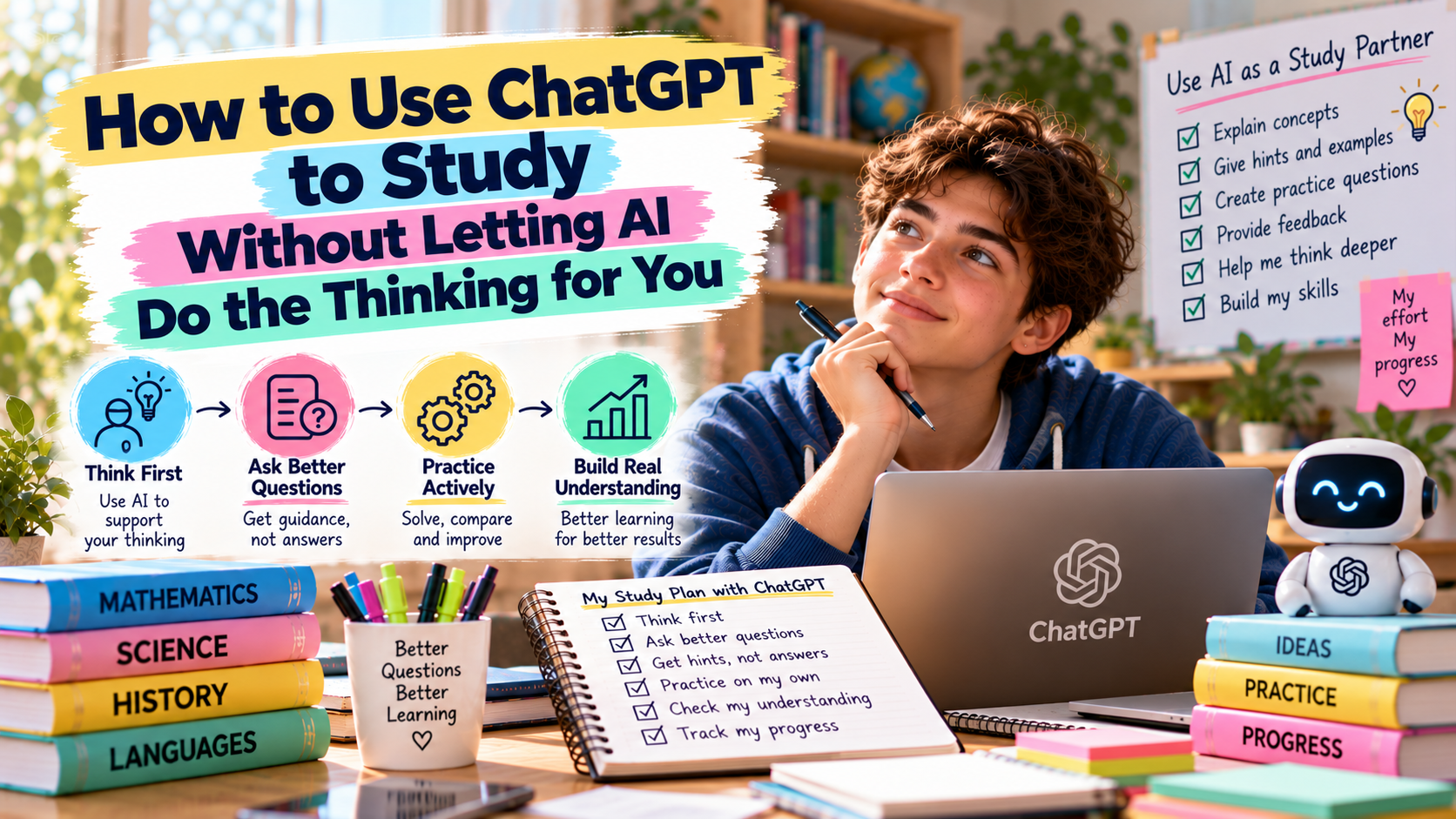
You have a math assignment open, an exam next week, and ChatGPT ready to answer almost anything. You type a question, receive a beautifully organized explanation, and feel immediate relief. Five minutes later, you have a completed solution.
But there is a more important question: Could you solve a similar problem if ChatGPT were unavailable?
That question changes how you use artificial intelligence to study. An AI assistant can explain unfamiliar vocabulary, provide hints, generate practice questions, challenge an argument, and help you organize revision. It can also make it extraordinarily easy to skip the mental work that learning requires.
How can you use ChatGPT to study without letting AI do the thinking for you? Make an independent attempt first, ask for limited help at the precise point where you are stuck, verify the explanation against trustworthy material, and finish with a fresh question you can answer without ChatGPT.
This guide is built for students, not school administrators or software buyers. It includes a complete twenty-minute study session, ten copy-ready prompts, examples from mathematics, science, history and languages, a practical decision table, and a seven-day starter routine.
The central idea is simple: use ChatGPT to improve the quality of your practice—not to replace the practice.
Can ChatGPT help you study effectively?
Yes, ChatGPT can be useful for studying, but the way you use it matters more than how quickly it produces an answer.
Suppose you are learning quadratic equations. You ask ChatGPT to solve ten problems and carefully read the solutions. That may clarify a procedure. It does not establish that you can choose and carry out the procedure yourself.
Now change the interaction. You attempt the first problem, explain where you get stuck, request one hint, and try again. When finished, you ask for a different problem, close the AI window, and solve it independently. That is a stronger opportunity to observe what you have actually learned.
The distinction is supported by increasingly relevant evidence.
The OECD Digital Education Outlook 2026 concludes that generative AI can support learning when it is guided by clear educational purposes. It also warns that better immediate task performance does not necessarily mean better underlying learning when the tool carries too much of the cognitive work.
A 2025 experiment with nearly one thousand high-school math students in Turkey compared two AI-assisted practice conditions with a control group. Students using an unconstrained AI interface performed better during practice, but performed worse than controls on a later assessment without AI. A second, carefully scaffolded tutor condition largely removed that negative effect, though it did not produce a clear positive independent-test advantage in the study. These findings apply to the experimental setting and specific math tasks; they do not prove that ChatGPT always harms learning or that every guided chatbot improves it. Read the peer-reviewed study.
The lesson is not “never use AI.” It is never confuse help completing a task with evidence that you learned how to do the task.
The difference between asking for help and outsourcing your thinking
Two requests can look almost identical but produce very different learning opportunities.
Outsourcing: “Write my history argument about the causes of World War I, with quotations and a conclusion.”
Learning support: “I have drafted my own claim about the causes of World War I. Ask me two questions that test my reasoning. Do not write my paragraph. Tell me which evidence I need to verify in the original sources.”
The first delegates the reasoning and writing. The second preserves those activities for the student.
This is a continuum, not a moral judgment about every use of technology. Some forms of assistance—for example, accessibility support, definitions of unfamiliar words, or help navigating approved materials—may be entirely appropriate. Some academic tasks explicitly require students to analyze AI output. What matters is which intellectual skill the task is meant to develop or assess, and which forms of assistance are allowed.
Before opening ChatGPT, decide:
What do I need to be able to do by myself when this study session ends?
If you cannot answer that question, you risk measuring success by the quality of the generated text rather than your growing competence.
A three-part habit: FIRST, HINT, PROVE
You do not need a complicated prompt-engineering system to protect your learning. Use three checkpoints.
FIRST — Make a first attempt. Read the question, recall what you can, and write your own initial steps or explanation. The attempt may be incomplete. Its purpose is to reveal what you know and where you need help.
HINT — Ask for the smallest helpful intervention. Request one question, one cue, one worked comparison, or a simpler explanation. Ask ChatGPT to wait while you respond. If you genuinely lack the prerequisite knowledge, request a correct instructional explanation rather than forcing yourself into repeated guessing.
PROVE — Show what remains without AI. Close or hide the conversation. Solve a new problem, explain a concept, critique a source, or answer a question without generated wording. Check the result against a trustworthy source or rubric.
The FIRST–HINT–PROVE routine is a practical template developed for this article, not a scientifically validated treatment or a proprietary psychological scale. It translates established learning principles into a manageable student habit.
Research on retrieval practice supports checking what can be recalled without the answer displayed. The U.S. Institute of Education Sciences recommends quizzes, spaced learning, and explanatory questions as ways to support learning and retention. See the What Works Clearinghouse practice guide.
The habit is flexible. If you are studying a completely unfamiliar concept, “FIRST” might mean listing what you already know and asking one relevant question—not pretending you can solve advanced work without instruction.
A complete 20-minute ChatGPT study session
Here is a realistic way to use ChatGPT for one small, well-defined learning goal. The timing is an example, not an experimentally established ideal.
Minutes 0–3 — Define the learning goal.
Write: “By the end of this session, I should be able to solve a linear equation with brackets and explain why each step is valid.”
Then try 3(x + 2) = 18 on paper, without AI.
Minutes 3–6 — Identify the first gap.
You may know that the answer is x = 4, but be uncertain why dividing both sides by 3 is permitted.
Ask ChatGPT: “I have tried the problem. Do not solve it for me. Ask me one question that will help me explain why I can divide both sides by the same nonzero number.”
Answer the question before requesting more guidance.
Minutes 6–11 — Work through a supported example.
If you remain stuck, ask for a concise explanation of the rule or for an analogous worked example with different numbers. Compare it with your course method. Then return to your own problem and finish it independently.
A useful assistant makes the next learner action clear. It does not simply produce a longer solution.
Minutes 11–15 — Check and correct.
Show your work and ask: “Identify the first step that may be invalid. Ask me to correct it before giving the answer.”
Verify your result by substituting x = 4 into the original equation: 3(4 + 2) = 18.
Minutes 15–18 — Close the tool and transfer.
Without looking at the chat, solve a changed equation such as 5(x − 1) = 20. The correct answer is x = 5. Explain the operations aloud or in writing.
If you cannot solve the new problem, you have useful information: more learning is required. That is better evidence than a completed answer copied from a chat window.
Minutes 18–20 — Plan the next review.
Record one sentence: “I can isolate the variable, but I still confuse the signs when removing brackets.” Schedule a short independent return later in the week.
A twenty-minute session with a checked, unaided final attempt can be more informative than an hour of reading explanations while never testing your own ability.
What should students ask ChatGPT to do—and not do?
Use this decision table when you are about to type a prompt.
| Study goal | Ask ChatGPT to… | Avoid relying on it to… | Independent proof of learning |
|---|---|---|---|
| Understand a new concept | Explain one confusing point, ask about prior knowledge and provide a checked analogy | Replace every original explanation or textbook example | Explain the concept accurately in your own words |
| Solve mathematics | Give one hint after your attempt and question the first incorrect step | Complete all the homework problems before you try | Solve a changed problem with justified steps |
| Memorize essential knowledge | Ask one practice question at a time and correct responses | Generate perfect flashcards and assume that means you remember | Retrieve after a delay with no hints |
| Improve a history argument | Challenge your claim and suggest questions for source verification | Invent quotations or write the assessed argument as your own | Defend the claim with original evidence |
| Practice a language | Role-play, pause for your response and provide selective correction | Write every message, script and translation for you | Communicate a fresh meaning without generated wording |
| Prepare for an exam | Help sort topics into practice tasks and test weak areas | Guarantee results based on a polished revision plan | Attempt representative questions independently |
| Review a draft | Ask clarification questions and point out places to check against the rubric | Rewrite all the evaluated reasoning without permission | Explain and justify your revisions |
The boundary changes with the task. If your assignment explicitly evaluates your ability to critique generated text, working with an AI-written example may be central. If the assignment measures independent essay writing, using AI to write the essay may defeat the purpose or violate the rules.
Always check the instructions for the particular assignment. General advice about good learning does not override school, university, examination-board, or instructor requirements.
Ten ChatGPT prompts that keep students doing the thinking
These prompts are ready to adapt. Insert your topic, level and learning objective where indicated. They are suggestions, not guarantees that the model will obey every instruction or supply a correct answer.
1. The tutor that does not reveal the solution too early
I am studying [topic] at [level]. My goal is to [specific performance]. Ask what I already understand. Give me one question or hint at a time. Wait for my response before continuing. Do not give the full solution unless I specifically ask for an explanation after I have tried.
Use it when: A problem seems difficult but you can attempt at least the first step.
Your job: Actually answer the questions. Do not keep pressing “next” until the model reveals the solution.
2. The “find my first wrong step” prompt
Here is my attempt at [problem]. Identify the earliest step that may be incorrect, but do not rewrite the whole solution. Ask me to explain that step and let me correct it. If the problem statement or answer is ambiguous, tell me what needs verifying.
Use it when: Your math or science answer is not working, but you want to repair the reasoning.
Your job: Find and fix the error yourself. Then verify the final result through calculation, substitution, or an approved answer key.
3. The active-recall quiz partner
I have studied [topic]. Ask me five questions one at a time, starting with essential recall and moving toward explanation and application. Wait for each answer. After I respond, give concise feedback and note uncertainties that require checking in my course materials.
Use it when: You want to test retention rather than reread.
Your job: Close your notes for the first attempt, then check them afterward.
4. The teach-back interviewer
I will explain [concept] as if I were teaching you. Listen to my explanation. Ask one follow-up question that tests an important assumption or relationship. Do not supply a perfect model explanation until after I have answered.
Use it when: You think you understand a topic but are not sure you can explain it.
Your job: Speak or write your own explanation before reviewing feedback.
5. The changed-example challenge
I have just practiced [skill]. Generate a new problem that uses the same principle but changes the surface details. Do not label the method or show the answer. Wait for my attempt and then help me check it.
Use it when: Your practice is becoming too familiar.
Your job: Identify the relevant principle and solve the new problem without relying on the previous worked example.
6. The source-check challenge
I am investigating the claim [claim]. Help me divide it into checkable statements and suggest which types of primary or authoritative sources could verify them. Do not invent citations, quotations or page numbers. Mark uncertainty clearly.
Use it when: You are studying history, science, social studies or current events.
Your job: Open the actual sources and inspect the evidence. A plausible AI citation is not proof that the source exists or supports the claim.
7. The exam question planner
I have an assessment on [topics] that requires [types of questions]. Help me create a study plan made mostly of independent practice tasks, including retrieval and application. Ask which topics I find difficult and what time is realistically available. Avoid assuming I can study for unlimited hours.
Use it when: You need a structured plan that does not become another long list of things to read.
Your job: Attempt the practice tasks without the plan-generating assistant doing them for you.
8. The conversation partner
Help me practice [language] for [realistic situation]. Play one role. Speak or write at an appropriate level and wait for my response. Give brief correction after I attempt the message. Include a slightly different situation at the end so I must respond spontaneously.
Use it when: You want to use vocabulary and grammar in communication.
Your job: Produce original language, not merely translate model-written sentences.
9. The respectful essay critic
I have written this paragraph myself for [assignment]. The rubric values [criteria]. Do not rewrite the paragraph. Ask two questions that reveal a missing justification, weak structure or unverified claim. I will revise the paragraph myself.
Use it when: Revision and feedback are allowed, but your assessed writing must remain your own.
Your job: Make the substantive decisions and verify quotations or evidence.
10. The “prove it without AI” exit ticket
We have just worked on [topic]. Give me a fresh question that checks whether I can explain or apply the idea without you. Do not provide hints or the solution. I will close this chat, answer on paper, then return to verify the result against an approved source.
Use it when: You are ready to end the study session.
Your job: Actually leave the conversation and complete the independent attempt.
These prompts are tools for organizing behavior, not standardized educational interventions. A well-worded prompt cannot substitute for a correct explanation, sound instruction, or the learner's willingness to try.
How to use ChatGPT Study Mode without becoming dependent on it
ChatGPT includes a Study experience designed to support step-by-step learning through questions, hints, and checks rather than only giving finished answers.
As described in OpenAI's current Study Mode guidance, logged-in users can select Study from the appropriate composer or tools menu; interfaces can differ across devices and versions. The guidance also explains that the feature may sometimes give a direct answer and that its content can still contain mistakes.
To get more useful help, tell the system your level, topic, learning objective, what you already understand, and where you are stuck. If relevant and permitted, you can also supply approved notes or a worksheet. Avoid entering sensitive personal information or prohibited materials.
A productive first message might be:
I am a high-school biology student studying diffusion and osmosis. I can remember the definitions, but I confuse the processes in new examples. Help me compare them through questions, one at a time. After I answer, ask me to predict what happens in an unfamiliar scenario. I need to be able to explain the distinction without AI.
The feature may help structure the conversation, but Study Mode is not proof of learning. You still need an independent task at the end.
If the chatbot gives the answer too quickly
You can interrupt the interaction:
Please stop revealing the solution. Return to the last step I understood. Ask me what I would try next and provide only one hint if needed.
If the tool continues to reveal the answer, use the generated explanation as a resource, close it, and attempt a different question without hints. The learning check belongs to you.
A math example: from copied solution to independent reasoning
Suppose your homework asks:
Solve 2(3x − 4) = 16.
A generated answer could tell you immediately that x = 4. That answer is correct: 2(12 − 4) = 16.
But the educational objective may be more demanding. You need to know how the equality is preserved when transforming the equation.
Begin by writing a first step yourself. One route is to divide both sides by 2, obtaining 3x − 4 = 8, then add 4 and divide by 3. Another valid route is to expand the bracket before solving. The methods differ in sequence, not in the final solution.
If you are unsure, ask: “Why is this division valid?” or “How can I check the solution without trusting the chat?”
Then solve a related equation, such as 3(2x + 1) = 21, without the original response displayed. Here x = 3. Explain the transformation.
An AI-produced correct answer shows that the tool can solve the equation. The independent changed problem shows much more about whether you can solve one.
A science example: use AI to challenge your explanation
You are revising photosynthesis and know that light intensity can affect the rate. Your notes say the rate rises as light increases.
Ask ChatGPT to pose a scenario where increasing light eventually stops producing a substantial increase in rate. Attempt an explanation before asking it to reveal a model answer.
You might write: “At some point another factor, such as carbon dioxide availability or temperature under the relevant conditions, becomes limiting.”
Check that explanation against your actual course material and the experiment described. Do not let the system invent experimental observations or treat a simplified model as universally true.
Now ask for a graph with changed values, or obtain a trusted textbook graph, and explain what it does and does not show.
The learning task is not “make ChatGPT produce a scientific summary.” It is predicting, explaining and evaluating evidence.
A history example: ask for objections, not an essay
You are asked to evaluate the relative significance of two factors in a historical development.
First, choose a provisional claim and locate relevant source evidence yourself. Next, ask ChatGPT: “What is the strongest question someone could ask about my interpretation? Do not invent facts or citations.”
You might discover that your claim overlooks a particular group, assumes a causal relationship, or relies on a source written much later than the event.
That response can be useful as a question to investigate. It is not a substitute for locating actual documents and checking scholarly interpretations.
After verifying the evidence, write your own response. Close the chat and see whether you can defend the argument against a new source or objection.
This is especially important because language models may produce convincing but nonexistent quotations or misleading attributions. A polished answer does not establish historical accuracy.
A language example: use ChatGPT to make you speak
Suppose you are learning French and want to book a train ticket.
Ask the model to play the ticket agent, keeping messages short and pausing after each question. Respond using your own words. Ask for a brief correction only after your attempt. Then change the destination, travel time, or number of passengers so you must adapt.
If you only ask ChatGPT to translate everything you intend to say, the exchange may become smoother while your ability to produce spontaneous language remains untested.
Use dictionaries, teacher feedback, authentic audio, or trusted examples when nuance and correctness matter. An AI role-play is a practice opportunity, not a complete language course.
What does research actually tell us about AI and learning?
A responsible article must separate four questions: Does the tool make a task easier? Does the student learn more? Does that learning last? Can the student use it without the tool?
These are different outcomes.
| Evidence | What it supports | What it does not establish |
|---|---|---|
| 2025 high-school math field experiment (Bastani and colleagues) | Unconstrained AI help can increase performance during practice while weakening later independent performance; tutor guardrails can mitigate that specific harm | That every chatbot interaction harms learning or that all guided AI tutors outperform teachers |
| OECD Digital Education Outlook 2026 | Pedagogical design and human agency matter; high-quality AI output is not sufficient evidence of skill acquisition | One universal prompt formula that guarantees learning |
| IES study guide on retrieval and spacing | Independent quizzing, delayed review, explanatory questions and suitable examples can support learning | That an AI-generated quiz is automatically accurate, appropriate or better than teacher-designed practice |
| EEF metacognition guidance (2025) | Teaching learners to plan, monitor and evaluate their strategies can support self-regulated learning | That a chatbot's confidence estimate or study dashboard is a validated measurement of mastery |
| UNESCO guidance on generative AI in education | AI use should be age-appropriate, human-centered and attentive to privacy and educational governance | That any public AI account is suitable for every child, assignment or school |
The table is an evidence map, not a quantitative meta-analysis. Its purpose is to stop useful but limited findings from becoming slogans such as “AI makes students smarter” or “AI destroys thinking.”
The 2025 second-edition EEF report on metacognition and self-regulated learning stresses explicit planning, monitoring and evaluation in real curriculum tasks. Those behaviors are particularly relevant when AI makes task completion feel easy.
Can ChatGPT make flashcards, quizzes and study schedules?
Yes, ChatGPT can generate questions, flashcard-style prompts and revision schedules. But the generated content requires checking.
Flashcards: Review whether each question is accurate, specific and relevant to the syllabus. Remove ambiguous cards or cards that encourage memorizing incorrect statements. Answer them without seeing the reverse side first.
Practice quizzes: Ask for questions that progress from recall to explanation and application. Have the tool wait for each attempt. Check mistakes against teacher materials, especially if the answer depends on a diagram, specialized convention or historical source.
Schedules: Begin with the actual exam date, available time, topic priorities and learning gaps. A timetable with beautiful intervals is not a promise of retention. Use brief independent checks to decide what should be reviewed next.
If you already use spaced repetition, you can ask ChatGPT to help format a review calendar. Just remember that planning a review is not the same as completing it.
The real question remains: What did I learn to remember or do without the tool?
The five warning signs that AI is doing too much of your studying
1. You regularly paste a question before attempting it. If the goal is to build an independent skill, this skips valuable information about what you can already do.
2. You read a long explanation and mistake familiarity for mastery. Feeling that the explanation “makes sense” is weaker evidence than reconstructing it without the text.
3. You ask for progressively more complete answers rather than clearer hints. Useful assistance should address the obstacle while preserving the next meaningful decision for the learner, when practical.
4. You accept citations, calculations and interpretations without verification. Chatbots can sound confident when wrong. Ask what original evidence would establish the claim.
5. You cannot perform a similar task without reopening the conversation. That does not mean the study session was worthless, but it tells you the learning objective has not yet been demonstrated independently.
No single sign proves misconduct or a fixed learning problem. The signs tell you when to redesign the interaction and ask for appropriate support.
What if I genuinely cannot start the problem?
“Try first” should not become a command to struggle indefinitely.
If you do not understand the instructions or lack an essential prerequisite, use an accurate explanation, a teacher-provided example, or guided instruction. You might ask ChatGPT to clarify vocabulary, compare a familiar problem with a new one, or break the task into manageable steps.
Then resume the independent attempt as soon as you can. The aim is to keep meaningful thinking with the learner—not to force someone to guess when clear instruction is needed.
Accessibility needs also matter. Assistive technologies, permitted translation, text-to-speech, and scaffolding can enable access without automatically compromising intellectual ownership. The boundary depends on what the task measures and what support has been authorized.
Can students use ChatGPT for homework without cheating?
Only if the particular use is permitted by the applicable assignment and institution rules.
A teacher may allow generating practice questions but prohibit using AI to write an assessed response. Another task may require the student to critique an AI-generated answer. An examination board may impose additional restrictions or documentation requirements.
Start with the task instructions and ask your teacher when uncertain. If AI use is allowed and disclosure is required, record what the tool did, which content or suggestions you retained, how you checked important claims, and what work remained yours.
Learning Coach's AI Homework Disclosure Protocol provides a more detailed framework for describing the tool's role. It complements this article: disclosure is about accountability and authorship; FIRST–HINT–PROVE is about structuring the student's practice.
There is no prompt that converts prohibited assistance into authorized work. You cannot make an independently assessed essay genuinely independent simply by asking AI to “sound like me.”
How to check ChatGPT's explanations and avoid invented sources
Treat a chatbot's answer as a starting point for inquiry, not as a primary source.
For mathematics, check operations, units, assumptions and the result using substitution or a second method.
For science, compare important mechanisms and claims with the course textbook, authoritative organizations, original research where appropriate, or teacher guidance. Distinguish generated hypotheses from measured data.
For history, locate the original document, verify quotations and dates, and check whether the author's interpretation fits the context.
For literature, verify quoted passages in the actual text. Do not accept invented line numbers.
For language, cross-check unfamiliar expressions with trusted reference materials, authentic examples or a qualified teacher where precision matters.
Asking the same chatbot, “Are you sure?” is not independent verification. It may produce a slightly different explanation of the same error. Use a separate appropriate source or a direct test.
Do not upload private student records, credentials, sensitive personal information or school-prohibited material into an unapproved AI service. The UNESCO guidance on generative AI in education and research emphasizes age-appropriate use, privacy and human-centered safeguards.
What to do if ChatGPT disagrees with your teacher or textbook
Do not automatically trust either source simply because of its authority cues. Identify the exact claim that differs.
Ask whether the sources are using different definitions, assumptions, curricula, units, editions or levels of simplification. In mathematics, work through the transformation. In science, examine the underlying evidence and conditions. In history, inspect the original source and context.
If the disagreement concerns how your course will be assessed, ask the instructor to clarify the expected method or answer and why. A correct advanced explanation may still be unsuitable for the particular lesson if it does not address the intended level or concept.
Sometimes the chatbot is wrong. Sometimes the source material is outdated or contains an error. The answer comes from checking evidence, not choosing whichever explanation feels more elegant.
A seven-day starter plan for using AI as a study partner
This plan is illustrative. It is not a scientifically validated seven-day program or a guarantee of higher grades.
Day 1 — Define one independent goal. Choose a small topic and write what you need to be able to explain or do by yourself. Attempt a first question on paper.
Day 2 — Ask for one helpful hint. Return to the same skill and use the smallest AI assistance that addresses your actual gap. Check the underlying explanation.
Day 3 — Test recall. Ask ChatGPT for three new questions one at a time. Answer without notes first, then correct against approved materials.
Day 4 — Change the example. Request an unfamiliar scenario, new dataset, different wording or mixed problem type. Do not let the prompt reveal the strategy.
Day 5 — Verify a claim. Identify one confident AI claim that matters to your subject. Find a trustworthy source or independent calculation and evaluate whether it is supported.
Day 6 — Practice without AI. Complete a representative question with the assistant closed. Write what you can now do and where you still need support.
Day 7 — Review the evidence. Compare your independent attempts with your Day 1 performance. Are your explanations more accurate? Can you choose the right method? What deserves another review?
If the answer is “I still need help,” adjust the teaching and practice. Do not turn the week into a streak contest.
For students: keep a simple AI study log
A log can help you understand whether AI assistance is gradually becoming less necessary. Keep it brief and avoid storing unnecessary personal data.
| Question | Short example entry | What this reveals |
|---|---|---|
| What was I trying to learn? | Explain why the graph shows a plateau | The actual learning goal |
| What could I do before AI? | Describe the trend but not the mechanism | Initial understanding |
| What help did I ask for? | One question about the limiting factor | The role of assistance |
| How did I check the response? | Compared with textbook explanation and graph | Verification quality |
| What could I do without AI afterward? | Explain a changed graph accurately | Independent evidence |
| What is the next learning step? | Review the mechanism after a delay | Self-regulated planning |
This is a reflection template, not a scoring rubric, surveillance system or standardized measure of intelligence or independence.
The strongest entry is not “I used AI for 45 minutes.” It is “I can now explain the new example without the explanation on screen.”
What can parents, teachers and learning coaches do?
A parent helping with homework can ask a child to explain what the chatbot contributed and what the child now understands. The objective is not to demand a confession about every interaction; it is to support increasingly independent work.
Teachers can define the learning target and permitted assistance before students start. They can model an AI-assisted study sequence that preserves students' first attempts, verifies claims and ends with a small independent performance.
Learning coaches can observe whether a learner knows when to ask for help, how to phrase a useful question, whether they can check a response, and when they can work without the tool.
A useful question across all three roles is:
“What thinking can the learner now do alone that they could not do before?”
That question keeps the focus on learning rather than on technological novelty.
For professionals who want to develop expertise in helping learners become autonomous in the age of AI, see Learning Coach's training pathways. The emphasis is on educational judgment, learning strategies and appropriate support—not a claim that any single chatbot or prompt guarantees success.
For a complementary learner-oriented perspective, the Learning Coach English books catalogue includes You Were Never Taught How To Learn. The catalogue is additional reading, not the scientific evidence for the claims made here.
Frequently asked questions
Is using ChatGPT to study bad for my brain?
The evidence does not justify a blanket claim that all ChatGPT use is harmful. The educational concern is that a tool can do the work a student needs to practice. Research has documented situations where unconstrained AI help improved immediate performance but weakened later independent results. Structured guidance and well-designed tasks may reduce this risk.
Should I use ChatGPT before or after trying homework?
When the goal is learning an independent skill and the use is allowed, attempt a meaningful part of the task first. If the content is entirely new, seek an accurate explanation or worked example, then return to an independent attempt.
Can ChatGPT replace a tutor or teacher?
It can provide useful explanations and practice, but it can make mistakes, miss relevant context, misunderstand a learner's needs and cannot provide every form of educational or human support. Teacher and tutor judgment remains important.
Is Study Mode better than ordinary ChatGPT for learning?
Study Mode is designed to guide practice through questions and explanations. That may fit a learning-oriented interaction, but it is not a guarantee of accuracy or retention. Evaluate success by an independent task after the conversation.
What is a good ChatGPT prompt for studying?
A good starting prompt includes your level, goal, what you already tried, and a request for one question or hint at a time. Also state that you want to attempt a new problem alone before ending.
How can I use ChatGPT for exam revision?
Ask for representative questions, practice schedules and feedback after your attempts. Verify answers, mix task types when appropriate, and include timed or independent practice if the assessment requires it.
Can ChatGPT make mistakes in math and science?
Yes. It can produce invalid steps, wrong units, fabricated sources, incorrect calculations and misleading explanations. Check important claims against trustworthy materials and direct calculations.
Should I tell my teacher that I used ChatGPT?
Follow the policy for your assignment or institution. If disclosure is required, identify the tool's role and what you retained or changed. Even if disclosure is not required, do not misrepresent AI-generated work as independent work when independent authorship matters.
How do I know if I am too dependent on AI?
Notice whether you routinely request full answers before trying and whether you can solve, explain or apply a similar task without the tool. A missed independent attempt is a signal to adjust the practice or seek instruction, not a diagnosis.
Is AI useful for students who struggle to study alone?
It can provide structure, practice questions and accessible explanations, but the support must be accurate, appropriate and consistent with school rules and learner needs. For younger students and sensitive situations, use approved tools and appropriate adult or professional guidance.
The best ChatGPT study session ends with you
ChatGPT can make a difficult evening feel more manageable. It can explain a confusing passage, help you notice an error, ask a better question or create a useful practice task.
But a fluent answer on the screen is not the same thing as knowledge in your mind.
Before you open the next chat, write down what you are trying to learn. Make an honest first attempt. Ask for the smallest useful help. Verify important claims. Then close the tool and prove to yourself what you can now do.
FIRST. HINT. PROVE.
The aim is not to use less technology at any cost. The aim is to become more capable, more critical and more independent, whether AI is available or not.
