
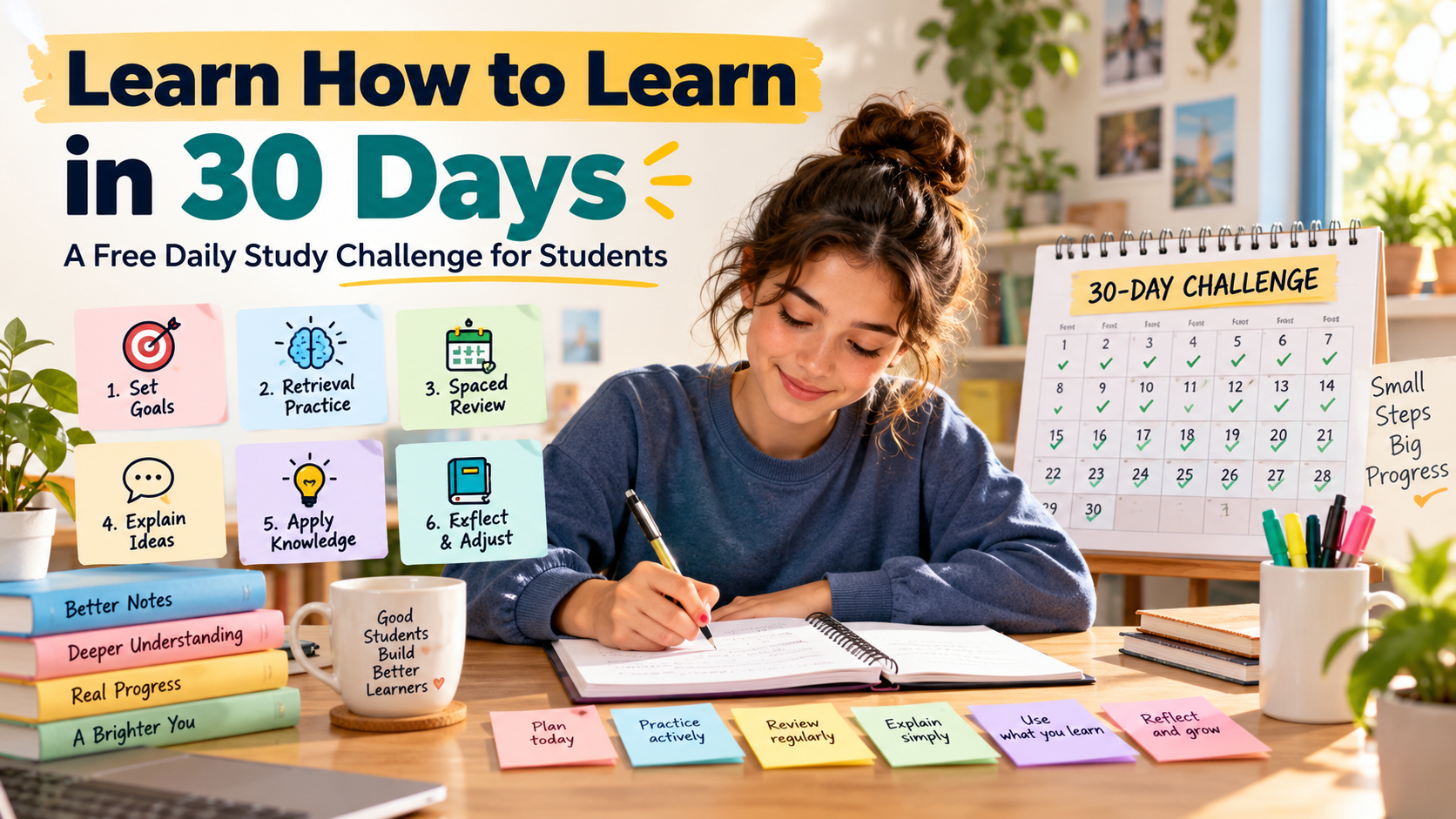
Learn How to Learn in 30 Days: A Free Daily Study Challenge for Students
Thirty days from now, you could have more study notes, more highlighted pages, and more hours recorded on a productivity app. Or you could have something more useful: a clearer understanding of how you learn, what you can remember after a delay, which methods help you solve new problems, and how to respond when studying is not working.
That is the purpose of this free 30-day Learn How to Learn Challenge.
You do not need to buy an app, sign up for a course, or complete an enormous daily workload to follow the challenge. Pick a real school or university topic, set aside a small, realistic period for the daily task, and record one piece of evidence about your learning.
How does the 30-day study challenge work? Each day gives you one focused learning action. Across six five-day phases, you will practice starting, retrieving information, spacing reviews, explaining ideas, applying knowledge, and evaluating your progress. By Day 30, you will design a study routine that fits your courses and real life.
The program is a practical educational plan, not a scientifically validated 30-day intervention. It cannot guarantee better grades, and there is no scientific rule that a permanent study habit forms after exactly 30 days. The individual methods draw on learning research; their arrangement in this challenge is an original Learning Coach editorial design.
Start today, bookmark this page, and return to the day you are on. If you miss a day, you can resume without punishment. The objective is not a perfect streak. It is increasingly independent learning.
What will you actually learn in these 30 days?
The challenge is organized around six questions:
Can I start and choose a clear learning target?
Can I remember what I learned without looking?
Can I return to material after time has passed?
Can I explain concepts and connect ideas?
Can I use knowledge in unfamiliar tasks and learn from mistakes?
Can I plan, monitor, and adjust my own study process?
These questions correspond to useful areas of educational research, including retrieval practice, distributed practice, explanations, problem solving, and self-regulated learning.
The U.S. Institute of Education Sciences' practice guide on organizing instruction and study recommends spreading learning over time, alternating worked examples with independent problems, using quizzes for retrieval, and asking deep explanatory questions. The Cornell Learning Strategies Center also offers accessible explanations of retrieval, spacing, and interleaving.
The Education Endowment Foundation's second-edition metacognition guidance focuses on teaching learners to plan, monitor, and evaluate their approaches to authentic subject learning.
None of these sources says that combining the techniques in this exact order for 30 days guarantees a specific result. We use them as evidence-informed ingredients, not as a certificate that this challenge has been experimentally tested.
Before Day 1: choose your subject and set a realistic daily time
Choose one anchor subject that matters to you right now. It could be algebra, biology, chemistry, history, literature, English, French, Spanish, or an introductory university course.
You can apply individual challenges to other subjects, but sticking with one anchor topic makes it easier to notice change. Do not choose a topic so large that you can only describe it as "everything I need to know."
A better target is specific:
"Explain and apply the concept of a limiting factor in biology."
"Solve linear equations and choose the right method in mixed questions."
"Write a historical paragraph that uses evidence to justify a claim."
"Understand and respond to a short conversation in Spanish."
Set aside approximately 10–20 minutes a day for the challenge activity, separate from any other homework that you already need to do. Some days will take less; difficult tasks may require more. The suggested time is an editorial convenience, not a proven ideal dose for every student.
Pick a reliable place and time when possible. You could write, "After I get home and have a snack, I will spend ten minutes on today's challenge before opening social media." If your daily schedule varies, choose a flexible cue such as "after my first class study block."
Research on implementation intentions suggests that specific if–then plans can help translate goals into action. A 2025 review by Gollwitzer and Sheeran summarizes evidence for these plans in goal pursuit and notes that effectiveness depends on characteristics of the plan and context. Read the scientific review.
Do not sacrifice sleep, meals, essential responsibilities, or required support to maintain a challenge streak. Cornell University's study-schedule guidance emphasizes including rest, health, other courses, and realistic commitments when planning learning.
Does a 30-day challenge really create a habit?
Thirty days can give you repeated opportunities to practice a study behavior and learn whether it fits your life. It does not guarantee that the behavior will become automatic.
The familiar claim that any habit forms after exactly 21 or 30 days is an oversimplification. A 2024 systematic review of health-related habit formation included 20 studies and found substantial variation in how long behaviors took to become habitual. The participants, behaviors, and measures concerned primarily health habits, not students learning algebra; those estimates must not be transferred mechanically to studying. Read the systematic review.
This challenge uses 30 days as a convenient trial period, long enough to revisit several techniques and examine evidence of progress. Some routines will need more time. Some will be unsuitable for your workload. A successful outcome may be learning to reject an ineffective technique or ask for more appropriate support.
By the end, the question is not "Did I become a perfect student?" It is "Which actions helped me learn, which still need support, and what will I do next week?"
Your six-phase 30-day learning roadmap
| Days | Phase | New habit to practice | Evidence you should collect |
|---|---|---|---|
| 1–5 | Discover your starting point | Choose clear targets, start small, notice barriers | A baseline independent attempt and a workable study cue |
| 6–10 | Learn to retrieve | Close the notes and test what you can explain | Corrected self-test answers and knowledge gaps |
| 11–15 | Make learning last | Return after a delay and adjust review intervals | Results from delayed questions and an adaptable calendar |
| 16–20 | Understand and connect | Explain relationships, build examples, use meaningful diagrams | Accurate explanations, representations, and comparisons |
| 21–25 | Apply and improve | Solve new tasks, select methods, analyze errors and feedback | Changed-problem performance and an error-to-action plan |
| 26–30 | Become your own learning coach | Plan, monitor, evaluate, and continue independently | A fresh final task and a sustainable next-month plan |
You do not need to master every new strategy before trying another one. The six phases accumulate: you will still use retrieval during the application phase, and you will still schedule delayed checks after learning a new concept.
Days 1–5: find your starting point
The first week is about getting reliable information about your learning, not fixing your entire study life overnight.
Day 1 — Take a baseline, without judging yourself
Today's challenge: Choose a real topic that you have encountered in class. Write down two or three things you should be able to do with it. Without opening your notes, attempt one representative question. Keep the result even if it is incomplete.
For algebra, solve one problem and show the steps. For biology, explain a mechanism. For history, write a short evidence-based argument. For language learning, respond to a short prompt.
Record: What could you do independently? Where did you stop? What source or feedback would you need to check the answer?
Do not score your entire intelligence or potential from this activity. The baseline is a starting sample. On Day 30, you will attempt a different but comparably demanding task to look for improvement.
Day 2 — Turn "study more" into one observable objective
Today's challenge: Rewrite your vague goal as an action that can be demonstrated.
Instead of "study chemistry," try: "Explain why changing concentration may alter the rate of a reaction in the conditions we studied." Instead of "get better at essays," try: "Write a paragraph with one claim, two pieces of accurate evidence, and an explanation of their relevance."
Now choose the learning material and practice task that fit that objective.
Record: Your one-sentence learning target and what a successful independent answer would look like.
A good objective makes the next study decision easier. It does not require perfect wording.
Day 3 — Find the smallest possible starting action
Today's challenge: If starting is difficult, reduce the first move until it feels manageable. Open the assignment, read the first question, write one known fact, or draw the first part of a diagram.
Set a small, realistic work period, perhaps five minutes, and begin. Continue if the task is going well; stop or take a break if your circumstances require it.
Record: What was the first action? What made it easier or harder to begin? What will you use as tomorrow's start cue?
The point is not to force motivation. It is to make the next useful action visible. If a task is unclear or beyond your current understanding, ask for instruction rather than treating confusion as laziness.
Day 4 — Remove one distraction and protect the conditions
Today's challenge: Identify one avoidable interruption—perhaps unnecessary notifications, an unrelated browser tab, or a chaotic study setup. Change only one thing.
Choose the setting that is workable and accessible for you. Some learners need assistive technology, approved support, quiet, or movement opportunities. "Distraction-free" should not mean removing support that enables access.
Record: Which change helped you make a genuine attempt? Was the task clearer, or did you still need an explanation?
Your goal is to learn which conditions support effort, not to build a flawless study aesthetic.
Day 5 — Review your first week and make one if–then plan
Today's challenge: Look at the results from Days 1–4. Write a short plan for the next study session:
"If [specific cue or situation], then I will [small learning action]."
For example: "If I finish dinner on a school night, then I will try one biology question with my notes closed before revising the answer."
Record: The cue, action, likely obstacle, and reasonable fallback.
If you missed one day, simply resume. Five days of observation can teach you something even if your streak is imperfect.
Days 6–10: discover what you can remember without looking
The central question in this phase is whether you can retrieve knowledge, not merely recognize it on the page.
Day 6 — Try the blank-page challenge
Today's challenge: Close your textbook and notebook. On a blank page, write or sketch everything important you can recall about one manageable topic. Do not aim for artistic presentation.
Afterward, compare your work with a reliable source. Circle missing facts, inaccurate relationships, and ideas that were correct but incomplete.
Record: Three things you recalled correctly and one thing you must relearn.
Cornell University's effective study strategies guide describes blank-page retrieval as a way to discover what you can and cannot remember.
Day 7 — Create three useful self-test questions
Today's challenge: Write three questions about yesterday's topic: one factual recall question, one explanation question, and one application question.
For example, in physics: What does acceleration mean? Why does a changing velocity imply acceleration? How would you interpret a new motion graph?
Answer them before looking at the source. Check each response. If you cannot answer because you never understood the concept, return to an accurate explanation rather than repeating the same failed guess.
Record: Which question was hardest, and why?
Day 8 — Teach an idea in your own words
Today's challenge: Explain one concept as if you were helping a younger learner who has some necessary background knowledge.
Use ordinary language without stripping away important meaning. If you use an analogy, state where the analogy stops being accurate.
For biology, explain what a limiting factor does. For history, explain why a particular event had several interacting causes.
Record: The first point you could not explain accurately and what clarified it.
The goal is not to sound like a lecturer; it is to test whether you can reconstruct the reasoning.
Day 9 — Compare your answer with a reliable explanation
Today's challenge: Choose one self-test question that you answered incorrectly or incompletely. Attempt it again, then compare your answer with the course material or teacher feedback.
Find the first meaningful difference: a wrong assumption, missing step, incomplete evidence, confused term, or inaccurate diagram.
Rewrite only what is necessary to make your explanation correct. Finish by attempting a slightly changed example.
Record: "My first error was ___; next time I will check ___."
Day 10 — Give yourself a mini-quiz without notes
Today's challenge: Create or use a short set of four or five questions covering different important ideas from Days 1–9. Use at least one application question where appropriate.
Attempt every answer independently. Then check, correct, and divide the topics into secure, uncertain, and needs teaching.
Record: A few honest observations rather than just a score.
A quiz is useful because it helps you detect gaps and can support memory. Do not treat an improvised five-question quiz as a formal measurement of mastery.
Days 11–15: make what you learn available later
Retrieval after a delay helps reveal whether information remains accessible once the original lesson is no longer fresh.
Day 11 — Schedule your first delayed reviews
Today's challenge: Choose two topics you have worked on this month. Put a short review appointment on your calendar for each, after a meaningful delay.
Write specific actions, not vague reminders. "Thursday: explain the causes of this event and verify two pieces of evidence" is better than "Thursday: history."
Record: The topic, next review time, and independent question you will attempt.
There is no universal optimal Day 1–3–7 review formula. Research supports distributing practice, but useful spacing depends on the learning goal, material, and retention horizon.
Day 12 — Test an older topic before you reread it
Today's challenge: Return to something you studied earlier in the challenge. Cover the notes and explain or solve one representative question.
Only after the attempt should you reopen the source. Do not punish yourself for forgetting. Note what was retained and what needs relearning.
Record: What was remembered after the delay? Which detail or process disappeared?
The difference between immediate and delayed performance is valuable information about the study process.
Day 13 — Choose the next interval based on evidence
Today's challenge: Review yesterday's topic. If your response was mostly accurate and independently explained, schedule a longer gap before the next check. If it was uncertain, schedule a nearer check. If it was fundamentally misunderstood, repair the explanation before relying on more retrieval.
Record: "Next review: ___, because ___."
A suggested calendar cannot tell you what you actually remember. The evidence from your response should guide the next decision.
Day 14 — Combine old and new learning
Today's challenge: Start with a short question from an older topic, then do one question from the new material you are currently learning.
Keep the session manageable. If you encounter a major prerequisite problem, focus on resolving it rather than adding more topics.
Record: Which older idea was still accessible? Which new idea needs clearer instruction?
This is a simple way to make cumulative study normal without trying to review every previous chapter every day.
Day 15 — Audit your review calendar
Today's challenge: Look at your upcoming school responsibilities and the next two weeks. Remove unnecessary repeated reviews of secure material and make space for concepts that remain weak.
Keep sleep, meals, exercise, family or work commitments, and other assignments in the schedule. A timetable that requires more hours than you have is not a realistic strategy.
Record: One review to keep, one to move, and one priority to clarify.
You have now practiced choosing review opportunities rather than depending on an automatic notification.
Days 16–20: understand ideas and connect knowledge
This phase focuses on making meaning, because memory without understanding may not be enough for unfamiliar questions.
Day 16 — Ask "why" and "how"
Today's challenge: Choose a concept that you can define but cannot yet explain confidently. Ask two meaningful questions: "Why does this happen?" and "How does it connect to what I already know?"
Answer from your understanding first, then use accurate course materials to check. Avoid inventing a causal explanation simply because it sounds plausible.
Record: One relationship you can now explain and one assumption you still need to check.
Deep explanatory questions are also highlighted in the Institute of Education Sciences study guide.
Day 17 — Find a concrete example and a non-example
Today's challenge: Take an abstract idea and create a realistic example. Then try to identify a case that looks superficially similar but does not fit the concept.
If studying proportionality, compare a proportional relationship with one containing a fixed starting charge. If studying a literary technique, compare a valid instance with a phrase that merely resembles it.
Record: The feature that distinguishes the true example from the non-example.
This exercise makes it harder to rely on memorized surface details alone.
Day 18 — Build a small map of relationships
Today's challenge: Draw a concept map with four to six important ideas. Use arrows or linking phrases that describe the relationships: causes, depends on, contrasts with, is evidence for, or another accurate link.
In science, map a system. In history, compare causes, constraints and consequences. In literature, connect claims with evidence and interpretation.
Record: Two important connections you can explain with the map hidden.
Do not let the appearance of the diagram substitute for accuracy.
Day 19 — Explain a diagram or graph in words
Today's challenge: Choose a diagram, graph or model from your course. Explain what it shows, how its parts relate, and one limit to the conclusion you can draw.
If the graph comes from an experiment, distinguish what was observed from what is merely proposed as an explanation.
Record: A short explanation and the evidence that supports it.
Graphics are powerful when they clarify the subject matter and are combined with accurate verbal explanations. They are not evidence that you have a fixed "visual learning style."
Day 20 — Explain the same idea in a different way
Today's challenge: Take one concept from Days 16–19 and present it in a different form: a brief paragraph rather than a diagram, a correctly labeled sketch rather than a paragraph, or a new example rather than a definition.
Close the original source before attempting the second form, then check whether you preserved the essential meaning.
Record: What was easier to explain? What became less clear?
The purpose is to test flexibility—not to create multiple attractive versions of the same notes.
Days 21–25: use knowledge in new tasks and learn from mistakes
Many assessments require you to decide which idea or method applies, not simply repeat yesterday's example.
Day 21 — Solve a changed problem
Today's challenge: Find or construct a question using the same underlying principle as a familiar worked example but different numbers, wording or context.
For mathematics, solve without the previous steps visible. For science, explain a changed condition. For language learning, respond to a different communicative situation.
Record: Did you recognize the underlying principle independently, and was your answer accurate?
If you still need the model, return to clear instruction before retrying.
Day 22 — Mix related problem types
Today's challenge: Choose two or three related skills you have already learned. Attempt a small unlabeled mixed set where the question does not announce which method to use.
Before answering each item, state why you selected that strategy. Then check both the method choice and the execution.
Record: Did you choose the correct method? Did you carry it out correctly?
Mixing completely unfamiliar skills is not the goal. Begin with enough understanding to make a meaningful choice.
Day 23 — Turn one error into an action plan
Today's challenge: Look at a wrong answer from a recent class task or challenge attempt. Identify the first meaningful error, not just the final wrong answer.
Was the problem a missing prerequisite, misunderstood concept, memory lapse, inappropriate strategy, calculation, weak evidence or an omitted rubric criterion?
Choose an action that targets the error: a guided explanation, an independent retrieval check, a new mixed problem, or a complete written response.
Record: "Error ___; likely cause to investigate ___; next action ___."
This is a formative reflection tool, not a diagnostic assessment.
Day 24 — Ask for useful feedback
Today's challenge: Share a short attempt with a teacher, tutor, appropriate peer, or an approved learning-support tool where helpful. Ask one specific question about the learning target.
For example: "I can remember the facts, but my argument did not use enough evidence. Which rubric criterion am I missing?"
Use the response to revise your own work, then attempt a new question independently.
Record: One feedback point and how you acted on it.
The Education Endowment Foundation's teacher-feedback guidance emphasizes making feedback actionable and enabling students to use it.
Day 25 — Complete an unfamiliar application task
Today's challenge: Try one authentic question you have not already seen. Make sure it resembles the kind of performance your course assesses: a mixed math problem, a data interpretation, a source-based historical paragraph, or a spontaneous language response.
Complete the task without unnecessary assistance, then check it carefully.
Record: What transferred to the new situation? What only worked in the original example?
This is a checkpoint, not a promise that any one new question establishes general mastery.
Days 26–30: become your own learning coach
Your final phase is about making better study decisions independently, even when no app, teacher or article tells you what to do next.
Day 26 — Plan a realistic study session for yourself
Today's challenge: Choose a real upcoming task. Write down the learning objective, most useful practice activity, how you will check the result, and what you will do if you get stuck.
Include a realistic time slot. Do not begin by making an elaborate schedule for an entire semester.
Record: Your plan and why this method fits the goal.
Day 27 — Monitor and change the plan mid-session
Today's challenge: Begin your planned task. Halfway through, ask: "Is this activity helping me demonstrate the target skill?"
If you notice you are repeatedly rereading when you need independent problem practice, change the activity. If you are attempting advanced questions without prerequisites, return to a correct explanation.
Record: One evidence-based adjustment you made during the session.
This is a practical application of self-regulated learning: planning, monitoring, and adjusting, not rigidly obeying a timetable.
Day 28 — Conduct an honest study-method review
Today's challenge: Look at your notes from the month. Which tasks helped you discover a learning gap? Which produced an accurate independent response? Which were time-consuming without helping you perform the required task?
Choose one strategy to keep, one to adapt, and one to stop using for its current purpose.
Record: Your reasons, based on actual attempts.
Avoid declaring a method "scientifically useless" based only on your personal trial. You are deciding what appears helpful for your current task and context.
Day 29 — Design your next seven days
Today's challenge: Build a sustainable one-week schedule using what you learned.
Include new course work, delayed retrieval of important prior topics, one practice task requiring application, and room for essential responsibilities. Identify the first question you will attempt at the start of each session.
Record: The plan, a realistic start cue, and how you will adapt when a day changes.
You are now using learning methods as tools you select, rather than rules imposed by a challenge.
Day 30 — Take a fresh final test and set your next goal
Today's challenge: Return to the kind of performance you attempted on Day 1, but use a different question of comparable difficulty. Attempt it with the same relevant conditions and level of assistance so the comparison is meaningful.
Check your answer using an accurate source or rubric. Compare what you could explain, retrieve, decide and apply on Day 1 with what you can do now.
Ask yourself:
What improved in the quality of my independent work?
What still breaks down?
Which method has earned a place in my normal routine?
Which kind of help should I seek next?
What will I review next week?
Record: The result, its limitations, and one realistic next-month commitment.
If the final attempt is not better, the month is not automatically wasted. You have information for a different instructional response. Do not claim a causal improvement from this uncontrolled personal challenge.
Your free 30-day challenge checklist
You can use the table below as a personal tracker. Copy it into a document, notebook, or spreadsheet, or print the page for your own reference. There is no account, automatic progress-saving feature, or hosted downloadable tracker required to complete the challenge. The article itself contains all 30 activities.
| Day | Daily action | What to record |
|---|---|---|
| 1 | Try a baseline question | What I can do independently |
| 2 | Write a precise learning goal | Observable success criterion |
| 3 | Start with one small action | My first step and barrier |
| 4 | Improve one study condition | What changed |
| 5 | Create an if–then study cue | My specific plan |
| 6 | Try blank-page recall | Correct and missing ideas |
| 7 | Write three self-test questions | Question I need to revisit |
| 8 | Explain an idea in my own words | First uncertain link |
| 9 | Analyze one wrong answer | What the feedback changed |
| 10 | Attempt a mini-quiz | Secure and uncertain items |
| 11 | Plan delayed review | Next date and question |
| 12 | Retrieve an older topic | What survived after the delay |
| 13 | Adjust an interval | When and why to review next |
| 14 | Combine old and new questions | Which idea needs support |
| 15 | Audit the review calendar | Priority and realistic workload |
| 16 | Ask why and how | Explained relationship |
| 17 | Make an example and non-example | Decisive distinguishing feature |
| 18 | Build a small concept map | Two accurate connections |
| 19 | Explain a diagram or graph | Claim, evidence and limit |
| 20 | Represent an idea differently | What remained accurate |
| 21 | Solve a changed problem | Independent strategy use |
| 22 | Mix related question types | Method selection and execution |
| 23 | Turn an error into an action | Most useful next practice |
| 24 | Request targeted feedback | How I acted on it |
| 25 | Complete an unfamiliar task | What transferred |
| 26 | Plan my own study session | Objective, method and check |
| 27 | Adjust a method during study | What evidence prompted change |
| 28 | Evaluate my study methods | Keep, adapt or stop |
| 29 | Plan the following week | Feasible schedule |
| 30 | Attempt a fresh final task | What changed, what comes next |
A checkmark only means you attempted the daily activity. It does not establish that you learned the concept. Use the final column to capture actual evidence and decide what to practice next.
A sample progress log: what a student's week might look like
To make the tracker concrete, here is an illustration using the anchor topic linear equations and proportional relationships.
| Day | What I attempted | What happened | What I will change |
|---|---|---|---|
| 1 | Two unfamiliar word problems | Correct arithmetic after choosing the wrong relationship once | Practice identifying problem type |
| 3 | Five-minute start with one equation | Started quickly but lost time checking a familiar example | Attempt independently before opening solutions |
| 7 | Three questions on ratios and equations | Recall was secure; method explanation incomplete | Write a reason before calculating |
| 12 | A delayed equation question | Sign error returned | Relearn the sign rule and check a new problem |
| 22 | Mixed ratio, percentage and equation set | Selected the right method more often but made one computation error | Separate strategy and calculation checks |
| 30 | Fresh mixed problem set | Compare independently with Day 1 using clear criteria | Choose next month's weakest priority |
This is an illustrative log, not a reported study of actual student results. It shows how a learner could record useful evidence without inventing a scientific score.
What if I miss a day of the challenge?
Resume on the next available day. You do not need to restart at Day 1.
If you miss one day, complete the missed task when it is still useful, or move forward and incorporate it into another session. If you miss an entire week, revisit your current learning goal and the most recent independent result before deciding where to resume.
A streak counter can make a routine visible, but it should not become a source of punishment or misleading proof of competence.
Research on habit formation points to consistency and context, but the time required for behaviors to become automatic differs substantially across individuals and activities. That is another reason not to treat a perfect thirty-checkmark row as an educational qualification.
If your schedule repeatedly falls apart, revise the plan. Make the activity smaller, choose a more realistic cue, or seek help identifying an obstacle. A study habit should support your life, not consume it.
Can I do the challenge if I have a major exam next week?
Yes, but the challenge must not displace appropriate exam preparation.
If your exam is in seven days, prioritize the specific curriculum objectives and representative practice you need for that assessment. You can use the first seven challenge days as support—diagnosing a topic, starting, retrieving, checking errors—but you do not have to postpone required exam preparation until the challenge reaches a later phase.
The challenge is a developmental program for learning skills. It is not a substitute for an exam-specific revision plan.
If you need urgent preparation, focus on actual assessment requirements, a realistic study schedule, guided help for missing prerequisites, and independent practice with feedback.
How should you adapt the challenge to math, science, history and languages?
The daily theme can stay the same while the actual task changes. A student learning mathematics should not test progress using only definition cards, and a language learner should not judge speaking ability entirely through a written multiple-choice quiz.
| Skill in the challenge | Mathematics | Science | History | Languages |
|---|---|---|---|---|
| Recall | Recover a formula or procedure and explain it | Reconstruct a mechanism | Recall chronology and key concepts | Retrieve vocabulary in context |
| Explain | Justify why a step is valid | Explain a causal relationship | Explain why evidence supports a claim | Explain a grammatical or communicative choice |
| Apply | Solve a changed problem | Interpret unfamiliar data or a scenario | Analyze a new primary source | Respond to a new spoken or written situation |
| Monitor | Separate wrong method from wrong calculation | Separate misconception from graph-reading error | Separate missing facts from weak argument | Separate comprehension from production difficulty |
This is why the challenge asks you to select an anchor learning target. "I reviewed for fifteen minutes" is less useful than "I can now solve a new equation and explain why each operation works."
Can I use ChatGPT or an AI study tool during the 30 days?
You may use approved learning tools if your school or instructor permits them. But protect the part of the task intended to show your own learning.
A useful approach is:
Make a first independent attempt.
Ask for a hint, question, or explanation limited to the step where you are stuck.
Check important facts, calculations, quotations, and sources independently.
Close the tool and complete a new question without its answer visible.
For example, ask:
"I'm doing a 30-day learning challenge. Today I need to practice explaining [topic]. Ask me one question at a time, wait for my attempt, and give feedback. Do not reveal a full answer unless I ask for instruction after trying. At the end, give me a changed question to do without AI."
Do not let a generated plan, completed essay, or perfect solution become your only evidence of success. AI output may be wrong and can make task completion appear easier than independent learning.
Follow academic-integrity, privacy, accessibility and age-appropriate-use requirements. Do not upload personal student records or school-prohibited materials to an unapproved service.
Three simple measurements that matter more than a streak
A habit tracker shows whether you returned to the activity. It does not show whether you learned.
For a more meaningful personal check, track three kinds of evidence:
1. Independent accuracy: Can you answer a question correctly without a worked solution or notes already visible?
2. Delayed access: Can you remember and explain key content after an interval, not just immediately after reading?
3. Flexible use: Can you apply the idea to new numbers, data, documents, or contexts?
You can write a short observation for each, such as "accurate after two days" or "could explain the definition but not interpret the new graph."
This is not a standardized score, diagnostic test, or controlled evaluation. It is a simple way to align your self-monitoring with the actual learning objective. The tests must be appropriate in difficulty and checked against reliable evidence.
If you use a rating such as "secure / uncertain / needs help," define it for yourself based on what you can demonstrate, not how confident a page looks.
How teachers and parents can use the challenge without taking over
A teacher can select a few activities as short formative exercises at the beginning or end of a lesson. Day 6 blank-page recall, Day 17 examples and non-examples, and Day 23 error analysis can be adapted to curriculum tasks.
But a teacher should model the methods first when students have not been taught to use them. A learner who struggles to explain a concept may need instruction, not merely more self-testing.
Parents can support participation by helping the student choose a workable time and then asking a small number of useful questions: "What did you try?" "How did you check it?" "What will you do next?" Avoid turning the challenge into a nightly high-pressure exam or rewarding only uninterrupted streaks.
An educational coach can guide the transition from external prompts to independent decisions, watching whether the learner increasingly identifies a target, selects a method, asks for appropriate help, and evaluates outcomes.
These uses are suggestions for educational practice, not claims that the Learning Coach 30-day sequence has been validated in a classroom trial.
What to do after Day 30: design a sustainable routine
The challenge does not end with a perfect checklist. It ends with a decision.
Look at the evidence you recorded. You may discover that you benefit from beginning with a small retrieval question, that spaced review needs an actual calendar appointment, or that mixed math problems reveal errors that repetitive worksheets conceal.
Now create a normal weekly routine that is simpler than the challenge:
Choose the most important learning goal for the week.
Use one or two purposeful practice sessions for new content.
Revisit essential ideas after a delay.
Attempt an unfamiliar problem or applied question.
Use feedback to decide what needs correction.
Review the plan against your real available time.
The plan does not have to include every strategy every day. A routine you can sustain and adapt is more useful than an impressive system you abandon after a week.
If your Day 30 evidence shows that a skill still needs explicit instruction, talk with a teacher, tutor, or appropriate support service. No self-guided challenge can replace every form of teaching or learning support.
Frequently asked questions
Is the Learn How to Learn in 30 Days Challenge really free?
Yes. The complete daily challenge is provided in this article. You can follow it with your current course materials, paper, and a simple calendar. No paid app or purchase is required to perform its activities.
How long should each daily study challenge take?
Many tasks can begin with approximately 10–20 minutes, but this is an editorial planning range rather than a proven optimal duration. Complex content may require longer sessions or guided instruction. Adjust based on the task and your circumstances.
Will I get better grades after 30 days?
No specific grade change can be promised. The challenge helps you practice evidence-informed learning behaviors, but grades also depend on curriculum, assessment design, instruction, previous results and individual circumstances. Examine improvements on representative independent tasks rather than relying only on the next grade.
Can a study habit form in 30 days?
Some routines may become easier through repeated practice, but research does not support a universal 30-day habit-formation deadline. The time required varies, and studies of health habits do not directly establish how long study behaviors need.
What if I miss two or three days?
Resume when you can. Adapt the calendar instead of treating a broken streak as failure. Review the most important prerequisite or missed activity if necessary, then keep going.
Can younger students do the challenge?
Yes, with suitable age-appropriate tasks and guidance. Younger learners may need help selecting questions, accessing material and checking correctness. The process should develop independence gradually, not require unsupported struggle.
Does the challenge replace my regular homework?
No. It is a short method-building activity that complements normal learning and assessment preparation. If homework already includes a comparable independent task, use that work when appropriate rather than duplicating effort.
Should I use flashcards every day?
Not necessarily. Flashcards may be helpful for facts and vocabulary but are insufficient on their own for argument, scientific reasoning, mathematics, or spontaneous communication. Match the practice to what you need to learn.
Do I need ChatGPT, a planner app, or a learning platform?
No. The challenge works on paper. You can use approved technology for reminders, accessibility or question generation, but verify important content and preserve your own independent thinking.
What if I don't improve on Day 30?
Examine the evidence rather than drawing a conclusion about intelligence or potential. You may need better feedback, clearer instruction, repaired prerequisites, a different assessment task or more time. Bring specific examples to a teacher or qualified learning-support professional.
A final invitation: come back tomorrow for the next meaningful step
Thirty days of perfect checkmarks are not the destination. Learning to notice what you know, choose a suitable strategy, and respond intelligently to mistakes is the destination.
You may begin the challenge with only a notebook and a single difficult topic. You may reach Day 30 with a clearer study plan and a more precise picture of what still needs teaching. Both are valuable when they produce better decisions.
Bookmark this challenge, complete Day 1 today, and return to Day 2 when you are ready. Share it with a classmate who wants to compare learning strategies without turning studying into a competition.
If you want additional reading, explore the Learning Coach English books catalogue for resources on learning and learner independence. For educators and aspiring learning coaches who want to support these practices professionally, the Learning Coach training pathways describe available professional-development options.
You do not need to become a perfect student in a month. You can begin becoming a more independent learner today.
References and further reading
Cornell University Learning Strategies Center. Effective Study Strategies.
Cornell University Learning Strategies Center. Guidelines for Creating a Study Schedule.
Education Endowment Foundation (2025). Metacognition and Self-Regulated Learning: Second Edition.
Education Endowment Foundation (2021). Teacher Feedback to Improve Pupil Learning.
Gollwitzer, P. M., & Sheeran, P. (2025). Psychology of Planning. Annual Review of Psychology.
The Learning Scientists. Six Strategies for Effective Learning (free educational explainer).
