
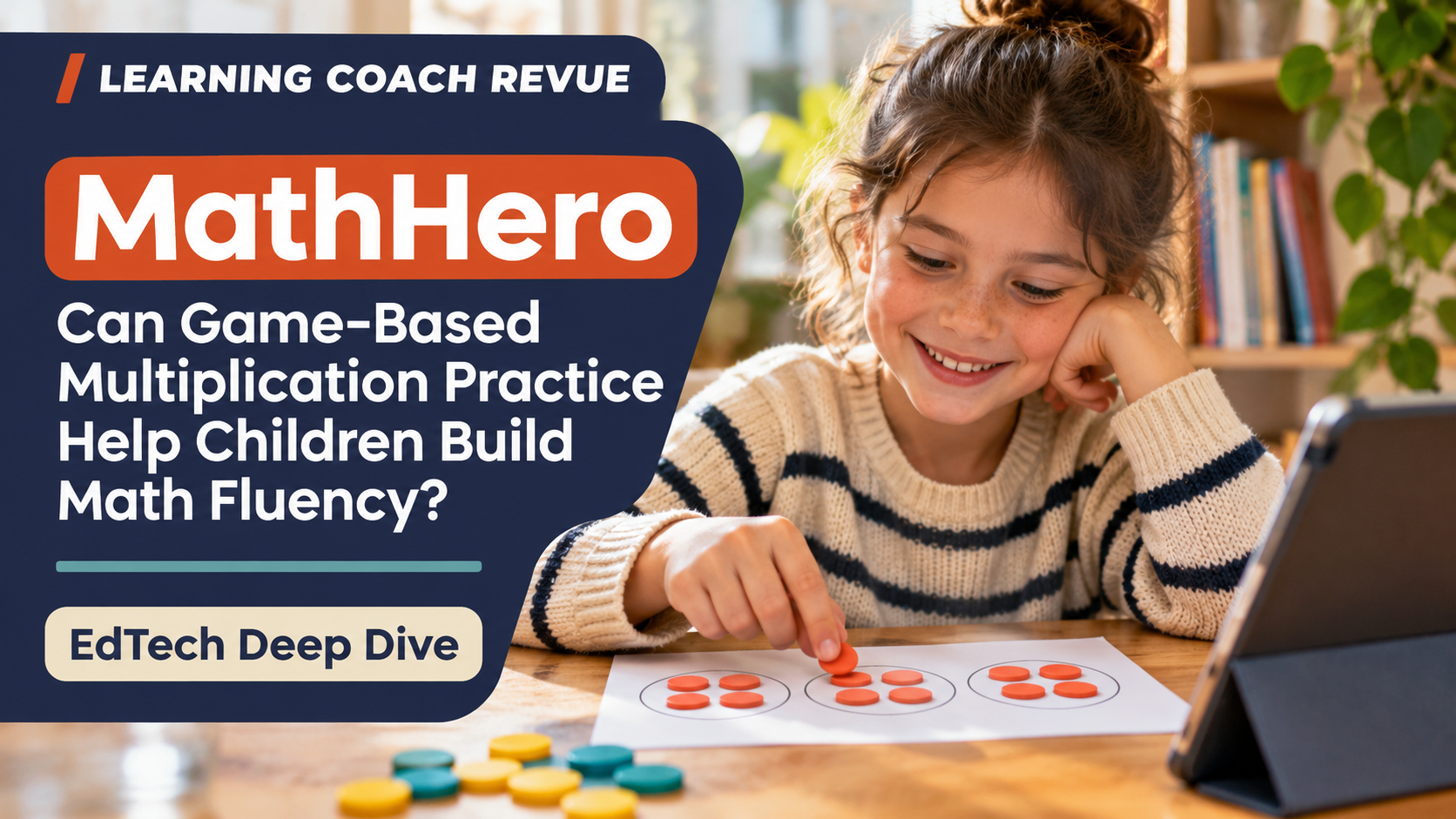
A child who knows what multiplication means may still struggle to retrieve a single answer. A child who remembers every answer may still struggle to use multiplication in a new situation. Between these two problems lies one of the most important territories of elementary mathematics: arithmetic fluency. MathHero, a story-driven educational game from SpeedyMind, offers an intriguing approach to the repeated practice that helps children navigate it. The question is not whether children can be persuaded to play mathematics, but whether play can help them carry mathematics into the rest of their lives.
The small hesitation that reveals a larger challenge
Consider an illustrative situation. A child is working on a problem about eight boxes containing seven crayons each. The child understands that every box contains the same number, recognizes multiplication as the appropriate operation and writes 8 × 7. Then comes a hesitation. Is the answer 54, 56 or 63? The reasoning is sound, but a seemingly small missing piece interrupts the work.
Now consider another child who answers 56 almost instantly, but cannot explain why the boxes require multiplication rather than addition. The children have different learning needs. Asking both to complete the same worksheet, at the same pace, might obscure the distinction.
For the first child, retrieving basic facts more reliably could create room to attend to the meaning of a longer problem. For the second, more repetitions of the same equation may do little to develop the underlying concept. Neither child deserves to be described simply as good or bad at mathematics.
This is the educational problem behind Learning Coach's guide to identifying mathematics learning gaps. Before increasing the amount of tutoring, homework or digital practice, it is worth identifying what actually needs to change.
MathHero enters this conversation from a specific direction. Its core proposition is not a comprehensive diagnosis of mathematical thinking or a replacement for instruction. It is a way of making basic arithmetic practice easier to start, easier to repeat and, potentially, more enjoyable.
That narrow ambition is more consequential than it might first appear. In primary education, a considerable amount of progress depends not on encountering another new concept, but on returning to a familiar one until it becomes sufficiently reliable to support something more complex. Designing a good experience around that return is an educational challenge in its own right.
From a family problem to a game studio
The team behind MathHero describes its origins in a problem familiar to parents: educational software could offer mathematically relevant exercises that children quickly tired of, or entertaining games in which the mathematics was incidental. SpeedyMind's account of its beginnings describes a collaboration between families and educators that developed into a studio with expertise in learning design, engineering and creative production.
The significance of this account is not that it establishes an unprecedented invention. Educational games have existed for decades. It is that the problem identified by the studio remains unresolved in many products: can the activity children want to repeat also be the activity that supports learning?
The studio's description of its work brings together teaching, illustration, animation, engineering and sound design. This mixture matters because educational quality is not located exclusively in the mathematics. The pace of a transition, the clarity of a response, the legibility of a number and the emotional tone of an error can all shape the experience of practice.
The legal structure is worth distinguishing from the public-facing brand. Under its terms of service, updated in February 2026, the iOS application and website are provided by MathHero Pte. Ltd. in Singapore; the Android application is provided by SpeedyMind LLC in Armenia. The documents describe them as separate entities. The product is internationally oriented, which makes an English-language investigation appropriate. The public material reviewed did not establish the names of the individual founders or the complete chronology of the venture; this dossier therefore does not attribute its creation to an unverified person.
There is already a distinct ambition visible in the product: building a lasting relationship with practice rather than trying to teach every aspect of mathematics through a single application.
Inside MathHero: a world built around practice
MathHero's application is designed for children approximately five to ten years old. It organizes arithmetic into story-led activities covering addition, subtraction, multiplication and division. The scope moves from elementary calculations to larger numerical ranges; the multiplication and division content is presented for learners who are ready for that stage rather than for every child of a particular age.
For the multiplication-focused learner, two routes are especially relevant. The company's multiplication games page describes a guided learning sequence in the application and a customizable practice mode. Its online resources also organize multiplication by individual tables, while the combined multiplication and division games open a route toward connecting related operations. The seven times table page describes the ability in the app to choose particular tables and select between answer-entry formats.
This is a meaningful distinction between a progression and an intervention. A progression is useful when a learner needs an organized path through new material. A targeted intervention is useful when most of the path is already familiar but certain facts remain unstable. Repeating an entire course because six products are difficult is an inefficient use of attention. Conversely, practicing six products repeatedly without understanding their meaning can leave the more important problem untouched.
MathHero's published design combines missions, feedback, rewards and adjustable difficulty. It also describes a review process in which previously encountered skills reappear. These are plausible components of a practice environment. The public description does not establish the exact scheduling algorithm, how individual misconceptions are classified, or whether the software adapts to every learner's memory profile in a scientifically validated manner.
The distinction is important because personalization is not a single technology. Allowing an adult to select a table is a legitimate form of customization; estimating precisely when each fact is likely to be forgotten is a different and more demanding capability. Neither needs to be called artificial intelligence to be educationally valuable.
This article is based on publicly accessible product documentation, store information and research. It is not a hands-on evaluation of a paid application session, and its descriptions of interface options should not be read as an independent usability test.
Why multiplication fluency is worth developing
The term fluency sometimes produces an unfortunate argument between advocates of conceptual understanding and advocates of memorization. One side worries that rapid answers conceal shallow reasoning; the other worries that a child who must reconstruct every elementary fact will be overwhelmed by more demanding mathematics.
Both concerns can be valid. An effective approach makes them complementary.
Understanding multiplication involves recognizing relationships: equal groups, arrays, scaling, combinations and, eventually, more abstract structures. Fluency concerns the ability to work with these relationships accurately, efficiently and flexibly. Automatic retrieval of a familiar fact is one useful resource within fluency, not its entire definition.
Imagine calculating 27 × 6. A learner who knows 7 × 6 and 20 × 6 can decompose the expression and combine 42 with 120. Another may use 30 × 6 minus 3 × 6. Knowing the basic facts makes either strategy easier to execute. Understanding place value and distributivity makes the strategies meaningful.
If every subcalculation requires extensive counting, the learner must maintain the intermediate values and the goal of the original task while performing additional mental operations. That can create an avoidable burden on working memory. A fluent fact does not remove all cognitive demand, but it can reduce the demand associated with one component of the problem.
There is also a social and emotional dimension. A child who regularly loses track of a calculation may come to avoid volunteering an answer, even when the underlying reasoning is sophisticated. Creating opportunities for successful practice can help change that experience. It would nevertheless be premature to infer from an improved score that a child's anxiety or self-concept has improved; those outcomes need their own evidence.
The 2025 review by Nicole McNeil, Nancy Jordan, Alexandria Viegut and Daniel Ansari, published in Psychological Science in the Public Interest, situates arithmetic fluency within the science of learning. It is a useful reminder that fact knowledge develops through instruction, meaningful numerical relationships and opportunities to bring information to mind. Fluency is not a demand that children become miniature calculators. It is a resource that should enlarge their capacity to think.
The science of remembering what we understand
Retrieval: the difference between seeing an answer and producing it
A multiplication chart is useful. It can reveal patterns, support reasoning and give a learner access to facts not yet remembered. But repeatedly looking at the entry where seven meets eight is not necessarily the same learning activity as being asked to produce the answer independently.
Retrieval practice requires an attempt to recover knowledge from memory. When appropriately supported, that attempt can strengthen access to the knowledge later. A correct response after a meaningful effort is not just a performance indicator; the act of retrieval is itself part of the learning opportunity.
In a particularly relevant 2023 classroom study, Fieke Ophuis-Cox, Leen Catrysse and Gino Camp compared flashcard retrieval with oral restudy of multiplication facts. The study involved 48 second-grade pupils, with three spaced practice sessions for each strategy and tests immediately afterward and one week later. Retrieval produced stronger gains in multiplication fact fluency than the comparison activity at both follow-ups.
This study makes a credible case for asking children to generate answers after learning the relevant material. It does not show that every digital question is equivalent to a flashcard, that retrieval is always superior to alternative instruction, or that MathHero produces the same effect.
An answer-entry interface illustrates why the details matter. Choosing 56 from four visible alternatives and producing 56 from memory are different tasks. The first may help a child discriminate among plausible responses and build confidence; the second more directly tests whether the answer can be recalled. A gradual transition between the two may make sense for some learners. It would be a mistake to compare the scores as though the cognitive demands were identical.
Spacing: what changes when practice returns tomorrow
A child may answer eight questions correctly at the end of a session and find the same questions difficult two days later. The initial performance was real, but it was not sufficient evidence of durable learning.
In 2025, Ewan Murray, Aidan Horner and Silke Göbel published a meta-analysis of spacing and retrieval in mathematics. Across 27 studies and 53 effect sizes, distributed practice showed an overall advantage over massed practice (Hedges' g = 0.28). The review also examined seven studies comparing retrieval and restudy; the estimated advantage was smaller (g = 0.18), and its confidence interval included zero.
That nuance is essential. The evidence supports returning to mathematics across sessions, but does not justify treating a generic memory principle as a guaranteed effect for every mathematical task. Multiplication facts and multi-step mathematical procedures, for instance, are not interchangeable learning materials.
MathHero's short activities and recurring practice may make a spaced routine easier to implement. Whether they deliver an optimized schedule, or whether a particular schedule works better than a simpler alternative for this age group, remains an open empirical question. The benefit of a digital product can lie in helping families sustain a sensible habit even if its scheduling mechanism is not unusually sophisticated.
Feedback: when being wrong becomes useful
Suppose a learner gives 54 for 7 × 8. There are several possibilities. The child may have recalled a neighboring fact, guessed under pressure, made an error while deriving the result, or misunderstood which operation was being asked.
A binary response can identify an incorrect answer. It cannot by itself identify its cause. A productive corrective response could connect 7 × 8 with 7 × 7 + 7, or with 8 × 7 and another known relationship, before allowing a fresh attempt. If the child has no stable concept of equal groups, the appropriate response may instead be a concrete representation.
MathHero's method page presents timely feedback and recurring practice as part of its design. The educational opportunity is clear, but the publicly reviewed material does not establish that the feedback diagnoses the cause of each error or teaches every relevant strategy.
This is one reason a parent or teacher remains valuable even in a well-designed game environment. Adults can ask a child how an answer was found. They can hear an explanation, notice an unusual strategy and decide whether another example, a drawing or a quieter pace would help.
When a game becomes an educational instrument
The world of children's games has long understood something that conventional learning materials sometimes neglect: repetition can feel different when it has purpose, variety and visible consequences. A sequence of apparently similar actions can become engaging when the player perceives growing competence and meaningful progress.
For educational game designers, the challenge is to connect the satisfying action with the intellectual action. In an arithmetic game, a mission might require correctly producing a fact rather than merely completing an unrelated activity before receiving a reward. The closer the two are connected, the more likely it is that returning to the game creates another genuine learning opportunity.
There is research to support taking this possibility seriously. In Game-Based Training to Promote Arithmetic Fluency, Tim Jay, Jacob Habgood, Maria Mees and Paul Howard-Jones reported a 2019 study of a purpose-built arithmetic game with 97 children aged seven to eight. The intervention trained numerical relationships and examined arithmetic performance outside the game. The game group improved more than the control group on the study's pre- and post-test comparison, with a reported standardized effect above 0.6.
That is valuable evidence precisely because the evaluation included transfer to a separate assessment. The finding belongs to the game and conditions studied, however. It cannot be borrowed as an effect estimate for MathHero.
A second lesson concerns the relationship between motivation and practice. A game may succeed at making a child want to return, which creates more opportunities to learn. It may also make a child want to collect a reward while doing as little of the educational task as possible. Both behaviors can look similar in a dashboard of daily sessions.
Game design therefore needs to be judged at several levels: the willingness to start, the amount and quality of mathematical activity, and what the learner can do after the game has closed. A highly entertaining session can be a worthwhile experience without being proof of substantial educational progress. A relatively quiet session can be valuable without generating dramatic engagement metrics.
MathHero's narrative approach is interesting in this respect. It makes practice an event rather than just a requirement. The next step is to look at whether the mathematical action and the child's sense of achievement remain aligned.
Recognizing progress beyond the score
For families, progress may be less mysterious than it initially appears. The same multiplication fact can be explored in several ways, each revealing a different aspect of learning.
The following framework is an illustrative Learning Coach Revue interpretation, not a description of a MathHero assessment feature.
| What the child can do | What it may reveal | What to explore next |
|---|---|---|
| Build four groups of seven objects | Meaning of equal groups is developing | Connect the model to 4 × 7 = 28 |
| Calculate 7 × 8 by deriving it from 7 × 7 | Flexible use of a known fact | Practice retrieving 56 without losing the strategy |
| Recall 7 × 8 accurately after a delay | A fact is becoming available from memory | Mix it with other tables and check again later |
| Solve 56 ÷ 8 and explain the connection | Understanding of an inverse relationship | Apply the fact family to a story problem |
| Choose multiplication to solve an unfamiliar problem | Transfer beyond isolated practice | Explore new contexts and explain the reasoning |
This sequence is not a rigid ladder. A learner can move between explanation and retrieval, and a previously memorized answer can become temporarily inaccessible. What matters is that the adult can see the difference between performance during familiar practice and the ability to apply knowledge independently.
Consider a learner who has spent several sessions on the seven times table. An informal check a day or two later could begin with a few orally presented facts, move to a division relationship, and finish with a simple problem about equal groups. The adult might ask for a drawing or explanation only when it adds information. This is not a formal assessment, and it should not become another high-pressure test.
A single missed answer is not necessarily a learning gap. A pattern of errors is more informative, particularly if it persists under different conditions. Nor is a slower answer necessarily evidence of poor learning. A child who deliberately derives 56 from 49 + 7 demonstrates a useful strategy, even if direct recall would eventually be more efficient.
The educational value of the game becomes clearer when its practice is embedded in this wider understanding of progress.
A place for MathHero in a child's learning ecosystem
At home, the most promising use may be to give arithmetic practice a predictable place in an ordinary day. A child who already understands a target operation can work on a small selection of facts, return to them on subsequent days and occasionally use them outside the application. The company suggests sessions of around ten to fifteen minutes; this is its general guidance, not a scientifically established optimal dose for every child.
A younger learner may need less time. A child who becomes increasingly frustrated may benefit from a different activity altogether. What looks like lack of motivation can sometimes be a sign that the content is too difficult, the instructions are unclear or the practice is not addressing the right gap.
For teachers, a digital activity can provide additional opportunities while the teacher works with individuals or small groups. The application documentation describes classroom possibilities and invites educators to contact the team about access. A school might use it at a practice station after teaching the concept, but it should not infer a pupil's overall mathematical understanding from game levels alone.
The What Works Clearinghouse's 2021 elementary mathematics intervention guide gives a broader context. Its recommendations include structured instruction, mathematical language, representations, number lines, word problems and appropriately designed fluency activities. These are complementary. A game focused on facts can occupy one part of a systematic intervention; it cannot stand in for all the others.
For learning coaches and tutors, the opportunity is more targeted still. If a learner has a specific fluency bottleneck, practice between meetings may allow the coaching session to concentrate on reasoning, learning strategies and the emotional experience of mathematics. But if the bottleneck is conceptual, the coach should address that directly before increasing retrieval demands.
In each setting, the guiding question is the same: what does this child need to become able to do that is not yet reliably possible?
Making pace an ally rather than an opponent
Some children enjoy responding quickly. Others are unsettled by a visible countdown or by the experience of being compared with peers. A design that celebrates fast answers needs to consider both groups.
Speed is relevant to automaticity, but accuracy and flexible reasoning should not disappear behind it. The IES guide describes short timed activities as one option within a broader instructional program, not a reason to time every mathematical encounter. A learner who has not developed a reliable strategy may need teaching, rather than repeated demands for faster performance.
A family can therefore prioritize comfort and correctness, observe whether pace improves naturally and avoid making elapsed time a verdict on intelligence. If a particular game mode creates pressure, a less time-sensitive alternative may be better. The reviewed documentation did not establish all timer controls or accommodations in every MathHero mode, so families should inspect these settings directly.
This is especially important for children with mathematics learning difficulties, attention differences or motor and language needs. An interface that feels easy to one child may introduce extra demands for another. Digital accessibility must be examined through actual use, not inferred from colorful design or broad age recommendations.
The economics of making practice accessible
MathHero's public product page describes a free version with an optional premium offer and a trial. Its website also presents freely accessible browser games, including multiplication activities. This combination reduces the cost of exploring the approach before deciding whether to pay for more extensive access.
The economic logic is familiar but meaningful: free activities help families discover a product; paid access may support ongoing development of richer content, technical infrastructure and creative production. The actual financial performance of the studio is not publicly established by these sources. Nor did the research confirm a current universal subscription price. Storefront prices, introductory offers, renewal terms and available features can differ by country and platform.
The most useful purchasing question for a family is not how much content the app contains. It is whether the content the child actually needs is accessible, sufficiently varied and likely to be used. A subscription that creates a sustainable habit may have value; a vast library that remains unopened does not.
The website reports availability in more than 25 languages and advertises offline use after installation and the absence of third-party advertising. These design choices have potential implications for household access. A child may be able to practice in a familiar language or continue during travel without a continuous connection. Multiple learner profiles, also described by the company, can allow siblings to maintain separate settings. The precise restrictions and availability should be checked on the chosen version.
The developer's reported reach of more than five million families is an indication of its claimed scale, not an independently audited count of active learners or demonstrated improvements. Reach, retention and educational outcomes are separate measures.
A particularly important distinction is that an ad-free environment is not the same thing as an environment that collects no data. The privacy policy, dated February 2026, describes categories of usage and device information and identifies the entities responsible for their respective services. Parents and institutions should examine the relevant policy and platform-specific disclosures, particularly for analytics, purchases, parental controls and data handling. This review has not independently audited the application's security or data flows.
For school adoption, additional questions include data minimization, deletion procedures, local compliance, access arrangements for shared devices and whether individual learners can participate without unnecessary information being collected. These questions are not unique to MathHero; they are part of responsible educational technology procurement.
What evidence would make the picture clearer?
Research into retrieval, spacing and arithmetic games gives a rationale for MathHero's general approach. It is not a substitute for evidence about this particular implementation.
In the sources reviewed for this dossier, no independent controlled evaluation of MathHero itself was identified. The company publishes product descriptions and user experiences, which can help explain how families perceive it. They do not provide the same information as an independently designed comparison study.
One useful evaluation could recruit children who already understand multiplication but differ in their ability to recall facts. Participants could receive MathHero practice or an equally long alternative using the same mathematical content. Both groups could complete short assessments before and after the intervention, followed by delayed assessments away from the application.
The primary outcome might be accurate recall of trained facts after a few weeks. Secondary outcomes could include the ability to use the facts in division, multi-step calculations and unfamiliar problems. Researchers could also distinguish motivation from actual practice time and record whether benefits differed across starting levels.
An active comparison would matter because a game could appear effective simply by adding practice that a comparison group did not receive. Matching mathematical content and time would help investigate what the delivery format itself contributes. Recording implementation and attrition would help readers understand whether the results apply to children who do not readily engage with games.
Finally, the evaluation could include child and parent experience without assuming that positive experiences are evidence of larger mathematical gains. A child might become more comfortable with practice without yet improving delayed recall. Another might demonstrate a measurable gain without preferring the game. Both outcomes are informative.
This kind of research would not merely settle whether one application works. It would illuminate which forms of digital practice are worth developing for elementary mathematics and which children benefit most from them.
Beyond the Innovation: a game that remembers the learner's mathematics
Consider a possible future practice environment. A child answers 7 × 8 correctly several times, but continues to confuse 6 × 8 with 7 × 8 when those facts appear together. Rather than treating the seven and eight tables as complete or incomplete units, the system could represent the particular relationships that remain unstable.
It might offer a brief contrast between the neighboring facts, prompt the learner to construct an answer from a known relationship, and return to the difficult pair on a later day. A simple practice model could use response accuracy and prior attempts to select the next activity. Such a system would not necessarily need generative AI. It would need a defensible way to interpret responses without claiming more certainty than the evidence supports.
There is another possibility in the space between recall and application. After successfully recalling 56, a child might meet a small challenge in which 56 is useful but not explicitly requested as a multiplication fact. A game could ask the child to distribute objects evenly, complete a rectangular arrangement or determine how many resources are needed. Different activities could make the same mathematical relationship visible without reducing the experience to identical repetitions.
These are prospective ideas, not claims about existing MathHero features. Their educational attraction lies in linking practice to a richer representation of mathematical knowledge. Their feasibility depends on the quality of the activities, the reliability of any inference about the learner, and whether more complex interaction would compromise the simplicity that makes short practice attractive.
A further opportunity lies in communicating progress to adults. Instead of showing only a total score, a future tool could distinguish facts remembered after a delay, facts still supported by a strategy and facts that have not yet been applied outside a familiar format. The resulting picture could help a teacher decide when additional instruction is useful and help a parent resist the temptation to demand faster answers indiscriminately.
There are limitations. Fine-grained progress reports can give false precision, create surveillance concerns and encourage adults to compare children in unhelpful ways. Useful reports would have to communicate uncertainty, protect data and avoid treating every hesitation as a deficit. The most valuable information might be the next helpful learning activity, not another numerical label.
This is the broader design territory MathHero makes visible: a practice environment that respects the distinction between a child playing, a child performing and a child learning.
Discovering MathHero without losing sight of the goal
Parents curious about the approach can begin with the official multiplication games, choose a familiar skill and explore how their child responds to the activity. The MathHero app page provides a route to the mobile experience and its fuller learning and practice options. The multiplication and division section may be particularly interesting when a child is ready to connect related facts.
An adult can then ask a simple question outside the game. Not a difficult examination, and not a race: perhaps how many objects are in seven equal groups of eight, or why dividing 56 into seven equal groups gives eight. The answer, and the way the child arrives at it, may reveal more than an accumulated reward.
MathHero is worth examining as an attempt to make a necessary but often repetitive aspect of early mathematics more inviting. Its strongest plausible contribution is the creation of accessible opportunities for sustained arithmetic practice, rather than a promise to resolve every kind of mathematical difficulty. Its effectiveness in producing durable, transferable learning remains a question for independent evaluation.
The ambition behind such a product is ultimately larger than a memorized times table. It is to help a child reach the point where a familiar calculation no longer interrupts a new idea. When that happens, the most important achievement may not be the speed with which seven times eight is answered. It may be the mathematical question the child is now free to ask next.
References and further reading
MathHero — Official website, application and access, learning method, studio, multiplication games.
MathHero / SpeedyMind — Terms of service and privacy policy, February 2026.
Ophuis-Cox, F. H. A., Catrysse, L., & Camp, G. (2023). The effect of retrieval practice on fluently retrieving multiplication facts in an authentic elementary school setting. Applied Cognitive Psychology, 37(6), 1463–1469.
Murray, E., Horner, A. J., & Göbel, S. M. (2025). A meta-analytic review of the effectiveness of spacing and retrieval practice for mathematics learning. Educational Psychology Review, 37, 75.
McNeil, N. M., Jordan, N. C., Viegut, A. A., & Ansari, D. (2025). What the science of learning teaches us about arithmetic fluency. Psychological Science in the Public Interest.
Jay, T., Habgood, J., Mees, M., & Howard-Jones, P. (2019). Game-based training to promote arithmetic fluency. Frontiers in Education, 4, 118.
What Works Clearinghouse (2021). Assisting Students Struggling with Mathematics: Intervention in the Elementary Grades. Institute of Education Sciences.
Learning Coach — My Child Is Falling Behind in Math: How to Find Learning Gaps Before More Tutoring.

