
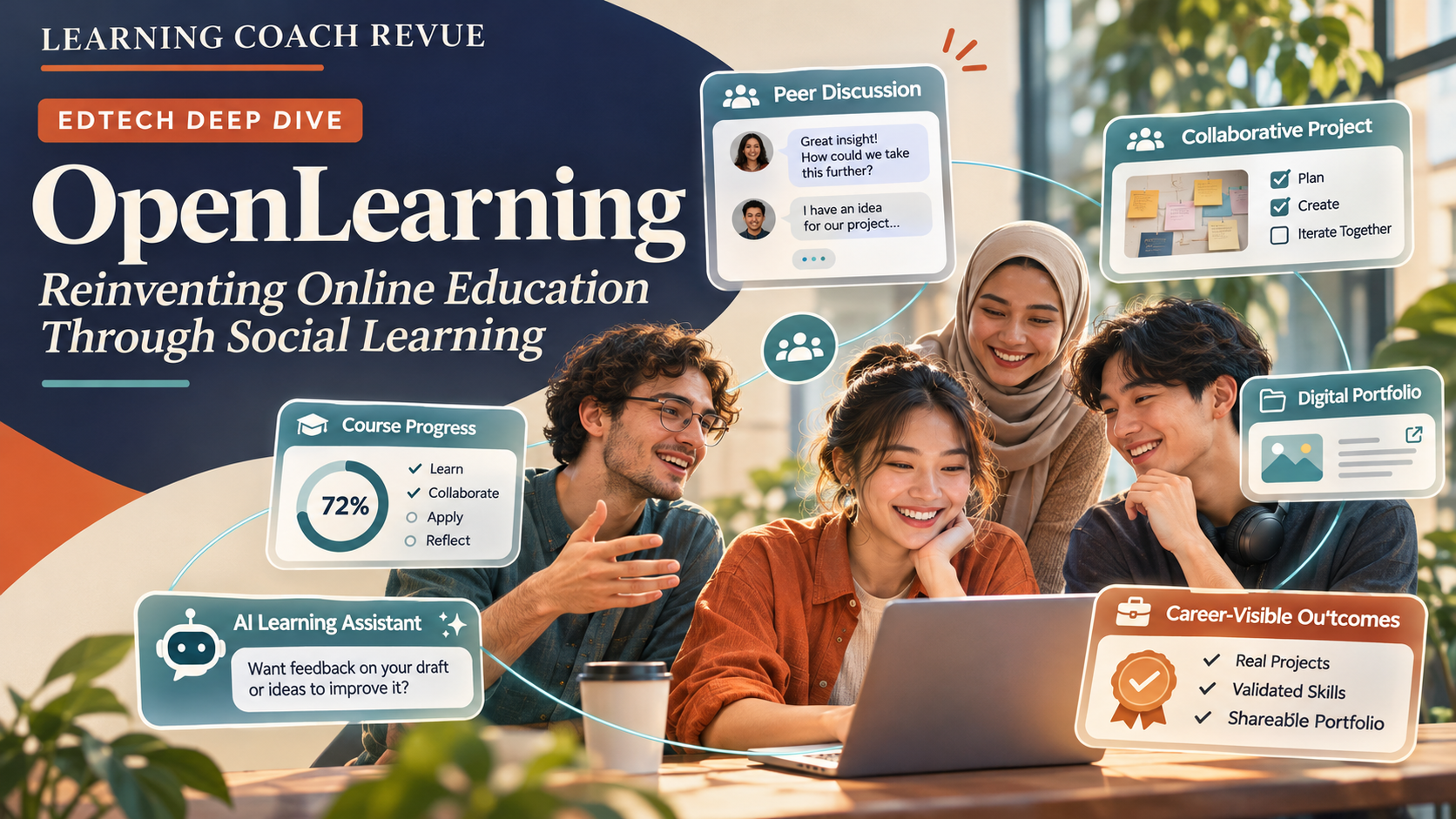
An online course can reach thousands of people without ever bringing them together. Students watch the same videos, answer the same questions and receive the same certificate, yet remain strangers to one another. Australia's OpenLearning challenges this paradox by treating the course itself as a social environment: a place where learners produce ideas, encounter different interpretations, and build visible evidence of their capabilities. As artificial intelligence makes educational content increasingly abundant, this approach raises a timely question: what happens when the principal value of an online course is no longer the information it contains, but the intellectual work people do together?
A company built around the learning experience
OpenLearning began in 2012, founded by Adam Brimo, Richard Buckland and David Collien. The venture emerged from an educational vision connected to the University of New South Wales, rather than from a desire simply to digitise classroom administration. Its starting point was that an online environment could be organised around the learner's contributions as much as around the educator's materials.
Based in Sydney, OpenLearning Limited (ASX: OLL) now operates a cloud-based learning management system, or LMS, and course marketplace serving universities, colleges and training providers. Its footprint extends into Southeast Asia, notably Malaysia and the Philippines. The company's investor website reports that more than 250 education providers have used the platform to deliver courses reaching over five million learners. These figures describe company-reported reach, not the number of active learners today or evidence of educational effectiveness.
The timing is particularly interesting. On 13 November 2026, OpenLearning announced a strategic A$500,000 commitment from the Philippines' World Citi Group, increasing commitments in its capital raising to approximately A$1.48 million. The ASX announcement reproduced here and independent financial coverage describe potential collaboration in digital education. An entitlement offer subsequently opened on 19 November. As of 27 November, the commitments should not be confused with final proceeds of the entire fundraising. Nor do commercial developments establish that a teaching approach is effective.
The pedagogical question is more enduring than the market news: can an online learning environment be designed to help people think together?
From a library of lessons to a workshop of ideas
Imagine two students taking an online course in environmental management. In a conventional sequence, they watch an explanation of water conservation, take a quiz and move to the next lesson. In a socially designed course, each investigates water use in a different setting, proposes an intervention, and explains the assumptions behind it. They examine each other's proposals and identify an overlooked constraint. Each returns to their original work and improves it.
This is an illustrative scenario, not an observed OpenLearning class. It reveals the difference between transmitting a concept and organising the activity through which a learner appropriates that concept.
OpenLearning's platform documentation describes tools for learner-generated submissions, shared galleries, discussion, smaller collaborative groups, activity streams, learning-outcome assessment and digital portfolios. In practical terms, a submitted diagram can become a resource for a classmate; a question can become the beginning of a discussion; an assignment can become evidence of progress rather than a document that disappears after marking.
The platform also supports private or open courses, different pacing arrangements, institutional branding and digital credentials. This makes its pedagogical proposition applicable to short professional courses as well as more extensive educational programmes.
The interesting design decision is the proximity of content and conversation. A learner does not necessarily have to leave the learning activity and enter a separate forum in order to encounter other people's work. When the activity is well designed, the exchange becomes part of the intellectual task itself.
The learning science: why interaction can matter
Social constructivism is not the same as social media
OpenLearning explicitly grounds its learning philosophy in social constructivism. The essential idea is that learning involves constructing understanding through activity and encounters with other perspectives. A classmate's unexpected explanation may expose a gap in our own mental model. Articulating why we disagree obliges us to make that model more explicit.
But the mere existence of a social feed does not produce this process. An enthusiastic reaction, a short compliment and a carefully reasoned objection are not cognitively equivalent. A digital course can be full of visible activity and still demand very little thinking.
The ICAP framework developed by Michelene Chi and Ruth Wylie (2014) provides a useful lens. It distinguishes four forms of engagement, from receiving information to manipulating it, generating new understanding and developing understanding through substantive interaction. The framework predicts stronger learning as engagement becomes more intellectually productive, under appropriate conditions. Read the original paper.
In a course gallery, uploading a screenshot may do little more than document participation. Explaining why an approach works requires construction. Comparing two competing explanations and revising both in response to evidence may create genuine interactive learning. The same technology accommodates all three; the difference lies in the task.
What peer assessment can contribute
A 2020 meta-analysis by Kit Double, Joshua McGrane and Therese Hopfenbeck combined 54 experimental and quasi-experimental studies involving students across primary, secondary and higher education. It found a positive overall effect of peer assessment on academic performance (Hedges' g = 0.31). Effects varied substantially across studies, and the authors could not isolate the contributions of giving and receiving feedback with confidence. Read the meta-analysis.
This matters because the reviewer is also a learner. To evaluate a peer's work, students need to retrieve relevant knowledge, interpret criteria and identify the distance between an actual solution and a stronger one. They may subsequently recognise weaknesses in their own approach.
Consider a professional-development course in which managers construct a plan for a difficult feedback conversation. Reviewing a colleague's plan might expose a distinction between describing an observable behaviour and attributing a motive. The learner benefits not only from the advice received but potentially from the intellectual act of examining another approach.
For this to be productive, learners need usable criteria, examples, time to revise and an educator capable of intervening when misconceptions circulate. High-stakes certification cannot simply delegate expert judgement to a popularity vote.
Belonging is valuable, but it is not mastery
The Community of Inquiry framework distinguishes the experience of being connected to others, the work of developing meaning, and the educator's role in designing and guiding inquiry.
Martin, Wu, Wan and Xie's 2022 meta-analysis of 19 empirical studies found that measured learning was more strongly associated with teaching presence (r = .353) than with social presence (r = .199). Cognitive presence had an intermediate correlation (r = .250). Social presence was more strongly related to perceived learning than to measured achievement. These are associations rather than causal estimates.
The lesson is not that social connections are unimportant. It is that an online community becomes educationally valuable when connection supports a specific intellectual purpose. The teacher's presence is not rendered obsolete by social technology; it becomes a condition that helps social interaction lead somewhere.
The ergonomics of participating
OpenLearning's course feeds and galleries make the work of other learners visible. This can reduce the psychological distance between an isolated student and a cohort. A person confronting a difficult assignment can see that others are trying different solutions, encountering uncertainty and refining their work.
Yet visibility has a cost. A crowded feed can fragment attention, and a public submission can feel intimidating to a novice. Students working in a second language may need time to compose a contribution. A learner who produces a thoughtful but late response may be less visible than someone who posts frequently.
Asynchronous interaction offers a useful counterweight: it can permit reflection before responding and reduce the need for everyone to be online at the same time. Small groups, clearly bounded tasks and an option for private reflection can further make participation meaningful for people who do not thrive in highly visible spaces.
OpenLearning publishes an accessibility statement and a status overview which distinguishes platform accessibility from the accessibility of course materials supplied by providers. Institutions still need to test their actual courses with assistive technology users and learners on limited connectivity. Captions, text alternatives, manageable file sizes, accessible assessments and moderation matter as much as the choice of platform.
There is a related question of privacy. Sharing work can support learning without making every draft public. Course designers need clarity about who can see submissions, which artefacts are retained, whether learners can control visibility, and how personal or sensitive information is protected. The company's privacy policy is a starting point for institutional review, not a substitute for evaluating a particular deployment.
AI in a social learning environment
OpenLearning now describes its product as an AI-powered LMS. Its pricing and product information advertises AI-assisted course and activity creation, as well as assistance with facilitation and feedback. The technology is attractive in part because high-quality interactive courses can be more demanding to design and manage than a sequence of prerecorded lessons.
An educator could use an AI-assisted authoring process to generate initial versions of discussion prompts or contrasting case studies, then evaluate and adapt them to the actual learners. This is an illustrative use, not evidence of the effectiveness of a particular AI feature.
The deeper challenge is to prevent automation from removing the intellectual activity that the social environment is meant to create. If AI writes the student's first response, critiques the peer's submission and supplies a polished revision, the resulting exchange may look excellent while the student performs very little of the reasoning.
An alternative model is to reserve AI for scaffolding: asking learners to justify a decision, revealing an overlooked assumption through a question, or helping them identify what to investigate next. Authentic assessment can then ask the learner to defend a choice, apply the concept to an unfamiliar problem or explain how their initial understanding changed. Teachers remain responsible for important judgements, accuracy, appropriateness and fairness.
The promise of AI here is not simply cheaper content. It is the possibility of giving educators more time to recognise the moments when human support is most valuable. Whether that promise is realised requires measurement of time saved, feedback quality and actual learning, not just the quantity of AI-generated materials.
Learning that leaves evidence behind
One particularly fertile aspect of the OpenLearning design is its portfolio capability. The company describes how shared artefacts can become entries in a learner portfolio, while its credential tools allow institutions to issue badges and certificates.
A portfolio can make the learning journey intelligible in a way that a completion certificate cannot. A student in a project-management course may be able to show a risk register, an explanation of decisions, a revised plan and a reflective account. The evidence tells a richer story about capability than a record of videos watched.
The distinction between completion and competence remains essential. A badge is only as meaningful as the quality of assessment that supports it. The portability, recognition and academic status of a microcredential depend on its issuer, evidence and relevant educational or professional standards.
A compelling possibility is a longitudinal portfolio in which a learner can compare versions of work and identify the strategies behind improvement. An educator could ask what changed between the first and final artefact and whether the learner can transfer that improvement to a new context. That would connect visible achievement with metacognition, turning the portfolio into a tool for learning rather than merely a record of learning. This is a prospective scenario, not a claim that the platform already provides every aspect of such a workflow.
The economics of learning together
OpenLearning combines institutional SaaS licensing with course delivery, marketplace and commerce infrastructure. This matters for universities, training organisations and independent providers that want to establish a branded learning environment without building every component themselves.
For learners, the course marketplace provides access to offerings from different organisations, with fees, prerequisites and credentials determined by the relevant course. For institutions, the official pricing page advertises organisational plans starting at $6,170 per year, excluding GST on annual organisational plans. The currency and precise inclusions should be confirmed with the provider before purchasing; enterprise arrangements may vary.
There is an economic tension at the centre of social learning. Recorded content scales readily; thoughtful facilitation consumes human time. A shared environment can distribute some formative feedback across the cohort, but facilitation, moderation and assessment still need resourcing. The fairest comparison is not simply the price per registered learner, but the cost per learner who reaches a well-defined level of competence.
The company's published case studies include the transition to online teaching at the University of Wollongong Malaysia KDU UC and examples of professional short courses. They illustrate institutional applications, while remaining vendor-selected accounts rather than independent comparative evaluations.
The Philippines investment highlights the potential for locally embedded relationships to support regional adoption. Long-term sustainability will depend on the ability to retain institutions, support educators and deliver value beyond initial implementation. No conclusion about profitability or financial security follows from a fundraising commitment or growing customer reach.
Beyond the Innovation: a course as a collective intelligence system
Consider a teacher-training course offered across several countries. Each participant documents a learning difficulty encountered in a classroom, describes the context and proposes a response. Rather than disappearing when an assignment is marked, these anonymised contributions could become a structured collection of practical cases that future cohorts can investigate, compare and challenge.
With educator review, appropriate permissions and explicit attention to differences in context, a new cohort could build on the work of earlier cohorts. AI might help retrieve relevant cases without replacing the reasoning needed to decide whether a case applies. The course would gradually become a living body of professional knowledge.
The idea is technically plausible but pedagogically and ethically demanding. Learner-generated material is not automatically accurate, reusable or safe to share. Moderation, attribution, consent, cultural context and periodic review would be fundamental. The point is not to maximise the amount of content produced; it is to make collective work useful for new acts of learning.
Such an environment might help universities connect formal learning to professional communities, enable smaller training providers to develop shared case libraries, and allow experienced practitioners to make their knowledge available without requiring everyone to study in the same place.
What would convincing evidence look like?
The studies reviewed here support several mechanisms relevant to OpenLearning, but they do not prove that using the platform causes better learning than an alternative LMS. This investigation did not identify a robust independent comparative evaluation establishing that claim.
A valuable study could compare two versions of the same course using equivalent content and teaching time: one with individual practice and another with structured peer explanation, feedback and revision. It could measure baseline knowledge, an immediate assessment, delayed retention, transfer to an unfamiliar task, participation equity and educator workload. Learner satisfaction and course completion would be useful secondary measures, rather than substitutes for demonstrated competence.
Analysis of the quality of revisions and the substance of peer exchanges could reveal why any difference occurs. Reporting outcomes for learners with different levels of prior knowledge, language fluency and access needs would also help institutions understand who benefits most.
This would be more informative than a dashboard showing that a cohort posted thousands of comments.
Discover OpenLearning
For learners curious about the experience, the OpenLearning marketplace is a place to explore available courses and their providers. For educators and institutions, the platform overview, feature documentation and demonstration options provide a starting point for evaluating a specific teaching scenario.
OpenLearning invites us to reconsider what an online course can be. The internet has already made information widely distributable. The next challenge is to make meaningful intellectual encounters equally accessible. The most valuable educational platforms may be those that help learners do more than receive what others know: they help them discover what they can understand, create and improve together.
Sources and further reading
OpenLearning. Company and investor profile; founding team; about.
OpenLearning. Learning philosophy; features; pricing; case studies.
OpenLearning. Accessibility status; privacy policy.
OpenLearning Limited (13 November 2026). World Citi Group strategic investment announcement; (19 November 2026). Entitlement offer opens.
ShareCafe (13 November 2026). OpenLearning strategic investment.
Chi, M. T. H., & Wylie, R. (2014). The ICAP framework. Educational Psychologist. DOI.
Double, K. S., McGrane, J. A., & Hopfenbeck, T. N. (2020). The impact of peer assessment on academic performance. Educational Psychology Review, 32, 481–509. DOI.
Martin, F., Wu, T., Wan, L., & Xie, K. (2022). A meta-analysis on the Community of Inquiry presences and learning outcomes. Online Learning, 26(1). DOI.

